

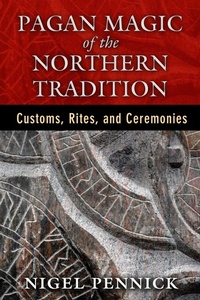
Pagan Magic of the Northern Tradition
Customs, Rites, and Ceremonies
Published on 21. May 2015
352 pages
978-1-62055-390-9 (ISBN)
Description

A practical guide to the magical history, customs, and practices of pre-Christian Northern Europe
• Details the everyday magic of the Northern Tradition, including household magic, protection spells, and the significance of the days of the week
• Explores direct natural magic, such as shapeshifting and soul travel, and talismanic or sigil magic, including runes and rituals to unlock the power of crafted objects
• Explains how many of these customs continue to the present day
In the pre-Christian societies of Northern Europe, magic was embedded in the practical skills of everyday life. Everything in Nature was ensouled with an inner spirit, as was anything made by hand. People believed in magic because it worked and because it was part of the functionality of their day-to-day lives. Many of these practical observances and customs continue to the present day as rural traditions, folk customs, household magic, and celebrations of the high and holy days of the calendar.
Exploring the magical pagan traditions of the people now called Celtic, Germanic, Scandinavian, Slavonic, and Baltic, Nigel Pennick examines the underlying principle of the Northern Tradition--the concept of Wyrd--and how it empowers the arts of operative magic, such as direct natural magic and talismanic or sigil magic. Through direct natural magic, individuals can shape shift, journey out of the body, or send one of their three souls (fylgia or ?fetch?) ahead of them. Sigil magic involves the powers contained in objects, which can be channeled after the appropriate ritual. Runes are the most powerful sigils in the Northern Tradition and were used to ward off illness, danger, hostile magic, and malevolent spirits. Emphasizing the importance of the cycles of Nature to the tradition, Pennick explores the eightfold sun dials and the four ways the solar year is defined. He looks at the days of the week and their symbolic association with different deities as well as why particular acts are performed on certain days and what the customary lucky and unlucky days are. He also examines sacred spaces, household magic, protection spells, and the role of music in the Northern Tradition.
Explaining all the traditional holidays and activities necessary to honor them, Pennick shows how anyone can participate authentically in the magic of the Northern Tradition if they take care to do things properly, with respect, and on the right day.
• Details the everyday magic of the Northern Tradition, including household magic, protection spells, and the significance of the days of the week
• Explores direct natural magic, such as shapeshifting and soul travel, and talismanic or sigil magic, including runes and rituals to unlock the power of crafted objects
• Explains how many of these customs continue to the present day
In the pre-Christian societies of Northern Europe, magic was embedded in the practical skills of everyday life. Everything in Nature was ensouled with an inner spirit, as was anything made by hand. People believed in magic because it worked and because it was part of the functionality of their day-to-day lives. Many of these practical observances and customs continue to the present day as rural traditions, folk customs, household magic, and celebrations of the high and holy days of the calendar.
Exploring the magical pagan traditions of the people now called Celtic, Germanic, Scandinavian, Slavonic, and Baltic, Nigel Pennick examines the underlying principle of the Northern Tradition--the concept of Wyrd--and how it empowers the arts of operative magic, such as direct natural magic and talismanic or sigil magic. Through direct natural magic, individuals can shape shift, journey out of the body, or send one of their three souls (fylgia or ?fetch?) ahead of them. Sigil magic involves the powers contained in objects, which can be channeled after the appropriate ritual. Runes are the most powerful sigils in the Northern Tradition and were used to ward off illness, danger, hostile magic, and malevolent spirits. Emphasizing the importance of the cycles of Nature to the tradition, Pennick explores the eightfold sun dials and the four ways the solar year is defined. He looks at the days of the week and their symbolic association with different deities as well as why particular acts are performed on certain days and what the customary lucky and unlucky days are. He also examines sacred spaces, household magic, protection spells, and the role of music in the Northern Tradition.
Explaining all the traditional holidays and activities necessary to honor them, Pennick shows how anyone can participate authentically in the magic of the Northern Tradition if they take care to do things properly, with respect, and on the right day.
More details
Other editions
Additional editions
Book
06/2015
Destiny Books,U.S.
€16.50
Article in reprint
Person
Nigel Pennick is an authority on ancient belief systems, traditions, runes, and geomancy and has traveled and lectured extensively in Europe and the United States. He is the author and illustrator of more than 50 books, including The Pagan Book of Days. The founder of the Institute of Geomantic Research and the Library of the European Tradition, he lives near Cambridge, England.
Content
Preamble
Introduction: Northern Magic
1 The Web of Wyrd and the Eldritch World
2 Traditional Operative Magic, Philosophy, and Theory
3 Place, Space, and Time
4 Astronomy and the Winds
5 Magical and Sacred Places in the Landscape
6 Boundaries and Liminal Spaces
7 Materials and Crafts
8 The Spirit of Craftsmanship
9 Natural Measure
10 Traditional Buildings and Practical Magic
11 The Craft and Magic of Buildings
12 Magical Protection against Supernatural and Physical Attack
13 Practical Magic: Patterns and Sigils
14 The Magic of Music
15 Northern Instruments
16 Keeping Up the Day
Postscript
Glossary
Bibliography
Index
Introduction: Northern Magic
1 The Web of Wyrd and the Eldritch World
2 Traditional Operative Magic, Philosophy, and Theory
3 Place, Space, and Time
4 Astronomy and the Winds
5 Magical and Sacred Places in the Landscape
6 Boundaries and Liminal Spaces
7 Materials and Crafts
8 The Spirit of Craftsmanship
9 Natural Measure
10 Traditional Buildings and Practical Magic
11 The Craft and Magic of Buildings
12 Magical Protection against Supernatural and Physical Attack
13 Practical Magic: Patterns and Sigils
14 The Magic of Music
15 Northern Instruments
16 Keeping Up the Day
Postscript
Glossary
Bibliography
Index
