

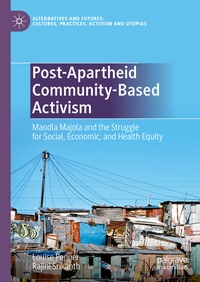
Post-Apartheid Community-Based Activism
Description

This book provides a timely study of community-based activism in contemporary South Africa. Grounded in oral history, the book examines the acquired expertise and life experiences of an impactful South African activist, Mandla Majola, within the context of the people, circumstances, and affiliations that have shaped his strategic thinking and practice. The authors situate Mandla Majola's activist and everyday experiences within histories of the complex connections between post-apartheid political and social movements and human rights discourse as they emerged after 1994. The book illuminates the relationship of state power to public health activism for HIV, tuberculosis and COVID-19 and for a life of basic human dignity, including access to sanitation and housing. Mandla Majola's life spotlights the inspiring, sometimes grueling, and tireless quotidian work of thousands of "invisible" community-based activists whose collective actions have impacted the entire spectrum of social and economic rights of untold numbers of people in South Africa and beyond.
More details
Other editions
Additional editions
Persons
Louise Penner is Associate Professor of English at UMass Boston specializing in Victorian Literature and Culture and Global Health Humanities. Her published work as author and editor includes Victorian Medicine and Social Reform: Florence Nightingale among the Novelists (Palgrave, 2010), and Victorian Medicine and Popular Culture (2015).
Rajini Srikanth is Dean of Faculty and Professor of English and Human Rights at the University of Massachusetts Boston. He is the author and co-editor of several books, including Interdisciplinary Approaches to Human Rights: History, Politics, Practice (2018) and Climate Justice and Public Health: Realities, Responses, and Reimaginings for a Better Future (2024).
Content
Chapter 1 Introduction.- Chapter 2 Formative Years.- Chapter3 Awakening to HIV/AIDS and the Right to Health.- Chapter 4 The Legacy of TAC in Activists' Lives.- Chapter 5 Xenophobia and The Moral Imperative Facing a Community Activist.- Chapter 6 The Birth of the Social Justice Coalition: From Anti-Xenophobia to Sanitation and Township Safet.- Chapter 7 "Embracing the Local: How the Movement for Change and Social Justice Came To Be".- Chapter 8 "Combatting Gender-Based Violence: A Persistent Effort Across Community Organizations".- Chapter 9 Coda.
