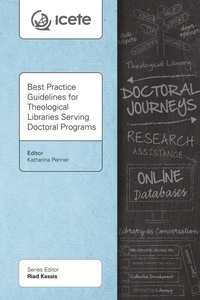
Best Practice Guidelines for Theological Libraries Serving Doctoral Programs
Katharina Penner(Editor)
Langham Publishing
Published on 25. November 2021
98 pages
978-1-83973-609-4 (ISBN)
System requirements
for ePUB without DRM
E-Book Single Licence
You are acquiring a single user licence for this eBook, which you might not transfer. [L]
Available for download
Description
Alles über E-Books | Antworten auf Fragen rund um E-Books, Kopierschutz und Dateiformate finden Sie in unserem Info- & Hilfebereich.
Libraries and librarians are indispensable to student learning and the formation of researchers at the doctoral level. This book identifies five areas and sixteen principles that need to be considered by theological schools when optimizing library operations to serve doctoral programs. As an illustration of these principles, the book provides narratives from four theological libraries - in Nairobi, Hong Kong, Bangalore, and Amsterdam - that have successfully transitioned to serve doctoral programs. The contributors present tested best practice alongside their successful experiences pioneering libraries that serve doctoral programs in challenging situations. An invaluable training resource for Majority World librarians, this book also offers insight into quality guidelines for accreditation agencies supporting theological institutions in developing robust and flourishing programs.
More details
Series
Language
English
File size
0,83 MB
ISBN-13
978-1-83973-609-4 (9781839736094)
Schweitzer Classification
Other editions
Additional editions

Book
11/2021
Langham Global Library
€15.40
Shipment within 3-4 weeks

System requirements
File format: ePUB
Copy protection: without DRM (Digital Rights Management)
System requirements:
- Computer (Windows; MacOS X; Linux): Use a reader that can handle the file format ePUB, such as Adobe Digital Editions or FBReader – both free (see eBook Help).
- Tablet/Smartphone (Android; iOS): Install the free app Adobe Digital Editions or the app PocketBook (see eBook Help).
- E-reader: Bookeen, Kobo, Pocketbook, Sony, Tolino and many more (not Kindle).
The file format ePUB works well for novels and non-fiction books – i.e., 'flowing' text without complex layout. On an e-reader or smartphone, line and page breaks automatically adjust to fit the small displays.
This eBook does not use copy protection or Digital Rights Management
For more information, see our eBook Help page.