

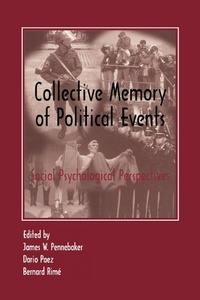
Collective Memory of Political Events
Social Psychological Perspectives
Published on 17. June 2013
320 pages
978-1-134-80045-2 (ISBN)
Description

Research in collective memory is a relatively new area capturing the interest of scholars in social psychology, memory, sociology, and anthropology. The core idea is that collective attitudes and behaviors are created and shared through common experiences and communication among a cohort of people. For example, people born between 1940 and 1960 are often defined via the JFK assassination and the Vietnam War. Their parents typically experienced lesser impact from these events.
Papers about collective memory have appeared in the literature under different guises for the last hundred years. Freud's Civilization and Its Discontents, Jung's ideas on the collective unconscious, and McDougall's speculation on the group mind posited that identity and action could be viewed as resulting from the shared development of a culture. Halbwachs, a French social psychologist (1877-1945) who was the first to write in detail about the nature of collective memory, argued that basic memory processes were all social. That is, people remember only those events that they have repeated and elaborated in their discussions with others.
In the last several years, there has been a resurgence of interest in this general topic because it addresses some fundamental questions about memory and social processes. Work closely related to these questions deals with the nature of autobiographical memory, traumatic experience and reconstructive memory, and social sharing of memories. This book brings together an international group of researchers who have been empirically studying some basic tenets of collective memory.
Papers about collective memory have appeared in the literature under different guises for the last hundred years. Freud's Civilization and Its Discontents, Jung's ideas on the collective unconscious, and McDougall's speculation on the group mind posited that identity and action could be viewed as resulting from the shared development of a culture. Halbwachs, a French social psychologist (1877-1945) who was the first to write in detail about the nature of collective memory, argued that basic memory processes were all social. That is, people remember only those events that they have repeated and elaborated in their discussions with others.
In the last several years, there has been a resurgence of interest in this general topic because it addresses some fundamental questions about memory and social processes. Work closely related to these questions deals with the nature of autobiographical memory, traumatic experience and reconstructive memory, and social sharing of memories. This book brings together an international group of researchers who have been empirically studying some basic tenets of collective memory.
Reviews / Votes
"This astonishingly international volume marks the coming-of-age of a new approach to the study of memory, in which the memories of entire nations and cultures are treated as social phenomena in their own right. Converging evidence for the value of this approach is provided by contributors from a remarkably wide range of countries -- Spain, Chile, Belgium, Portugal, Italy, the Netherlands, Great Britain, the US. There is a great deal here that most American memory researchers do not yet know, but they will have to learn it soon."-Ulric Neisser
Cornell University
More details
Language
English
Place of publication
London
United Kingdom
Publishing group
Taylor & Francis Ltd
Target group
Professional and scholarly
Product notice
Reflowable
File size
7,42 MB
ISBN-13
978-1-134-80045-2 (9781134800452)
Copyright in bibliographic data and cover images is held by Nielsen Book Services Limited or by the publishers or by their respective licensors: all rights reserved.
Schweitzer Classification
Other editions
Additional editions
James W. Pennebaker | Dar!o Paez | Bernard Rim'
Collective Memory of Political Events
Social Psychological Perspectives
Book
05/2015
1st Edition
Psychology Press Ltd
€77.50
Shipment within 10-20 days
James W. Pennebaker | Dar!o Paez | Bernard Rim'
Collective Memory of Political Events
Social Psychological Perspectives
Book
02/1997
Psychology Press
€206.90
Shipment within 10-20 days
Persons
Bernard Rim', James W. Pennebaker, Dar!o Paez, Dario Paez
Content
Contents: J.W. PennebakerIntroduction. Part I:The Life of Collective Memories.J.W. Pennebaker, B.L. Banasik, On the Creation and Maintenance of Collective Memories: History as Social Psychology. M.A. Conway, The Inventory of Experience: Memory and Identity. H. Schuman, R.F. Belli, K. Bischoping, The Generational Basis of Historical Knowledge. J. Igartua, D. Paez, Art and Remembering Traumatic Collective Events: The Case of the Spanish Civil War. N.H. Frijda, Commemorating. Part II:Social and Emotional Processes of Collective Memories.B. Rime, V. Christophe, How Individual Emotional Episodes Feed Collective Memory. D. Paez, N. Basabe, J.L. Gonzalez, Social Processes and Collective Memory: A Cross-Cultural Approach to Remembering Political Events. G.D. Gaskell, D.B. Wright, Group Differences in Memory for a Political Event. C. Finkenauer, L. Gisle, O. Luminet, When Individual Memories Are Socially Shaped: Flashbulb Memories of Sociopolitical Events. G. Bellelli, M.A.C. Amatulli, Nostalgia, Immigration, and Collective Memory. Part III:The Construction, Distortion, and Forgetting of Collective Experiences.E. Lira, Remembering: Passing Back Through the Heart. L. Iniguez, J. Valencia, F. Vazquez, The Construction of Remembering and Forgetfulness: Memories and Histories of the Spanish Civil War. J. Marques, D. Paez, A.F. Serra, Social Sharing, Emotional Climate, and the Transgenerational Transmission of Memories: The Portuguese Colonial War. R.F. Baumeister, S. Hastings, Distortions of Collective Memory: How Groups Flatter and Deceive Themselves.
