

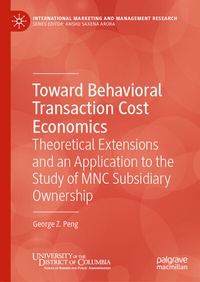
Toward Behavioral Transaction Cost Economics
Description

Adopting a critical realist position, this book renders transaction cost economics (TCE) into a behavioral theory of organizational decision-making by foregrounding psychological processes and introducing and integrating with effectuation theory. Consistent with its behavioral agenda, the book introduces the concept of uncertainty controllability and provides a clearer conceptualization and a novel modeling strategy of bounded rationality based on the conceptual separation of cognitive bounds from psychological 'rationalizing.' The book inspires new insights into the significance of cultural distance (CD). Based on the understanding that culture is socially-extended cognition, the author re-conceptualizes CD as reflecting cognitive bounds, and uses the biases arising from CD to contextualize effectuation and deepen the flat ontology of both TCE and effectuation theory.
The book presents a full two-sided behavioral framework of organizational decision-making, with behavioral TCEand behavioral real options theory complementing each other to complete the full behavioral picture. Both sides are further linked to organizational learning, which reduces biases over time and thus drives governance structures toward more rational directions. The full framework uses prospect theory as the overarching theory that determines which side of the behavioral framework is relevant for the uncertainty of concern based on the different problem frames resulting from different degrees of uncertainty controllability. Because effectuation can take place on both sides of the framework based on competing risk logics, prospect theory serves to harmonize inconsistencies in the effectuation literature as a side note. This book applies the behavioral TCE side of the framework to the study of MNC subsidiary ownership decision-making process using a dataset of over 10,000 Japanese subsidiaries founded in 43 host countries. It concludes with a discussion of implications and futuredirections for TCE in general and international business in particular.More details
Other editions
Additional editions
Person
Content
1. Is Transaction Cost Economics Behavioral?.- 2. Clarifying Key Terms and Philosophical Foundations of Transaction Cost Economics.- 3. Opportunism and Bounded Rationality in Transaction Cost Economics: Values, Attitudes, or Behaviors?.- 4. Modeling Bounded Rationality: Mediation or Moderation-or Bounded Rationalizing?.- 5. Toward Behavioral Transaction Cost Economics and Beyond.- 6. An Empirical Application to the Study of MNC Subsidiary Ownership.- 7. Implications, Future Directions, and Conclusion.
