

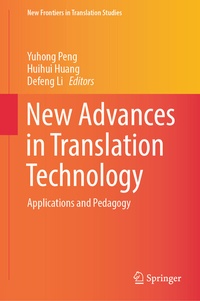
New Advances in Translation Technology
Description

From using machine learning to shave seconds off translations, to using natural language processing for accurate real-time translation services, this book covers all the aspects. The world of translation technology is ever-evolving, making the task of staying up to date with the most advanced methods a daunting yet rewarding undertaking. That is why we have edited this book-to provide readers with an up-to-date guide to the new advances in translation technology. In this book, readers can expect to find a comprehensive overview of all the latest developments in the field of translation technology. Not only that, the authors dive into the exciting possibilities of artificial intelligence in translation, exploring its potential to revolutionize the way languages are translated and understood.
The authors also explore aspects of the teaching of translation technology. Teaching translation technology to students is essential in ensuring the future of this field. With advances in technology such as machine learning, natural language processing, and artificial intelligence, it is important to equip students with the skills to keep up with the latest developments in the field.
This book is the definitive guide to translation technology and all of its associated potential. With chapters written by leading translation technology experts and thought leaders, this book is an essential point of reference for anyone looking to understand the breathtaking potential of translation technology.
More details
Other editions
Additional editions
Persons
Yuhong Peng is an Assistant Instructor at United International College, where she contributes to the teaching of language studies courses. Peng has a strong interest in translation and language studies, as well as translation technology and cognitive aspects of translation. She has authored multiple publications on the latest advancements in translation studies.
Huihui Huang, Ph.D. in Translation and Literary Studies, is currently the dean of the School of Foreign Languages at the Henan University of Technology. Her impressive credentials include a Ph.D. in Translation and Literary Studies, and she has published extensively in the fields of both translation and literature. Dr. Huang has an impressive research focus, and she is deeply committed to furthering scholarship in these areas and paving the way for the next generation of academics in translation and literary studies.
Defeng Li is Distinguished Professor of Translation Studies and Director of the Centre for Studies of Translation, Interpreting and Cognition (CSTIC) at the University of Macau. Prior to his current appointment, he served as Chair of the Centre for Translation Studies and reader in Translation Studies at SOAS, University of London; Director of the MA in Translation and Associate Professor at the Chinese University of Hong Kong; Dean and Chair Professor at Shandong University; and (visiting) Chair Professor at Shanghai Jiaotong University. He is currently President of World Interpreter and Translator Training Association (WITTA). He has researched and published extensively in the field of cognitive translation studies, corpus-assisted translation studies, curriculum development in translator training, research methods in translation studies, professional translation (e.g., business, journalistic, and legal translation), as well as second language education.
Content
The rise of translation technology and its historical and continued symbiotic relationship to the pursuit of ideological power.- Revolutionising Translation with AI: Unravelling Neural Machine Translation and Generative Pre-trained Large Language Models.- Cloud Technologies in Media Localisation (Subtitling and Revoicing).-Integrating ASR and MT tools into cloud subtitling workflows: the ¡Sub! and ¡Sub!2 projects.- Industry insights about translation technologies: current needs and future trends.
