

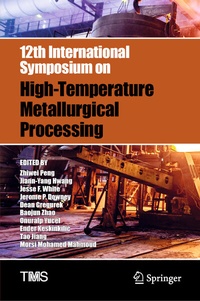
12th International Symposium on High-Temperature Metallurgical Processing
Description

This collection includes the analysis, development, and operation of high-temperature processes that involve the extraction and processing of material resources, production, and treatment of metals, alloys, and ceramic materials. Contributions describe innovative methods for achieving property enhancement, impurity segregation and removal, byproduct recovery, waste minimization, energy efficiency, and utilization of complex ores. Also included are various technical, economic, and environmental issues associated with commercial-scale high-temperature processing methods.
More details
Other editions
Additional editions
Persons
Zhiwei Peng, Central South University; Jiann-Yang Hwang, Michigan Technological University; Jesse F. White, Elkem Carbon Solutions; Jerome P. Downey, Montana Technological University; Dean Gregurek, RHI Magnesita; Baojun Zhao, Jiangxi University of Science and Technology; Onuralp Yücel Istanbul Technical University; Ender Keskinkilic, Atilim University; Tao Jiang, Central South University; and Morsi Mohamed Mahmoud, King Fahd University of Petroleum & Minerals.
Content
- Intro
- Preface
- Contents
- About the Editors
- Part I Simulation of High-Temperature Processes
- 1 3D Experimental Model Study on Gas-Solid Flow of Raceway in BF
- 2 Modelling of Permanent Magnetic Field for Its Application in Electroslag Remelting
- 3 Numerical Simulation of the Effect of Bed Height Diameter Ratio on Gas-Solid Flow Characteristics in a Side Stirred Fluidized Bed
- 4 First-Principles Calculations of Adsorption Reactions of C and Cl² on TiO² (001) Surface with Bridge-Oxygen Defect in Fluidized Chlorination
- 5 Research on Cost System of Total Scrap EAF Steel-Making Process
- 6 Study on Stress-Strain and Deformation Behavior of Bloom in the Heavy Reduction Process Under Single Roll
- 7 Decarburization and Chromium Conservation Model in AOD Refining Process of 304 Stainless Steel
- Part II Energy Efficient Clean Metallurgical Technologies
- 8 Removal of Arsenic from Leaching Residue of Tungsten
- 9 Experimental Studies on Reduction Mechanisms of Lead-Rich Slag with Different PbO Concentrations
- 10 Experimental Study on Dephosphorization of High-Phosphorus Mn-Si Alloys
- 11 Recent Studies on Hot Metal Desulfurization
- 12 Modification of Basic Oxygen Furnace Slag Using Iron Ore Tailing and Blast Furnace Dust
- 13 Evaporation of Antimony Trioxide from Antimony Slag by Nitrogen Injection in a Top-Submerged Lance Smelting Set-Up
- 14 Microstructural Evolution of Thermal Insulation Materials Prepared by Sintering of Ferronickel Slag and Fly Ash Cenosphere
- 15 Comparative Study on the Cleanliness of Ultra-Low Carbon Al-Killed Steel by Different Heating Processes
- Part III Fundamentals of Metallurgical Processes
- 16 Thermal Analysis of Potential High Entropy Alloy Binder Alternatives for Tungsten Carbide
- 17 Dynamics Behaviors of Droplets Impacting on a Heated Tailings Surface
- 18 Contact Line Undulation Induced Capillary Interaction Between Micron-Sized Ce²O³ Inclusions at the Ar Gas/Liquid Steel Interface
- 19 Experimental Study on Thermodynamics of CaO-SiO²-Ce²O³-5wt.% Al²O³ System at 1773 K
- 20 Investigation of Bubble Penetration Through Interface Between Immiscible Liquids
- 21 Calculation of Heat Loss of Furnace Body in Electric Arc Furnace Steelmaking
- 22 Comparison of Copper Smelting Slags Between Flash Smelting Furnace and Bottom-Blowing Furnace
- Part IV High-Temperature Processing
- 23 Effect of Ce Content on Non-metallic Inclusions in Si-Mn-Killed Stainless Steels
- 24 Effect of Ti and Ca Content on the Characteristics of Inclusions in Si-Mn-Al Deoxidized Spring Steel
- 25 Effect of Coarse Coke Breeze Addition on Magnetite Concentrate Sintering
- 26 Effect of the Injection Angle of Reducing Gas on Coal Flow and Combustion in a 50% Oxygen Blast Furnace
- 27 Removal of Arsenic from Molten Bearing Steel by Adding Rare Earth Lanthanum
- 28 Observation on Clogging Behavior of Submerged Entry Nozzle of Al-Killed Steels
- 29 Effect of Lanthanum on Inclusions in a High Sulfur Steel
- Part V Process Optimization
- 30 Effect of Calcium Treatment on Non-metallic Inclusions in Steel During Refining Process
- 31 Improvement of Iron Coke Strength by Adding Coal Tar During Coking
- 32 Pelletizing of Iron Ore with High Iron Grade and Low Silicon Content
- 33 Influence of Aluminum on the Hot Ductility of a High-Strength Steel
- 34 Separation and Recovery of Iron from Low-Grade Refractory Iron Ore by Magnetizing Roasting
- Part VI Preparation of Alloys and Materials
- 35 Evaluation of Processing Parameters for the Production of Tungsten Carbide in a Fluidized Bed Reactor
- 36 Effect of Austenitizing and Cooling Process on Microstructure Transformation of Low-Carbon Bainite Steel
- 37 Evaluation of Aluminum White Dross
- 38 Investigation of Microstructure and Mechanical Properties of Ferritic Stainless Steels Joined by Laser Welding
- 39 Structural and Magnetic Properties of Rare Earth Lanthanum-Doped Cobalt Ferrites
- 40 Optimization of VD Refining Slag and Control of Non-metallic Inclusions for 55SiCrA Spring Steel
- Part VII Poster Session
- 41 Changes of SO², NO? Emission, and Production of Iron Ore Sintering with Steam Injection at the Surface of Sintering Bed
- 42 Comprehensive Recovery of Multisource Metallurgical Solid Wastes: Coupling Modification and Carbothermal Reduction of Converter Slag and Copper Slag
- 43 Disintegration Behavior of Vanadium-Titanium Magnetite Pellets in CO-H²-CO²-N² Gas Mixtures
- 44 Distribution of Inclusions in a IF Steel Continuous Casting Slab Casted During SEN-Clogged State
- 45 Effect of Channel Heights on the Flow Field, Temperature Field, and Inclusion Removal in a Channel-type Induction Heating Tundish
- 46 Effect of Slag Basicity on Non-metallic Inclusions in a Heavy Rail Steel
- 47 Enrichment of Amorphous B into Mg²B²O5 Crystals Through Phase Transformation of B-bearing Blast Furnace Slag
- 48 Experimental Study on Thermal Shock Resistance of Magnesia Carbon Brick
- 49 Highly Efficient Iron Recovery from Low-Grade Refractory Iron Ores by Coal-Based Direct Reduction
- 50 Numerical Simulation of Dispersion Behavior of Modifier Particle in Hot Slag with Mechanical Stirring
- 51 Numerical Simulation of Inclusion Coagulation During Soft Blowing Process of Ladle Furnace
- 52 Prediction Model of Calcium Addition in SPHC Steel Refining Process
- 53 Preparation of Spherical Iron Powder by High-Temperature Re-melting and Spheroidizing
- 54 Phosphorus Migration Behavior in the Process of Converter Slag Gasification Dephosphorization
- 55 Removal of Heavy Metals from Sn-bearing Lead Slag: Effect of Reductant Dosage
- 56 Simulation Study on Top Blowing Combustion in Iron Bath Smelting Reduction
- 57 Study on Burden Mineral Phase Identification System and Prediction Model of Metallurgical Properties Based on BP Neural Network
- 58 Thermodynamic Study on Modification of Converter Slag by Using Hot Blast Furnace Slag
- Author Index
- Subject Index
