

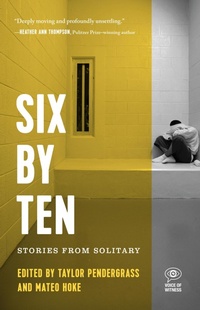
Six by Ten
Description

Six by ten feet. That's the average size of the cells in which tens of thousands of people incarcerated in the United States linger for weeks, months, and even decades in solitary confinement. With little stimulation and no meaningful human contact, these individuals struggle to preserve their identity, sanity, and even their lives. In thirteen intimate narratives, Six by Ten explores the mental, physical, and spiritual impacts of America's widespread embrace of solitary confinement. Through stories from those subjected to solitary confinement, family members on the outside, and corrections officers, Six by Ten examines the darkest hidden corners of America's mass incarceration culture and illustrates how solitary confinement inflicts lasting consequences on families and communities far beyond prison walls. Stories include those of Brian, who was shuttled from prison to prison across Illinois as part of an unofficial program that came to be known as "the circuit"; Heather, a mother fighting for the life of her son, Nikko, who was diagnosed as bipolar at a young age and sent to solitary as a teenager; and Sonya, a trans woman sent to solitary in a men's jail in Texas, supposedly for her own protection.
Praise for Six by Ten
"A consistently eye-opening, urgent report on the use and misuse of prisoner isolation." - Kirkus Reviews
"Compels change by giving a voice to the voiceless.... The stories stop you in your tracks, but the appendices help move progress forward with simplicity, depth, and hope, beginning with ten things anyone can do that are impactful and accessible. The educational pieces of the book give apt background on the history and usage of solitary confinement, allowing even those examining the practice for the first time to have a firm grasp of the situation." -Foreword Reviews
"A deeply moving and profoundly unsettling wake up call for all citizens. The use of solitary confinement is deeply immoral and we must insist that it be banned in all of our nation's prisons. Immediately." -Heather Ann Thompson, Pulitzer Prize-winning author, Blood in the Water: The Attica Prison Uprising of 1971 and Its Legacy
More details
Other editions
Additional editions
Persons
Mateo Hoke is writer, journalist, and coeditor of Palestine Speaks: Narratives of Life under Occupation. He studied journalism at the University of Colorado and the University of California-Berkeley Graduate School of Journalism.
Taylor Pendergrass is an advocate and activist around ending mass incarceration and racial injustice in the criminal legal system. He currently works for the ACLU and lives in Denver, Colorado. He graduated from Duke University and the University of Colorado School of Law.
Content
INTRODUCTION by Taylor Pendergrass and Mateo Hoke
EDITORS' NOTE: Ten Things to Know as You Read This Book
COFOUNDER AND EXECUTIVE EDITOR'S NOTE by Mimi Lok
NARRATORS:
Maryam Henderson-Ulohu (Louisiana)
"I was the only woman in the prison who was Muslim, the only one who wore a headscarf."
Brian Nelson (Illinois)
"There were times where I lost track of time. And I'm afraid of that happening again."
Aaron Lewis (Connecticut)
"They create this hardened person and then they release them to the community, which is doomed for destruction."
Vernesia Gordon (Alaska)
"They pepper-sprayed him through that slot in the door. You see these long shots of pepper-spray going in."
Mohammed "Mike" Iftiker Ali (California)
"In immigration detention, everybody was fighting for their lives but in different ways. You knew you might not ever see your family again."
Steve Blakeman (Washington)
"I think that mercy and justice in proper balance is the key."
Candie Hailey (New York)
"If anybody wants to know what hell is, that's what hell is."
Shearod McFarland (Michigan)
"I had started to envision myself hanging from beams and having other suicidal visions."
Sonya Calico (Texas)
"It seemed like they had a rule that every time someone who's transgender goes in . . . they automatically go straight to solitary."
Travis Trani (Colorado)
"How safe is that, really, to take somebody from twenty-three-hour-a-day lockdown, and now he's on the street corner in Denver, catching a bus with civilians?"
Tonja Fenton (New York)
"I have developed zero tolerance for anything. I wasn't like this before."
Jason Mollino (California)
"Is it torture? I'd say yes because we crave human contact."
Heather Chapman (Florida)
"They're torturing my husband. They're torturing me. They're torturing my daughters. They're destroying our family."
Michael "Zaharibu" Dorrough (California)
"I think that many of us reclaimed our humanity. Fighting back will do that."
APPENDIXES:
- Timeline of Solitary Confinement in the United States
- Glossary TK
III. Solitary as Violence (Title TK): essay by law professor Hope Metcalf
- ACLU piece on current state of solitary policy and reform TK by Amy Fettig
- Five Demands of 2011 California Prisoner Hunger Strike
- Ten Things You Can Do
VII. Q&A with mental health expert TK
ACKNOWLEDGMENTS
