

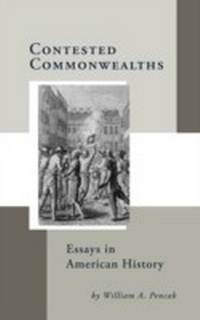
Contested Commonwealths
Essays in American History
1st Edition
Published on 16. September 2011
390 pages
978-1-61146-084-1 (ISBN)
Description

United States historian William Pencak here collects thirteen of his essays, written beginning in 1976. Some deal with colonial and revolutionary crowds and communities in Massachusetts-the impressment riot of 1747, the popular uprisings of the 1760s and 1770s, and Shays' Rebellion. Others discuss the popular ideology of the American Revolution as expressed in songs and almanacs, while several revisit revolutionary era statesmen George Washington, John Adams, Benjamin Franklin, and loyalist Peter Oliver. Interpretive essays argue that revolutionary economic thought turned smuggling from a vice into the "natural law" of free trade; and that focusing on the Civil War and the years 1861 to 1865, leads to a glorified conception of the national past that is better understood as shaped by "An Era of Racial Violence" that extended from 1854 to at least 1877.
Pencak's essays do not conform to standard interpretations of the revolutionary era that stress the importance of republican ideology or socio-economic conflict. Rather, he looks at colonial experiences of the French and Indian War as definitive in shaping dislike of Britain. He stresses that the popular thought expressed in songs and almanacs portray America as an open society, a land of plenty, threatened by British restrictions rather than a land where ancient Roman virtue or traditional British liberties flourished.
Moving to the early republic, Pencak looks at Shays's Rebellion from the point of view of those who suppressed it, and finds that they were genuinely concerned that Massachusetts's newly-formed republic was threatened by westerners. Westerners who presented themselves as an army and sought to restructure a constitution formed only six years before. George Washington was, in effect, the chief executive of the new nation from 1775 to 1797 and borrowed heavily from his wartime experiences to shape his presidency.
Pencak's essays do not conform to standard interpretations of the revolutionary era that stress the importance of republican ideology or socio-economic conflict. Rather, he looks at colonial experiences of the French and Indian War as definitive in shaping dislike of Britain. He stresses that the popular thought expressed in songs and almanacs portray America as an open society, a land of plenty, threatened by British restrictions rather than a land where ancient Roman virtue or traditional British liberties flourished.
Moving to the early republic, Pencak looks at Shays's Rebellion from the point of view of those who suppressed it, and finds that they were genuinely concerned that Massachusetts's newly-formed republic was threatened by westerners. Westerners who presented themselves as an army and sought to restructure a constitution formed only six years before. George Washington was, in effect, the chief executive of the new nation from 1775 to 1797 and borrowed heavily from his wartime experiences to shape his presidency.
More details
Series
Edition
1. Auflage
Language
English
Place of publication
NJ
United States
Publishing group
Associated University Presses
Target group
Professional and scholarly
ISBN-13
978-1-61146-084-1 (9781611460841)
Copyright in bibliographic data and cover images is held by Nielsen Book Services Limited or by the publishers or by their respective licensors: all rights reserved.
Schweitzer Classification
Other editions
Additional editions
Book
09/2011
Lehigh University Press
€120.50
Shipment within 3-4 weeks
Persons
William Pencak is professor of history and Jewish studies at Penn State University.
Content
Part 1 Acknowledgements
Part 2 Introduction
Part 3 Part One: Communities
Chapter 4 Chapter 1: 1.The Knowles Riot and the Crisis of the 1740s in Massachusetts
Chapter 5 Chapter 2: Metropolitan Boston Before the American Revolution: An Urban Interpretation of the Imperial Crisis
Chapter 6 Chapter 3:The Social Structure of Revolutionary Boston: Evidence from the Great Fire of 1760
Chapter 7 Chapter 4: Play as Prelude to Revolution: Boston, 1765-1776
Chapter 8 Chapter 5:"The Fine Theoretic Government of Massachusetts is Prostrated to the Earth": The Response to Shays's Rebellion Reconsidered
Part 9 Part Two: People
Chapter 10 Chapter 6:Politics and Ideology in Eighteenth-Century Almanacs: Benjamin Franklin's Poor Richard and Nathanael Ames, Sr.'s An Astronomical Diary
Chapter 11 Chapter 7: The Beginning of a Beautiful Friendship: Benjamin Franklin, George Whitefield, the Dancing School, and a Defense of the "Meaner Sort"
Chapter 12 Chapter 8: John Adams and His Contemporaries
Chapter 13 Chapter 9:The Extended Presidency of George Washington (1775-1797)
Chapter 14 Chapter 10: Peter Oliver (1713-1791), Chief Justice of the Massachusetts Superior Court
Part 15 Part Three: Ideas
Chapter 16 Chapter 11: From Racket to Natural Law: The Permutation of Smuggling Into Free Trade
Chapter 17 Chapter 12: "The Great War for the Empire" Reconsidered as a Cause of the American Revolution
Chapter 18 Chapter 13: The Civil War Did Not Take Place
Part 19 Index
Part 2 Introduction
Part 3 Part One: Communities
Chapter 4 Chapter 1: 1.The Knowles Riot and the Crisis of the 1740s in Massachusetts
Chapter 5 Chapter 2: Metropolitan Boston Before the American Revolution: An Urban Interpretation of the Imperial Crisis
Chapter 6 Chapter 3:The Social Structure of Revolutionary Boston: Evidence from the Great Fire of 1760
Chapter 7 Chapter 4: Play as Prelude to Revolution: Boston, 1765-1776
Chapter 8 Chapter 5:"The Fine Theoretic Government of Massachusetts is Prostrated to the Earth": The Response to Shays's Rebellion Reconsidered
Part 9 Part Two: People
Chapter 10 Chapter 6:Politics and Ideology in Eighteenth-Century Almanacs: Benjamin Franklin's Poor Richard and Nathanael Ames, Sr.'s An Astronomical Diary
Chapter 11 Chapter 7: The Beginning of a Beautiful Friendship: Benjamin Franklin, George Whitefield, the Dancing School, and a Defense of the "Meaner Sort"
Chapter 12 Chapter 8: John Adams and His Contemporaries
Chapter 13 Chapter 9:The Extended Presidency of George Washington (1775-1797)
Chapter 14 Chapter 10: Peter Oliver (1713-1791), Chief Justice of the Massachusetts Superior Court
Part 15 Part Three: Ideas
Chapter 16 Chapter 11: From Racket to Natural Law: The Permutation of Smuggling Into Free Trade
Chapter 17 Chapter 12: "The Great War for the Empire" Reconsidered as a Cause of the American Revolution
Chapter 18 Chapter 13: The Civil War Did Not Take Place
Part 19 Index
