

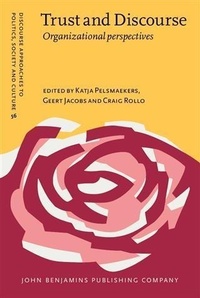
Trust and Discourse
Organizational perspectives
1st Edition
Published on 24. July 2014
VII, 224 pages
978-90-272-7002-3 (ISBN)
Description

Trust and Discourse: Organizational perspectives offers a timely collection of new articles on the relationship between discursive practices in organizational or institutional contexts and the psychological/moral category of trust. As globalization, the drive for efficiency and accountability, and increased time pressure lead groups and individuals to rethink the way they communicate, it is becoming more and more important to investigate how these streamlined and impersonal forms of communication affect issues of responsibility, authenticity and - ultimately - trust. The book deals with a variety of organizational settings ranging from in-hospital bedside teaching encounters and government communication following a nuclear accident to job interviews and foreign news reporting. This comprehensive study of an emerging new field will provide essential reading for linguists, discourse analysts, communication scholars, and other social scientists interested in a range of perspectives on oral, written and digital language use in society, including interactional sociolinguistics, Critical Discourse Analysis, ethnography, multimodality and organizational studies.
More details
Other editions
Additional editions
Book
07/2014
John Benjamins Publishing Co
€100.70
Shipment within 10-15 days
Persons
Content
- Trust and Discourse
- Editorial page
- Title page
- LCC data
- Table of contents
- Acknowledgements
- Chapter 1. Trust and discursive interaction in organizational settings
- 1. Trust breakdown as a contemporary concern
- 2. Conceptions of trust
- 3. Trust, language and discourse
- 4. Trust in organizations
- 5. The chapters in this volume
- References
- Chapter 2. Trust in action
- 1. Introduction
- 2. The job interview - a gatekeeping game
- 3. Winning the interviewer's trust
- 4. Multimodality in interview interaction
- 5. Multimodal Interaction Analysis
- 6. Trust as an emic category
- 7. The salient 'silent' gesture
- 8. Incremental understanding
- 9. Dealing with misunderstanding
- 10. Trust and distrust in intercultural interview settings
- 11. Trust and interactional dynamics
- 12. Conclusion: Accumulating trust
- References
- Transcription conventions
- Chapter 3. The reciprocal nature of trust in bedside teaching encounters
- 1. Introduction
- 2. Conception of trust
- 3. The concept of trust in practice
- 4. Methodology and background to the data
- 5. The opening exchanges in BTEs
- 5.1 The doctor's summary
- 5.2 The patient's own words
- 5.3 Doctor-patient co-construction
- 6. History-taking in BTEs
- 6.1 Geriatric outpatient medicine - new and persistent problems
- 7. The closing exchanges in BTEs
- 8. Conclusion
- 8.1 General features of trust
- 8.2 Setting-specific lessons about trust in BTEs
- References
- Chapter 4. "They just want to confuse you"
- 1. Background
- 1.1 Trust as a mutual commitment to shared practices and endeavours
- 1.2 Discourses of 'trust' in adult numeracy and literacy education
- 2. Trust and distrust in classroom discourse: A framework for analysis
- 3. Methodology
- 3.1 The teacher, the students and their classroom
- 3.2 Data collection, coding and approaches to analysis
- 4. Findings from analysis of student discussion
- 4.1 Trust within classroom relations
- 4.2 Distrust of pedagogic texts
- 4.3 The mediating role of the teacher
- 4.4 Hegemony disrupted: Questioning 'their' identity
- 5. Discussion
- 6. Transcription conventions
- References
- Chapter 5. In foreign news we trust
- 1. Introduction: Trust in news media
- 2. Data collection and selection: The fall of Leterme II
- 3. Engaging the reader with foreign news
- 3.1 Challenges and obstacles
- 3.2 Making or breaking trust: The ideal versus the real
- 3.3 Journalists' assumptions of readers' interest
- 4. Concluding remarks
- References
- Chapter 6. Trust work
- 1. Introduction
- 2. The two-dimensional view of trust
- 3. Study approach and participants
- 4. Shaping Gunz' culture
- 5. Influence of Gunz' internal culture on the trust strategy.
- 6. External influences on the Trust Strategy
- 7. Framing the trust strategy: A case of competing discourses
- 8. Operationalising the TS
- 9. General findings from participant interviews
- 10. Participants' views of Gunz's culture
- 11. Focus on the language of the TS
- 12. Managers' perceptions of TS language
- 13. Employees Perceptions of TS Language: Espousing trust.
- 14. Enacted trust
- 15. Concluding Comments
- Appendix 1. Transcription symbols
- References
- Chapter 7. Putting yourself down to build trust
- 1. Introduction
- 2. The concept of trust in public speaking: Speaker ethos
- 2.1 The dimensions of ethos: Competence, character and goodwill
- 2.2 Three stages: Initial, derived and terminal ethos
- 3. The case of self-disparaging humor: A technique to build up or break down speaker ethos
- 3.1 Humor theories
- 3.2 Advice on humor and ethos in public speaking textbooks
- 3.3 Self-disparaging humor in public speaking textbooks
- 3.4 Observed effects of self-disparaging humor
- 4. Research design: Self-disparaging humor as a presentation style and as a tool to repair awkward situations
- 4.1 Hypotheses of both experiments on self-disparaging humor
- 4.1.1 Hypotheses experiment 1: Self-disparaging humor as a presentation style
- 4.1.2 Hypotheses experiment 2: Self-disparaging humor as a tool to repair awkward situations
- 4.2 The presentation and the presenter
- 4.3 Self-disparaging humor moments and mistakes used
- 4.4 Dependent variables: Questionnaire used to measure attitudes
- 4.5 Audience
- 5. Results of the experiments on self-disparaging humor
- 5.1 Results experiment 1: Self-disparaging humor as a presentation style
- 5.2 Results experiment 2: Self-disparaging humor as a repair tool
- 6. Conclusion and discussion
- 6.1 Conclusions on the self-disparaging humor experiments
- 6.2 Discussion: Factors and methodological issues influencing the effect of self-disparaging humor
- 6.2.1 Unsuccessful humor
- 6.2.2 Important factors influencing ethos
- 6.3 Self-disparaging humor and trustworthiness: A winning combination?
- References
- Chapter 8. "Trust us: Bootcamp Pilates does not sound half as hard as it is, but it works"
- 1. Introduction: Trust and women's magazines
- 2. Description and characterization of the corpus
- 3. Communicating trustworthiness - linguistic characteristics
- 4. The discourse of women's magazines
- 5. Instructive tone and pseudo-dialogue
- 6. Findings
- 6.1 Imperatives
- 6.2 Pseudo-dialogue
- 6.3 Exclusive/inclusive we
- 7. Summary and conclusions
- References
- Chapter 9. "There is reason to believe however."
- 1. Introduction
- 2. Methodological issues
- 3. The linguistic construction of trust and trustworthiness in nineteenth-century documents
- 3.1 Self-(re)presentation
- 3.2 Doubts and challenges
- 3.3 Authorities
- 4. The expression of trust andtrustworthiness: Lexical and syntactic choices
- 4.1 Open-class lexical items
- 4.2 Modality
- 5. Concluding remarks
- References
- Primary sources
- Secondary sources
- Chapter 10. Discursive construction and deconstruction of trust
- 1. Public trust in government regarding nuclear power plant construction
- 2. Modernity
- 3. Methodology
- 4. Analysis
- 4.1 Public trust in the government
- 4.1.1 A priori trust under the fixed order
- 4.1.2 Emotional construction of trust: A techno-utopian vision
- 4.2 Transformation of trust
- 4.2.1 Erosion of trust
- 4.2.2 Residual modernity
- 5. Conclusion
- References
- Research data
- List of contributors
- Index
