

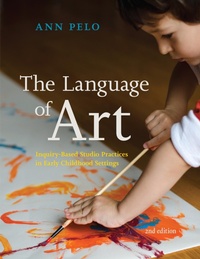
The Language of Art
Description

Typical art resources for teachers offer discrete art activities, but these don't carry children or teachers into the practice of using the languages of art. This resource offers guidance for teachers to create space, time, and intentional processes for children's exploration and learning to use art for asking questions, offering insights, exploring hypotheses, and examining experiences from unfamiliar perspectives.
Inspired by an approach to teaching and learning born in Reggio Emilia, Italy, The Language of Art, Second Edition, includes:
- A new art exploration for teachers to gain experience before implementing the practice with children
- Advice on setting up a studio space for art and inquiry
- Suggestions on documenting children's developing fluency with art media and its use in inquiry
- Inspiring photographs and ideas to show you how inquiry-based practices can work in any early childhood setting
Ann Pelo is a teacher educator, program consultant, and author whose primary work focuses on reflective pedagogical practice, social justice and ecological teaching and learning and the art of mentoring. Currently, Pelo consults early childhood educators and administrators in North America, Australia, and New Zealand on inquiry-based teaching and learning, pedagogical leadership, and the necessary place of ecological identity in children's-and adults'-lives. She is the author of several books including the first edition of The Language of Art and co-author of Rethinking Early Childhood Education.
More details
Other editions
Additional editions
Content
- Front Cover
- Copyright
- Contents
- Acknowledgments
- Introduction
- Part One: Studio Explorations
- Chapter 1: General Guidelines for Studio Explorations
- Chapter 2: Exploring Textures and Movement
- Fingerpaint
- Easel Paint
- Chapter 3: Exploring Color
- Black and White Paints
- Tempera Paints
- Watercolor Paints
- Oil Pastels and Chalk Pastels
- Chapter 4: Three-Dimensional Media
- Clay
- First Steps into Clay: Stage One
- First Steps into Clay: Stage Two
- Further Steps into Clay
- Found Materials and Loose Parts
- Wire
- Chapter 5: Representational Drawing and Painting
- Still-Life Portraits
- Self-Portraits
- Murals
- Part Two: Moving Art from the Studio to the Classroom
- Chapter 6: Growing a Culture of Inquiry through Art
- Chapter 7: Using Art Media to Grow Long-Term Investigations
- Chapter 8: To See Takes Time: A Long-Term Investigation into Leaves
- Glossary
- References
- Index
