

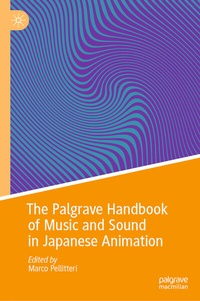
The Palgrave Handbook of Music and Sound in Japanese Animation
Description

Reviews / Votes
"This book is an indispensable point of reference for the studies on the music and sound of Japanese animation and their role in world culture. Due to the vastness of the topics covered, the completeness of the references, and the expertises of the contributors, the volume allows wide-ranging and at the same time in-depth dives into the various elements that make up the soul and reasons for the success of an enormous production that is in itself difficult to master. The editor, Marco Pellitteri, one of the leading European experts of Japanese animation, pulls the strings of a true concert of authors' voices which-together-generate a profound and discoursively harmonious narrative on the aural dimensions of animation made in Japan." -Prof. Fausto Colombo, Pro-Rector, Head of Department of Communication and Performing Arts, Cattolica del Sacro Cuore University. Author of La cultura sottile ('The thin culture') and Il potere socievole ('The sociable power')"Marco Pellitteri and an international team of scholars have produced the first extended history of how sound impacts on anime and beyond. The Handbook generates thought-provoking analyses of music, the voice, and sound in Japanese animation. Particular highlights can be found in the global approach, which allows this Handbook to think about the aural worlds of anime globally; and work by Japanese scholars affords a window onto long-standing discussions of sound's significance to Japanese animation. By placing a global frame around the worlds of Japanese animation music and sound, The Palgrave Handbook of Music and Sound in Japanese Animation demonstrates why animation music and sound matter to all of us." -Prof. Rayna Denison, Head of Department for Film and Television, University of Bristol. Author of Anime: A Critical Introduction and Studio Ghibli: An Industrial History
"This ambitious book aims to deliver a thoroughand contemporary examination of the intricate interplay of sound, voice, and music within the realm of Japanese animation. Helmed by Marco Pellitteri, a pre-eminent authority in the field of anime studies, this extraordinary volume seamlessly blends cutting-edge historical insights and empirical research. It equips readers with a robust array of methodological and theoretical tools essential for comprehending the enduring allure of the anime phenomenon." -Prof. Nissim Otmazgin, Dean of the Faculty of Humanities, The Hebrew University of Jerusalem. Author of Regionalizing Culture and co-author of The Anime Boom in the United States
"This is an essential handbook on sound in Japanese animation, which offers valuable resources for researchers and fans alike, and opens exciting avenues for future research on the topic. Want to read about anime's music, songs, voice acting, and interviews with key players in the industry? This book is for you." -Prof.Marc Steinberg, Director of the Platform Lab, Concordia University. Author of Anime's Media Mix and co-editor of Media Theory in Japan
"This handbook is truly long-awaited, as there has never been such an ambitious and full-fledged introductory reference on music and sound in Japanese animation. It gives us a first unified overview of the music, songs, voice acting, sound effects, and the music industry that surround Japanese animation. The interviews with prominent anime music and song composers, anime song singers, and anime directors are also extremely valuable. It will be a must-read basic reference for anyone interested in this field." -Prof. Akiko Sugawa-Shimada, Yokohama National University. Guest editor of Mechademia Second Arc, 15:2, "2.5d culture" and Co-editor of Animation bunka 55 no keywords ('55 keywords of animation culture'), and Giburi Animation no bunkagaku ('Cultural studies on the animation of Studio Ghibli')
"This handbook provides a comprehensive window into the sonic culture of Japanese animation, ranging from songs and thematic music to soundscapes, voice acting, and more. What makes this a particularly rich resource is the inclusion of voices from both academics and non-academics. Alongside scholarly discourse, interviews with key practitioners bring the subject matter to life through first-hand experiences and colourful anecdotes. This text will be essential reading for anyone studying or otherwise interested in this vibrant audio-visual field." -Assoc. Prof. Jonathan Weinel, University of Greenwich. Author of Inner Sound: Altered States of Consciousness in Electronic Music and Audio-Visual Media and Explosions in the Mind: Composing Psychedelic Sounds and Visualisations
More details
Other editions
Additional editions
Person
Content
About this book.- Praises for The Palgrave Handbook of Music and Sound in Japanese animation.- Acknowledgements.- Editorial Note .- List of Contributors.- List of Images and Tables.- Foreword. Birth and structure of the Handbook.- Introduction. Tool kits / 0: Presenting Japanese animation and a summary of selected sources on music and animation.- Part I. Early history, theoretical framing, and practice of music and sound in Japanese animation.- Chapter 1. Tool kits / 1: Hearing moods, emotions, pictures. A basic overview on the rhetoric of music.- Chapter 2. Tool kits / 2: Key concepts of music language in anime.- Chapter 3. Tool kits / 3: A short outlook of anison from 1963 to the 21st century.- Chapter 4. Tool kits / 4: Mapping anime's voice acting industry.- Chapter 5. Early history / 1: Introducing European music to Meiji Japan.- Chapter 6. Early history / 2: The early period of music in Japanese animation. From the 1930s to the advent of Toei Doga (1956).- Chapter 7. Early history / 3: Shiftingpractice, industry, and ideology in the first decade of TV anime songs (1962-72). From Toriro Miki to Michiaki Watanabe.- PART II. Music and sound for animation in Japan from the 1970s to the 2010s.- Chapter 8. Scoring Japan's pasts and futures / 1: Legends, folklore, monsters, and his-torical drama.- Chapter 9. Scoring Japan's pasts and futures / 2: Drama, trauma, and sonic eclecticism in mainstream music scores for giant armour-themed and SF animated se-ries of the 1970s.- Chapter 10. Scoring Japan's pasts and futures / 3: The soundtrack of Shunsuke Kikuchi for UFO Robo Grendizer. Composition and selection criteria.- Chapter 11. Transcultural musical encounters / 1: Jo Hisaishi and Yuji Nomi. Variation, citation, and emulation.- Chapter 12. Transcultural musical encounters / 2: A cultural history of Dvorák's Largo from Meiji era to anime.- Chapter 13. Transcultural musical encounters / 3: Koji Morimoto, Yoko Kanno, and the Zagreb school of animation.- Chapter 14. Transcultural musical encounters / 4: The power of alternative music in Japanese animation. Can the beats and vibes of anime change the world?.- Chapter 15. Authorship in music and sound design / 1: Isao Takahata and his music di-rection.- Chapter 16. Authorship in music and sound design / 2: Geino Yamashirogumi and Akira.- Chapter 17. Authorship in music and sound design / 3: The music and method of Kenji Kawai.- Chapter 18. Authorship in music and sound design / 4: Koji Yamamura and Satoshi Kon.- Chapter 19. Authorship in music and sound design / 5: Tenmon and his musics for Ma-koto Shinkai's films.- Chapter 20. Authorship in music and sound design / 6: Four outstanding cases in the anime industry, 1995-2016.- Chapter 21. Extra-musical sonic environments / 1: Voice actresses performing boy characters. Historical, political, social, and cultural significance in postwar Japan.- Chapter 22. Extra-musical sonic environments / 2: Sonic embedment and spatial "worlding". Soundscapes, psychoacoustics, and post-human sonics inShin-seiki Evangelion.- Part III. Musics, songs, and voices for Japanese animation beyond Japan.- Chapter 23. Re-written songs, musics, and dubbing for anime / 1: United States.- Chapter 24. Re-written songs, musics, and dubbing for anime / 2: Italy.- Chapter 25. Re-written songs, musics, and dubbing for anime / 3: Philippines.- Chapter 26. Re-written songs, musics, and dubbing for anime / 4: Indonesia.- Chapter 27. Re-written songs, musics, and dubbing for anime / 5: Latin America.- Chapter 28. Re-written songs, musics, and dubbing for anime / 6: Four outstanding cases in Europe and the United States.- Chapter 29. Re-written songs, musics and dubbing for anime / 7: Finland.- Chapter 30. Re-written songs, musics, and dubbing for anime / 8: Cultural strategies of anime's re-dubbing in Italy, France, Germany, and Spain.- Chapter 31. Anime's impact on pop music in the two European leading markets / 1: France.- Chapter 32. Anime's impact on pop music in the two European leading markets / 2: Italy.- Part IV. Interviews, supplemental essays, appendixes.- Chapter 33. Brief guide on sound design in the anime industry.- Chapter 34. Isao Tomita and his collaborations with Osamu Tezuka: Music's versatility between crosscultural epigonism and ultimate mastery.- Chapter 35. Ambiguities of post-dubbing in the United States.- Chapter 36. Interview with Shunsuke Kikuchi.- Chapter 37. Interview with Michiaki Watanabe.- Chapter 38. Interview with Mitsuko Horie.- Chapter 39. Interview with Kentaro Anai.- Chapter 40. Conversations with four outstanding animators: what they have to say.- Chapter 41. Interview with Takuya Imahori.- Chapter 42. Interview with Kenji Kawai.- Chapter 43. Appendix 1: The main music score composers in the history of anime.- Chapter 44. Appendix 2: The main vocal performers in the history of anison.- Chapter 45. Appendix 3: Historic composers for animation in Japan, 1920s-1950s.- Afterword.- Glossary. Basic keywords of Japanese animation, music, and sound.- Filmography and videography.- Discography and dubs.- Editor and Contributors.- Index.
