

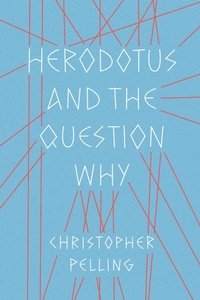
Herodotus and the Question Why
1st Edition
Published on 15. July 2019
524 pages
978-1-4773-1834-8 (ISBN)
Description

In the 5th century BCE, Herodotus wrote the first known Western history to build on the tradition of Homeric storytelling, basing his text on empirical observations and arranging them systematically. Herodotus and the Question Why offers a comprehensive examination of the methods behind the Histories and the challenge of documenting human experiences, from the Persian Wars to cultural traditions.
In lively, accessible prose, Christopher Pelling explores such elements as reconstructing the mentalities of storyteller and audience alike; distinctions between the human and the divine; and the evolving concepts of freedom, democracy, and individualism. Pelling traces the similarities between Herodotus's approach to physical phenomena (Why does the Nile flood?) and to landmark events (Why did Xerxes invade Greece? And why did the Greeks win?), delivering a fascinating look at the explanatory process itself. The cultural forces that shaped Herodotus's thinking left a lasting legacy for us, making Herodotus and the Question Why especially relevant as we try to record and narrate the stories of our time and to fully understand them.
In lively, accessible prose, Christopher Pelling explores such elements as reconstructing the mentalities of storyteller and audience alike; distinctions between the human and the divine; and the evolving concepts of freedom, democracy, and individualism. Pelling traces the similarities between Herodotus's approach to physical phenomena (Why does the Nile flood?) and to landmark events (Why did Xerxes invade Greece? And why did the Greeks win?), delivering a fascinating look at the explanatory process itself. The cultural forces that shaped Herodotus's thinking left a lasting legacy for us, making Herodotus and the Question Why especially relevant as we try to record and narrate the stories of our time and to fully understand them.
Reviews / Votes
[An] excellent new book...Herodotus and the Question Why offers a comprehensive, rigorous and engaging introduction not only to Herodotus, but to many other Greek authors too: for this reason alone, it is highly recommended reading not only for scholars...In a time when we risk getting caught in narrow, fatalistic modes of explanation, Christopher Pelling celebrates open-minded, multiform and sometimes uncertain approaches to the question 'why.' * Times Literary Supplement * [An] epic tome...There are not many scholars alive who could match the depth and breadth of Pelling's understanding of Herodotus; this work lays it all on the table. Every page shows his careful thought, meticulous attention to detail, and desire to push the envelope in our reassessment of the much-maligned historian. The work is a monument to Pelling's enduring fascination with Herodotus, and it shows that there is always more to be learned. * Ancient World Magazine * [Readers] interested in Herodotus's approach to recording history and his mode of historical explanation will find Pelling's book an engaging work of consummate scholarship...Essential. * CHOICE * [Pelling] works his way through the Herodotean narrative sedulously and with meticulous attention to detail...In a short review it is impossible to illustrate adequately the mass of material in this book, the subtlety of argument and interpretation, and the complex balance of perspectives...[Herodotus and the Question Why] is complex and demanding, but compellingly readable. Pelling deploys an amazingly wide range of material, ancient and modern, with remarkable lucidity. * Greece & Rome * There is much that is excellent in Pelling's book. It is comprehensive in scope, treating an impressive number of Herodotean passages. At the same time it is well-structured and argued, with each chapter flowing easily into the next...Pelling has produced a book that has a definite Herodotean feel to it: sweeping, rich, and thought-provoking. Readers will come away with renewed respect for Herodotus' overall historiographic achievement and especially for the dogged nature of Herodotus' attempts to get at the reason why things happened. * Bryn Mawr Classical Review * Erudite and wide-ranging. * Polis *All prices
More details
Series
Language
English
Place of publication
Austin, TX
United States
Target group
Professional and scholarly
File size
1,98 MB
ISBN-13
978-1-4773-1834-8 (9781477318348)
DOI
10.7560/318324
Copyright in bibliographic data and cover images is held by Nielsen Book Services Limited or by the publishers or by their respective licensors: all rights reserved.
Schweitzer Classification
Other editions
Additional editions
Christopher Pelling
Herodotus and the Question Why
Book
03/2021
University of Texas Press
€58.44
Shipment within 15-20 days
Christopher Pelling
Herodotus and the Question Why
Book
07/2019
University of Texas Press
€74.56
Shipment within 15-20 days
Person
Christopher Pelling was Regius Professor of Greek at Oxford University from 2003 to 2015 and is now an Honorary Fellow of University College; he is also a Fellow of the British Academy and a Fellow of the Learned Society of Wales. He has held visiting positions at Utah State University, Washington and Lee University, and the University of North Carolina. His numerous previous books include Literary Texts and the Greek Historian and Plutarch and History. Most recently, he coauthored Twelve Voices from Greece and Rome: Ancient Ideas for Modern Times and a commentary on Herodotus 6.
Content
Abbreviations
Preface
1. Why did it all happen?
(a) "Mother, what did they fight each other for?"
(b) The words
(c) Narrative: Show, not tell
(d) Explanation: A game for two
(e) Historical consciousness
(f) Reconstructing mentalities
2. To blame and to explain: Narrative complications
(a) The proem
(b) The exchange of abductions (1.1-5)
(c) Payback and its complications
(d) Whose fault is it anyway?
(e) Them and us
3. How can you possibly know?
(a) Putting in the working
(b) Scientific and historical explanation
(c) Stories in cahoots
4. Adventures in prose
(a) Something different?
(b) Hecataeus
(c) Other peoples and their past
(d) Rhetorical finger-pointing
(e) Sameness and difference
5. Hippocratic affinities
(a) Medical science
(b) Harmonious balancing
(c) Corroboration and revision
6. Explanations in combination
(a) Hippocratics
(b) Herodotus
7. Early moves
(a) Croesus and Candaules
(b) Croesus: Pride, aggression, downfall
8. Empire
(a) Croesus again
(b) From Cyrus to Xerxes
(c) Blame?
9. Herodotus' Persian stories
(a) The world of the court
(b) Biography?
(c) Be careful what you say . . .
(d) Overconfidence?
(e) But are we so different?
10. The human and the divine
(a) Divine perspectives
(b) Enigmatic divinity
(c) Historical explanation?
11. Explaining victory
12. Freedom
(a) Inspiration
(b) The unruly free
(c) Freedom from and freedom to
13. Democracy
(a) Democracy and freedom?
(b) Characterizing the demos
(c) Democracy in and out of focus
14. Individuals and collectives
(a) Self-expression?
(b) Narrative shape
(c) Individuals and communities
(d) An Athenian virtue?
(e) National characteristics?
15. Then and now: Herodotus' own day
(a) Shadows of the future
(b) Thinking backwards and forwards
(c) Back to the future
16. Why indeed?
Notes
Bibliography
Passages in Herodotus
Passages in Other Authors
General Index
Preface
1. Why did it all happen?
(a) "Mother, what did they fight each other for?"
(b) The words
(c) Narrative: Show, not tell
(d) Explanation: A game for two
(e) Historical consciousness
(f) Reconstructing mentalities
2. To blame and to explain: Narrative complications
(a) The proem
(b) The exchange of abductions (1.1-5)
(c) Payback and its complications
(d) Whose fault is it anyway?
(e) Them and us
3. How can you possibly know?
(a) Putting in the working
(b) Scientific and historical explanation
(c) Stories in cahoots
4. Adventures in prose
(a) Something different?
(b) Hecataeus
(c) Other peoples and their past
(d) Rhetorical finger-pointing
(e) Sameness and difference
5. Hippocratic affinities
(a) Medical science
(b) Harmonious balancing
(c) Corroboration and revision
6. Explanations in combination
(a) Hippocratics
(b) Herodotus
7. Early moves
(a) Croesus and Candaules
(b) Croesus: Pride, aggression, downfall
8. Empire
(a) Croesus again
(b) From Cyrus to Xerxes
(c) Blame?
9. Herodotus' Persian stories
(a) The world of the court
(b) Biography?
(c) Be careful what you say . . .
(d) Overconfidence?
(e) But are we so different?
10. The human and the divine
(a) Divine perspectives
(b) Enigmatic divinity
(c) Historical explanation?
11. Explaining victory
12. Freedom
(a) Inspiration
(b) The unruly free
(c) Freedom from and freedom to
13. Democracy
(a) Democracy and freedom?
(b) Characterizing the demos
(c) Democracy in and out of focus
14. Individuals and collectives
(a) Self-expression?
(b) Narrative shape
(c) Individuals and communities
(d) An Athenian virtue?
(e) National characteristics?
15. Then and now: Herodotus' own day
(a) Shadows of the future
(b) Thinking backwards and forwards
(c) Back to the future
16. Why indeed?
Notes
Bibliography
Passages in Herodotus
Passages in Other Authors
General Index
