

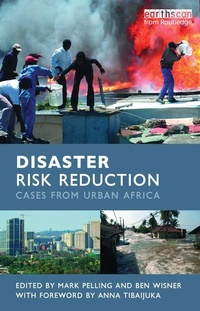
Disaster Risk Reduction
Cases from Urban Africa
1st Edition
Published on 16. May 2012
200 pages
978-1-136-56799-5 (ISBN)
Description

Published with ProVention Consortium, UNDP and UN-Habitat
'This excellent book is essential reading for those concerned with urban risk and its reduction in Africa, the most rapidly urbanizing region of the world.'
Professor Jo Beall, Development Studies Institute, London School of Economics
'At last a book that recognizes the impacts of disasters on Africa's 350 million urban dwellers, including the many disasters that get overlooked and go unrecorded. But also a book that, through careful case studies, shows what creates disaster risk and what local measures can be taken to address it.'
David Satterthwaite, International Institute for Environment and Development (IIED).
'This innovative volume combines the latest conceptualisations of urban disaster risk and vulnerability with case studies from across the African continent on how existing and innovative information can inform efforts to address the problems. Coverage ranges from the major catastrophes of news headlines to small, everyday disasters with which poor urban residents have to cope in their survival strategies. Written by international authorities and local specialists, this extremely useful book should find a place in the hands of academics and practitioners alike.'
Professor David Simon, Department of Geography, Royal Holloway, University of London
This is a one-of-a-kind book packed with original research and offering an innovative way of thinking about the reduction of risk in rapidly urbanizing cities across the globe. It is a must-have for professionals, researchers and policy makers.
The book addresses four inter-related themes critical for urban risk reduction: environment; livehood; urban governance and the generation of urban risks. Its focus is on Africa, the most rapidly urbanizing world region, but it illustrates global processes. Part one reviews development, urbanization and disaster risk in Africa as a whole, identifies state-of-the-art practices and policies for building urban resilience and provides a tool kit for urban risk reduction. It also presents a powerful conceptual framework to analyse and compare disaster risk and resilience in different cities and communities. Part two presents detailed case studies from Algeria, Ghana, Senegal, Kenya, Tanzania and South Africa illustrating vulnerability to hazards ranging from earthquake to shack fire, environmental health hazards, traffic hazards and flooding. Part three looks to the future and outlines a vision for a safer urban Africa based on achieving gains in human security through inclusive governance and investment in the creative capacities of Africa's urban dwellers.
With foreword by Anna Tibaijuka, Executive Director, UN-HABITAT
'This excellent book is essential reading for those concerned with urban risk and its reduction in Africa, the most rapidly urbanizing region of the world.'
Professor Jo Beall, Development Studies Institute, London School of Economics
'At last a book that recognizes the impacts of disasters on Africa's 350 million urban dwellers, including the many disasters that get overlooked and go unrecorded. But also a book that, through careful case studies, shows what creates disaster risk and what local measures can be taken to address it.'
David Satterthwaite, International Institute for Environment and Development (IIED).
'This innovative volume combines the latest conceptualisations of urban disaster risk and vulnerability with case studies from across the African continent on how existing and innovative information can inform efforts to address the problems. Coverage ranges from the major catastrophes of news headlines to small, everyday disasters with which poor urban residents have to cope in their survival strategies. Written by international authorities and local specialists, this extremely useful book should find a place in the hands of academics and practitioners alike.'
Professor David Simon, Department of Geography, Royal Holloway, University of London
This is a one-of-a-kind book packed with original research and offering an innovative way of thinking about the reduction of risk in rapidly urbanizing cities across the globe. It is a must-have for professionals, researchers and policy makers.
The book addresses four inter-related themes critical for urban risk reduction: environment; livehood; urban governance and the generation of urban risks. Its focus is on Africa, the most rapidly urbanizing world region, but it illustrates global processes. Part one reviews development, urbanization and disaster risk in Africa as a whole, identifies state-of-the-art practices and policies for building urban resilience and provides a tool kit for urban risk reduction. It also presents a powerful conceptual framework to analyse and compare disaster risk and resilience in different cities and communities. Part two presents detailed case studies from Algeria, Ghana, Senegal, Kenya, Tanzania and South Africa illustrating vulnerability to hazards ranging from earthquake to shack fire, environmental health hazards, traffic hazards and flooding. Part three looks to the future and outlines a vision for a safer urban Africa based on achieving gains in human security through inclusive governance and investment in the creative capacities of Africa's urban dwellers.
With foreword by Anna Tibaijuka, Executive Director, UN-HABITAT
More details
Language
English
Place of publication
London
United Kingdom
Publishing group
Taylor & Francis Ltd
Target group
College/higher education
File size
3,02 MB
ISBN-13
978-1-136-56799-5 (9781136567995)
Copyright in bibliographic data and cover images is held by Nielsen Book Services Limited or by the publishers or by their respective licensors: all rights reserved.
Schweitzer Classification
Other editions
Additional editions
Book
08/2014
1st Edition
Routledge
€71.80
Shipment within 10-20 days
Book
12/2008
1st Edition
Earthscan Ltd
€206.40
Shipment within 3-4 weeks
Persons
Mark Pelling is Reader in Human Geography at King's College London and author of The Vulnerability of Cities (2003). Ben Wisner is retired Professor of Geography and Director of International Studies at CSU at Long Beach, California and is co-editor of Towards a New Map of Africa (2005).
Content
Introduction * Conceptualising Urbanisation, Disaster Risk and Climate Change * Part I * A Safer Urban Future for Africa? * A Tool Kit for Urban Risk Reduction * Part II * Dar es Salaam, Tanzania: Building Disaster Resilient Communities * Algiers, Algeria: Evaluating Seismic Vulnerability * Greater Accra Metropolitan Area, Ghana: Environmental Health and Disaster Monitoring * Kisii and Kisumu, Kenya: Road Traffic Accidents as an Everyday Hazard * Saint Louis, Senegal: Multi-actor Governance for Flood Risk Reduction * Cape Town, South Africa: Fire Risk in Informal Settlements * Part III * A Vision of a Safer Urban Africa * Index
