

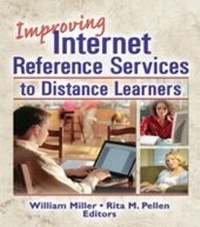
Improving Internet Reference Services to Distance Learners
1st Edition
Published on 3. June 2014
236 pages
978-1-317-95511-5 (ISBN)
Description

In their efforts to provide distance learners with the most effective services possible, librarians and information specialists are working more and more with faculty in academic departments, IT departments, and other librarians at cooperating institutions. Improving Internet Reference Services to Distance Learners chronicles how those efforts have seen librarians become actively involved in online course management and delivery systems, particularly Blackboard, Desire2Learn, and WebCT, or by embedding themselves into the online course structure to better learn where students need assistance. This invaluable resource also examines how librarians use Internet resources to support professional and continuing education and to establish university-wide information and referral services to provide quality service to distance learners.
Improving Internet Reference Services to Distance Learners encourages librarians to think more broadly about working with outside individuals when designing and providing reference and other services to nontraditional users. The book examines why it's best to consider user needs, funding, staff management, and collaboration development when planning Internet reference services, how to develop and implement a required, credit-bearing online information literacy course, and how to apply effective marketing techniques from the business world to increase awareness of reference support services available to distance learners. It also offers a look at the Walden University Library at Indiana University-Bloomington, which houses no print collectiononly online databasesand includes case studies that document the design and development of Internet reference services for the University of Illinois' Fire Service Institute, and the efforts to provide support for doctor of pharmacy students at the University of Wisconsin-Madison in their final year of study.
Improving Internet Reference Services to Distance Learners provides practical information on:
monitoring online discussion threads devoted to library research
Web-based interactive tutorials
integrating library services in support of coursework
integrating library services into online courses
offering, promoting, and providing instruction to public users, as well as local and distance students
developing a web site that centralizes information about library services and resources
the potential of the academic library to be the central provider of information and referral services for an entire university
Improving Internet Reference Services to Distance Learners is an invaluable resource for librarians working in academic, school, special, and public settings, and for library science faculty and students.
Improving Internet Reference Services to Distance Learners encourages librarians to think more broadly about working with outside individuals when designing and providing reference and other services to nontraditional users. The book examines why it's best to consider user needs, funding, staff management, and collaboration development when planning Internet reference services, how to develop and implement a required, credit-bearing online information literacy course, and how to apply effective marketing techniques from the business world to increase awareness of reference support services available to distance learners. It also offers a look at the Walden University Library at Indiana University-Bloomington, which houses no print collectiononly online databasesand includes case studies that document the design and development of Internet reference services for the University of Illinois' Fire Service Institute, and the efforts to provide support for doctor of pharmacy students at the University of Wisconsin-Madison in their final year of study.
Improving Internet Reference Services to Distance Learners provides practical information on:
monitoring online discussion threads devoted to library research
Web-based interactive tutorials
integrating library services in support of coursework
integrating library services into online courses
offering, promoting, and providing instruction to public users, as well as local and distance students
developing a web site that centralizes information about library services and resources
the potential of the academic library to be the central provider of information and referral services for an entire university
Improving Internet Reference Services to Distance Learners is an invaluable resource for librarians working in academic, school, special, and public settings, and for library science faculty and students.
More details
Language
English
Place of publication
London
United Kingdom
Publishing group
Taylor & Francis Ltd
Target group
College/higher education
File size
2,52 MB
ISBN-13
978-1-317-95511-5 (9781317955115)
Copyright in bibliographic data and cover images is held by Nielsen Book Services Limited or by the publishers or by their respective licensors: all rights reserved.
Schweitzer Classification
Other editions
Additional editions
Rita Pellen | William Miller
Improving Internet Reference Services to Distance Learners
Book
07/2005
1st Edition
Routledge
€68.60
Shipment within 10-20 days
Rita Pellen | William Miller
Improving Internet Reference Services to Distance Learners
Book
06/2005
1st Edition
Routledge
€54.90
Shipment within 10-20 days
Persons
Pellen, Rita; Miller, William
Content
Introduction: Improving Reference Services to Distance Learners Through Cooperative Activities (William Miller)
Librarian Participation in the Online Classroom (Jill S. Markgraf)
Information Literacy and the Distant Student: One University's Experience Developing, Delivering, and Maintaining an Online, Required Information Literacy Course (Elizabeth Mulherrin, Kimberly B. Kelley, Diane Fishman, and Gloria J. Orr)
Online Tutorials as Instruction for Distance Students (Rachel G. Viggiano)
Beyond Instruction: Integrating Library Service in Support of Information Literacy (Barbara J. D'Angelo and Barry M. Maid)
Embedding Library Reference Services in Online Courses (Jamie P. Kearley and Lori Phillips)
Got Distance Services? Marketing Remote Library Services to Distance Learners (James Fisk and Terri Pedersen Summey)
The Walden University Library: Reaching Out and Touching Students (Rita Barsun)
Providing Reference in a Joint-Use Library (Nora J. Quinlan and Johanna Tunon)
Centralizing Information About Library Services and Resources: Delivering the Library to Users at Any Distance (Mary Feeney)
Designing and Developing Internet Reference Services to Support Firefighter
Distance Learners in Illinois (Lian Ruan)
Distance Library Services for Doctor of Pharmacy Students: A Case Study (Ulrike Dieterle and Gerri Wanserski)
The Buck Stops Where? Establishing a University Information and Referral Service (Doris R. Brown and Kara Malenfant)
Index
Reference Notes Included
Librarian Participation in the Online Classroom (Jill S. Markgraf)
Information Literacy and the Distant Student: One University's Experience Developing, Delivering, and Maintaining an Online, Required Information Literacy Course (Elizabeth Mulherrin, Kimberly B. Kelley, Diane Fishman, and Gloria J. Orr)
Online Tutorials as Instruction for Distance Students (Rachel G. Viggiano)
Beyond Instruction: Integrating Library Service in Support of Information Literacy (Barbara J. D'Angelo and Barry M. Maid)
Embedding Library Reference Services in Online Courses (Jamie P. Kearley and Lori Phillips)
Got Distance Services? Marketing Remote Library Services to Distance Learners (James Fisk and Terri Pedersen Summey)
The Walden University Library: Reaching Out and Touching Students (Rita Barsun)
Providing Reference in a Joint-Use Library (Nora J. Quinlan and Johanna Tunon)
Centralizing Information About Library Services and Resources: Delivering the Library to Users at Any Distance (Mary Feeney)
Designing and Developing Internet Reference Services to Support Firefighter
Distance Learners in Illinois (Lian Ruan)
Distance Library Services for Doctor of Pharmacy Students: A Case Study (Ulrike Dieterle and Gerri Wanserski)
The Buck Stops Where? Establishing a University Information and Referral Service (Doris R. Brown and Kara Malenfant)
Index
Reference Notes Included
