

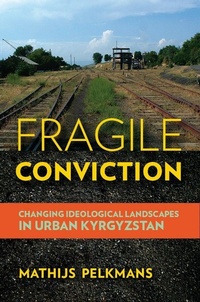
Fragile Conviction
Description

How do specific secular and religious ideologies-such as nationalism, neoliberalism, atheism, Pentecostalism, Tablighi Islam, and shamanism-gain popularity and when do they lose traction? To answer these questions, Mathijs Pelkmans critically examines the trajectories of a range of ideologies as they move into the post-Soviet frontier in Central Asia. Ethnographically rooted in the everyday life of a former mining town in southern Kyrgyzstan, Fragile Conviction shows how residents have dealt with the existential and epistemic crises that arose after the collapse of the Soviet Empire. Residents became enchanted by the truths of Muslim and Christian missionaries, embraced the teachings of neoliberal and nationalist ideologues, and were riveted by the visions of shamanic healers. But no matter how much enthusiasm and hope these ideas first engendered, the commitment to any of them rarely lasted very long.Pelkmans finds that there is an inverse relationship between the tenacity and the effervescence of collective ideas, between their strength to persist and their ability to trigger committed action. Introducing the concept of pulsation, he argues in Fragile Conviction that ideational power must be understood in relation to three aspects: the voicing of the idea, its tension with everyday reality, and its reverberation within groups of listeners. The conclusion that the power of conviction is rooted in the instability of sociocultural contexts is a message that has relevance far beyond urban Central Asia.
More details
Other editions
Additional editions
Person
Mathijs Pelkmans is Associate Professor of Anthropology at the London School of Economics and Political Science. He is the author of Fragile Conviction: Changing Ideological Landscapes in Urban Kyrgyzstan and Defending the Border: Identity, Religion, and Modernity in the Republic of Georgia, both from Cornell, and editor of Conversion after Socialism: Disruptions, Modernisms and Technologies of Faith in the Former Soviet Union and Ethnographies of Doubt: Faith and Uncertainty in Contemporary Societies.
Content
Introduction: Ideational Power in Times of TurmoilPart I: Uncertain Times and Places1. Shattered Transition: The Reordering of Kyrgyz Society2. Condition of Uncertainty: Life in an Industrial WastelandPart II: Dynamics of Conviction3. What Happened to Soviet Atheism?4. Walking the Truth in Islam with the Tablighi Jamaat5. Pentecostal Miracle Truth on the Frontier6. The Tenacity of Spiritual Healing and Seeing Conclusion: Pulsation and the Dynamics of Conviction
