


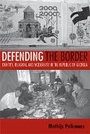
Defending the Border
Identity, Religion, and Modernity in the Republic of Georgia
1st Edition
Published on 16. May 2011
256 pages
978-0-8014-6176-7 (ISBN)
Description

This book, one of the first in English about everyday life in the Republic of Georgia, describes how people construct identity in a rapidly changing border region. Based on extensive ethnographic research, it illuminates the myriad ways residents of the Caucasus have rethought who they are since the collapse of the Soviet Union.
Through an exploration of three towns in the southwest corner of Georgia, all of which are situated close to the Turkish frontier, Mathijs Pelkmans shows how social and cultural boundaries took on greater importance in the years of transition, when such divisions were expected to vanish. By tracing the fears, longings, and disillusionment that border dwellers projected on the Iron Curtain, Pelkmans demonstrates how elements of culture formed along and in response to territorial divisions, and how these elements became crucial in attempts to rethink the border after its physical rigidities dissolved in the 1990s.
The new boundary-drawing activities had the effect of grounding and reinforcing Soviet constructions of identity, even though they were part of the process of overcoming and dismissing the past. Ultimately, Pelkmans finds that the opening of the border paradoxically inspired a newfound appreciation for the previously despised Iron Curtain as something that had provided protection and was still worth defending.
Through an exploration of three towns in the southwest corner of Georgia, all of which are situated close to the Turkish frontier, Mathijs Pelkmans shows how social and cultural boundaries took on greater importance in the years of transition, when such divisions were expected to vanish. By tracing the fears, longings, and disillusionment that border dwellers projected on the Iron Curtain, Pelkmans demonstrates how elements of culture formed along and in response to territorial divisions, and how these elements became crucial in attempts to rethink the border after its physical rigidities dissolved in the 1990s.
The new boundary-drawing activities had the effect of grounding and reinforcing Soviet constructions of identity, even though they were part of the process of overcoming and dismissing the past. Ultimately, Pelkmans finds that the opening of the border paradoxically inspired a newfound appreciation for the previously despised Iron Curtain as something that had provided protection and was still worth defending.
More details
Other editions
Additional editions
Book
09/2006
Cornell University Press
€38.36
Shipment within 10-20 days
Book
09/2006
Cornell University Press
€148.80
Shipment within 10-20 days
Person
Mathijs Pelkmans is a Research Fellow at the Max Planck Institute for Social Anthropology.
Content
- Intro
- Contents
- Preface
- A Note on Transliteration and Translation
- Terms and Abbreviations
- Introduction: Temporal Divides and Muddled Space along the Former Iron Curtain
- Part I: A Divided Village on the Georgian-Turkish Border
- Introduction: Divided Village
- 1. Caught between States
- 2. Mobilizing Cultural Stuff with Boundaries
- 3. Lost Relatives
- Part II: Frontiers of Islam and Christianity in Upper Ajaria
- Introduction: Christian Incursions
- 4. The Making and Transformation of the Frontier
- 5. Defending Muslim Identities
- 6. Ancestors and Enemies in Conversion to Christianity
- Part III: Postsocialist Borderlands
- Introduction: Treacherous Markets
- 7. Channeling Discontent
- 8. The Social Life of Empty Buildings
- Conclusion: Borders in Time and Space
- Bibliography
- Index
