

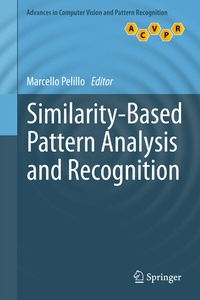
Similarity-Based Pattern Analysis and Recognition
Description

This accessible text/reference presents a coherent overview of the emerging field of non-Euclidean similarity learning. The book presents a broad range of perspectives on similarity-based pattern analysis and recognition methods, from purely theoretical challenges to practical, real-world applications. The coverage includes both supervised and unsupervised learning paradigms, as well as generative and discriminative models. Topics and features: explores the origination and causes of non-Euclidean (dis)similarity measures, and how they influence the performance of traditional classification algorithms; reviews similarity measures for non-vectorial data, considering both a "kernel tailoring" approach and a strategy for learning similarities directly from training data; describes various methods for "structure-preserving" embeddings of structured data; formulates classical pattern recognition problems from a purely game-theoretic perspective; examines two large-scale biomedical imagingapplications.
More details
Other editions
Additional editions
Content
Introduction.- Part I: Foundational Issues.- Non-Euclidean Dissimilarities.- SIMBAD.- Part II: Deriving Similarities for Non-vectorial Data.- On the Combination of Information Theoretic Kernels with Generative Embeddings.- Learning Similarities from Examples under the Evidence Accumulation Clustering Paradigm.- Part III: Embedding and Beyond.- Geometricity and Embedding.- Structure Preserving Embedding of Dissimilarity Data.- A Game-Theoretic Approach to Pairwise Clustering and Matching.- Part IV: Applications.- Automated Analysis of Tissue Micro-Array Images on the Example of Renal Cell Carcinoma.- Analysis of Brain Magnetic Resonance (MR) Scans for the Diagnosis of Mental Illness.
