


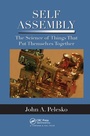
Self Assembly
The Science of Things That Put Themselves Together
Published on 21. May 2007
336 pages
978-1-58488-688-4 (ISBN)
Description

Hailed as one of the key areas of nanoscience likely to shape future scientific research, self-assembly offers the most promising route to true molecular nanotechnology. Focusing on this dynamic new field, Self Assembly: The Science of Things That Put Themselves Together explores nature's self-assembly of structures, the use of it to build engineer
Reviews / Votes
"[The book] is really very beautiful. It is a fantastic list of disparate topics that are all elegantly organized around the theme of self assembly. [The author has] managed to put together a coherent story starting with simple physical effects, such as surface tension and bubble rafts, to organic systems like the tobacco mosaic virus and the ribosome to the Cheerios effect (for those of us who like breakfast cereal!). This is then elegantly connected to George Whiteside's engineered Cheerios effect, to magnetic self assembly and finally ending with very recent work on DNA self assembly-including even the latest work out of Winfree's lab! It is really terrific. I had not considered how powerful a course about self assembly would be before I saw how [the author] put everything together in [this] book."-Dr. Michael P. Brenner, Glover Professor of Applied Mathematics and Applied Physics, Harvard University,
Cambridge, Massachusetts, USA
"Self-assembly is an exploding field, the basis of both biological systems and the most advanced nanotechnologies. Self Assembly offers the reader a unique guide: it spans scales ranging from molecular to macroscopic, levels of complexity ranging from simple crystals to systems that compute, and modes of understanding ranging from equations to experiments with floating soda straws. It's the best introduction I've seen."
-Dr. K. Eric Drexler, author of Nanosystems: Molecular Machinery, Manufacturing, and Computation
"This text of John Pelesko's is a wonderful introduction to the emerging field of self assembly. Self assembly is an important field to be informed about at this time, in part because it is critical to the science and engineering of nanostructures and nanodevices constructed on scales below the limits of conventional top-down methodologies such as lithography. He manages superbly to impart to the reader the excitement of the ongoing research in this quickly evolving and highly interdisciplinary field. The text ranges over a wide variety of topics, including the impact of self assembly to nanoscience, chemistry, biochemistry, physics, material science, and robotics. It covers a number of recent revolutionary breakthroughs in self assembly, demonstrating the self assembly of complex and richly patterned nanostructures. The text would be essential reading to anyone in these fields, as well as to anyone with a curiosity about the basic processes that are used by nature to assemble the most complex things we know about in the universe-ourselves."
-John H. Reif, A. Hollis Edens Distinguished Professor of Computer Science, Duke University, Durham, North Carolina, USA
More details
Language
English
Place of publication
London
United Kingdom
Publishing group
Taylor & Francis Ltd
Target group
Professional and scholarly
Physicists, engineers, chemists, and other scientists interested in nanotechnology; advanced undergraduate and graduate students in nanotechnology courses.
Illustrations
152 s/w Abbildungen, 14 farbige Abbildungen, 6 s/w Tabellen, 37 s/w Photographien bzw. Rasterbilder
152 b/w images, 14 color images, 6 tables, 37 halftones and 132 equations
File size
12,48 MB
ISBN-13
978-1-58488-688-4 (9781584886884)
Copyright in bibliographic data and cover images is held by Nielsen Book Services Limited or by the publishers or by their respective licensors: all rights reserved.
Schweitzer Classification
Other editions
Additional editions
Book
11/2017
1st Edition
CRC Press
€297.12
Shipment within 10-20 days
Book
05/2007
1st Edition
Chapman & Hall/CRC
€117.70
Shipment within 15-20 days
Content
Introduction. THE NATURAL WORLD: Inorganic Systems. Organic Systems. Lessons from the Natural World. ENGINEERED SYSTEMS: The "Cheerios Effect" and Other Simple Systems. Static Self Assembly. Dynamic Self Assembly. DNA Self Assembly. THE FUTURE: Models of Self Assembly. Directions. Color Plates. References. Appendices. Index.
