

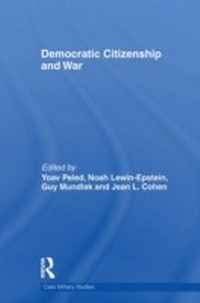
Democratic Citizenship and War
1st Edition
Published on 3. June 2014
256 pages
978-1-317-93335-9 (ISBN)
Description

This edited volume explores the theoretical and practical implications of war and terror situations for citizenship in democratic states.
Citizenship is a key concept in Western political thought for defining the individual's relations with society. The specific nature of these rights, duties and contributions, as well the relations between them, are determined by the citizenship discourses that prevail in each society.
In wartime, including low-intensity wars, democratic societies face different challenges than the ones facing them during peacetime, in areas such as human rights, the status of minorities, the state's obligations to its citizens, and the meaning of social solidarity. War situations can affect not only the scope of citizenship as an institution, but also the relations between the prevailing discourses of citizenship and between different groups of citizens. Since 9/11 and the declaration of the 'war on terror', many democracies have been grappling with issues rising out of the interface between citizenship and war. This volume examines the effects of war on various aspects of citizenship practice, including: immigration and naturalization, the welfare state, individual liberties, gender relations, multiculturalism, social solidarity, and state - civil society relations.
This book will be of great interest to students of military studies, political science, IR and security studies in general.
Citizenship is a key concept in Western political thought for defining the individual's relations with society. The specific nature of these rights, duties and contributions, as well the relations between them, are determined by the citizenship discourses that prevail in each society.
In wartime, including low-intensity wars, democratic societies face different challenges than the ones facing them during peacetime, in areas such as human rights, the status of minorities, the state's obligations to its citizens, and the meaning of social solidarity. War situations can affect not only the scope of citizenship as an institution, but also the relations between the prevailing discourses of citizenship and between different groups of citizens. Since 9/11 and the declaration of the 'war on terror', many democracies have been grappling with issues rising out of the interface between citizenship and war. This volume examines the effects of war on various aspects of citizenship practice, including: immigration and naturalization, the welfare state, individual liberties, gender relations, multiculturalism, social solidarity, and state - civil society relations.
This book will be of great interest to students of military studies, political science, IR and security studies in general.
More details
Series
Language
English
Place of publication
London
United Kingdom
Publishing group
Taylor & Francis Ltd
Target group
College/higher education
Professional and scholarly
Illustrations
3 s/w Tabellen
3 Tables, black and white
File size
1,25 MB
ISBN-13
978-1-317-93335-9 (9781317933359)
Copyright in bibliographic data and cover images is held by Nielsen Book Services Limited or by the publishers or by their respective licensors: all rights reserved.
Schweitzer Classification
Other editions
Additional editions
Yoav Peled | Noah Lewin-Epstein | Guy Mundlak
Democratic Citizenship and War
Book
05/2012
1st Edition
Routledge
€27.00
Shipment within 15-20 days
Yoav Peled | Noah Lewin-Epstein | Guy Mundlak
Democratic Citizenship and War
Book
07/2010
1st Edition
Routledge
€64.70
Shipment within 15-20 days
Persons
Yoav Peled is Professor of Political Science at Tel Aviv University.
Noah Lewin-Epstein is Professor of Sociology and Dean of the Faculty of Social Science at Tel-Aviv University.
Guy Mundlak is a researcher in the Faculty of Law and Department of Labor Studies, Tel Aviv University.
Jean L. Cohen is Nell and Edward Singer Professor of Political Theory and Contemporary Civilization at Columbia University.
Noah Lewin-Epstein is Professor of Sociology and Dean of the Faculty of Social Science at Tel-Aviv University.
Guy Mundlak is a researcher in the Faculty of Law and Department of Labor Studies, Tel Aviv University.
Jean L. Cohen is Nell and Edward Singer Professor of Political Theory and Contemporary Civilization at Columbia University.
Content
Introduction Part 1: Citizenship and War: The View From Political Theory 1. Republican Citizenship, Repression of Liberal Rights and Multi-Polarity Alberto Spektorowski and Carl Schmitt 2. Security Council Activism in the Age of the War on Terror: Implications for Human rights, Democracy and Constitutionalism Jean Cohen 3. Beyond The Security vs. Liberty Paradigm: A New Look on Security Politics Sharon Weinblum Part 2: Citizenship and War: An Historical Perspective 4. The Alien-Citizen Distinction and the Global War on Terrorism Tung Yin and David Abraham 5. Citizens at War: Traitors and Internal Enemies Ute Frevort 6. Limited War, Limited Citizenship: The Case of Veterans in the People's Republic of China Niel J. Diamant 7. Soldiers' Violence and the Dialectics of Citizenship and Victimhood in Contemporary Israel Yaron Ezrahi Part 3: Citizenship, War and the Rights of Women and Ethnic Minorities 8. Indian Muslims and the War on Terror: Reflections on Their Citizenship Status Ornit Shani 9. Women as the Bearers of the Nation: Women's Rights in Israel - between Liberal and Ethnic Citizenship Gila Stopler 10. The Palestinian-Israeli "Visionary Documents": Background, Implications and Critique Uri Ram Part 4: Social and Economic Citizenship in Wartime 11. Democracy's Disappearing Duties: The Washington Consensus and the Limits of Citizen Participation Timothy A. Canova 12. The Reversal of Citizenship: The Lebanon War and Intifada in the 1980's and the 2000's Lev Grinberg
