

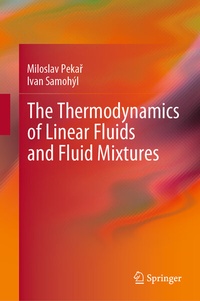
The Thermodynamics of Linear Fluids and Fluid Mixtures
Description

Reviews / Votes
"In this book, the authors provide a consistent presentation of thermodynamical properties of fluid and mixtures, developed in the spirit of rational thermodynamics of continua. . This very interesting book, which focuses more on fundamental physical laws than on a rigorous mathematical treatment, is perfectly suitable for a study of thermodynamics of continua at the undergraduate level and can be seen as a good introduction to more advanced texts . ." (Bernard Ducomet, Mathematical Reviews, April, 2017)More details
Other editions
Additional editions
Persons
Ivan Samohýl was born in 1936 in Modrý Kamen, Slovakia. In 1962 he received an MSc. in physical chemistry from the Institute of Chemical Technology in Prague (ICTP), Czech Republic and after taking a scholarship at the Institute of D.I. Mendeleev in Moscow, Russia, he joined the Department of Physical Chemistry at ICTP where he also received a Ph.D. in physical chemistry in 1970 based on measuring diffusivities in liquid mixtures of nonelectrolytes. Modern (rational) thermodynamic theory of gas and liquid mixtures is his main scientific field of interest. He has given lectures on this topic in Poland, Russia and Germany and spent about a year on stays in France and the USA. He is author of two monographs and one textbook on rational thermodynamics, co-author of one patent and author or co-author of about 30 papers from the field of physical chemistry.
Miloslav Pekar was born in 1962 in Kromeríz, Czech Republic. He received his M.Sc. in organic technology and Ph.D. in technical chemistry from the Institute of Chemical Technology in Prague, Czech Republic in 1985 and 1991, respectively. After spending several years at the Czech Academy of Sciences, in the regional analytical laboratory and industrial research, he joined the Brno University of Technology in 1994. He currently teaches physical and colloid chemistry at the Faculty of Chemistry. His research interests include relationships between thermodynamics and kinetics and physical chemistry of biocolloids and their application, particularly polysaccharides and humic substances. In 1999 he was appointed associate and in 2009 full professor of physical chemistry. He is director of the Institute of Physical and Applied Chemistry and Materials Research Centre. Miloslav Pekar is a member of the American Chemical Society, the Czech Chemical Society, the International Humic Substances Society, and the European Colloid and Interface Society. He has authored or co-authored three textbooks on theoretical and practical physical chemistry, seven book chapters, about 50 journal articles, and more than 150 conference contributions.
