

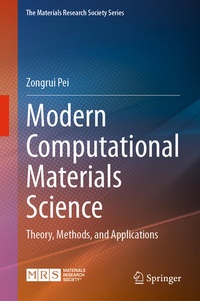
Modern Computational Materials Science
Description

This book serves as a concise and modern guide on computational materials science that meticulously revitalizes classical concepts, theories, and models through a contemporary lens and equally importantly, integrates cutting-edge advancements into a cohesive framework. It explores the transformative impact of machine learning and quantum computing on materials science research, as well as the influential role of language models and high-performance computing. The author includes detailed descriptions of advanced simulation methods such as First-principles methods, Molecular dynamics, Monte-Carlo simulations, Multi-scale methods, and more. Readers are also provided with in-depth case studies on specific materials, including structural materials, quantum materials, functional materials, biomaterials and beyond.
This book presents readers with a concise yet rich framework that introduces essential concepts, methods, and applications. It covers the fundamental principles of materials science, simulations, and modeling, while also addressing contemporary topics transforming the field and illuminating new research opportunities and perspectives. Designed to swiftly empower young researchers with essential knowledge and serve as a modern reference for seasoned professionals and educators, this book aims to prepare materials scientists for the future of this rapidly evolving field.
More details
Other editions
Additional editions
Person
Dr. Zongrui Pei holds a Ph.D. in materials science and engineering. He currently serves as a senior computational staff member at New York University. His current research focuses on developing physics-based methods and AI-for-science models, and utilizing these methods in conjunction with high-performance computing to investigate various materials. Dr. Pei's areas of expertise include computational materials science, high-performance computing, classical/quantum machine learning, and mathematical physics.
Content
Introduction.- Material properties, Crystallography and Defects.- Quantum Mechanics and Machine Learning.- Fundamentals of High-performance Computing.- First-principles Methods and Atomistic Simulations.- Computational Thermodynamics and Statistical Mechanics.- Mechanics of Materials.- Applications to Materials.- Machine Learning for Materials Science.- More Topics in Condensed Matter Physics.- Selected Topics in Mathematics and Mathematical Physics.
