

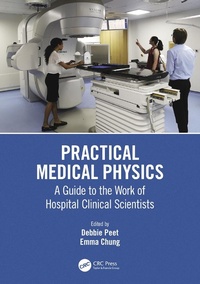
Practical Medical Physics
A Guide to the Work of Hospital Clinical Scientists
1st Edition
Published on 24. August 2021
262 pages
978-1-351-39171-9 (ISBN)
Description

This is the first all-encompassing textbook designed to support trainee clinical scientists in medical physics as they start work in a hospital setting whilst undertaking an academic master's course.
Developed by practising physicists and experienced academics using their experience of teaching trainee medical physicists, this book provides an accessible introduction to the daily tasks that clinical scientists perform in the course of their work. It bridges the gap between theory and practice, making the book also suitable for advanced undergraduate and graduate students in other disciplines studying modules on medical physics, including those who are considering a career in medical physics through applying to the NHS Scientist Training Programme (STP).
Features:
Provides an accessible introduction to practical medical physics within a hospital environment
Maps to the course content of the Scientist Training Programme in the NHS
Acts as a complement to the academic books often recommended for medical physics courses
Developed by practising physicists and experienced academics using their experience of teaching trainee medical physicists, this book provides an accessible introduction to the daily tasks that clinical scientists perform in the course of their work. It bridges the gap between theory and practice, making the book also suitable for advanced undergraduate and graduate students in other disciplines studying modules on medical physics, including those who are considering a career in medical physics through applying to the NHS Scientist Training Programme (STP).
Features:
Provides an accessible introduction to practical medical physics within a hospital environment
Maps to the course content of the Scientist Training Programme in the NHS
Acts as a complement to the academic books often recommended for medical physics courses
Reviews / Votes
"Peet (University Hospitals of Leicester NHS Trust) and Chung (Univ. of Leicester, Department of Cardiovascular Sciences) assembled an impressive team of contributors to develop a book uniquely positioned to support clinical scientists (also known as medical physicists) working in hospital settings. The book is comprehensive, covering all major medical imaging technologies, e.g., magnetic resonance imaging, ultrasound, X-ray, nuclear medicine. Each chapter first provides a brief summary of the theoretical aspects of the imaging technology at hand, then describes the role of clinical scientists in that field. The work is highly accessible and provides a wealth of practical reference information, including websites, conference recommendations, and easy-to-read tables. Though the terminology and examples are drawn from the National Health Service system in the UK, most of the information is applicable in the context of other developed countries. The book includes a great list of references and informative color figures, and each chapter features a series of thought-provoking case studies. The volume concludes with an interesting discussion of the role of clinical scientists as envisioned for the future. Summing Up: Recommended. Graduate students and professionals. Students in two-year technical programs."-L. S. Cahill, Memorial University of Newfoundland in CHOICE, November 2022.
More details
Edition
1. Auflage
Language
English
Place of publication
London
United Kingdom
Publishing group
Taylor & Francis Ltd
Target group
College/higher education
Product notice
Reflowable
Illustrations
37 Tables, black and white; 8 Line drawings, color; 53 Line drawings, black and white; 13 Halftones, color; 60 Halftones, black and white; 21 Illustrations, color; 113 Illustrations, black and white
ISBN-13
978-1-351-39171-9 (9781351391719)
Copyright in bibliographic data and cover images is held by Nielsen Book Services Limited or by the publishers or by their respective licensors: all rights reserved.
Schweitzer Classification
Other editions
Additional editions
Debbie Peet | Emma Chung
Practical Medical Physics
A Guide to the Work of Hospital Clinical Scientists
Book
08/2021
1st Edition
CRC Press
€224.40
Shipment within 10-20 days
Debbie Peet | Emma Chung
Practical Medical Physics
A Guide to the Work of Hospital Clinical Scientists
Book
08/2021
1st Edition
CRC Press
€84.47
Shipment within 10-20 days
Persons
Debbie Peet is the Head of Medical Physics in the University Hospitals of Leicester NHS Trust. She has worked in the NHS for nearly 40 years as a Clinical Scientist in all disciplines but has specialised in Radiation Safety and Diagnostic Radiology Physics for over 25 of them. She has an interest in facility design in Radiotherapy and Nuclear Medicine including PET/CT and has published several book chapters on these topics.
Emma Chung is a Lecturer in Medical Physics within the University of Leicester Department of Cardiovascular Sciences. She is a registered NHS Clinical Scientist specialising in ultrasound physics and is currently External Examiner for Imperial College London's MSc in Medical Ultrasound. Emma has worked jointly within the NHS and academia since 2004 and has been the recipient of numerous research awards. Throughout her career, Emma has been active in supporting the academic advancement of Clinical Scientist and encouraging students from all backgrounds to consider a career in Medical Physics.
Emma Chung is a Lecturer in Medical Physics within the University of Leicester Department of Cardiovascular Sciences. She is a registered NHS Clinical Scientist specialising in ultrasound physics and is currently External Examiner for Imperial College London's MSc in Medical Ultrasound. Emma has worked jointly within the NHS and academia since 2004 and has been the recipient of numerous research awards. Throughout her career, Emma has been active in supporting the academic advancement of Clinical Scientist and encouraging students from all backgrounds to consider a career in Medical Physics.
Content
Part 1 Non-ionising imaging
Chapter 1. Introduction
Chapter 2. Magnetic Resonance Imaging (MRI) Physics
Chapter 3. Ultrasound Physics
Part 2 Imaging and Therapy using Ionising Radiation
Chapter 4. Diagnostic Imaging using X-rays
Chapter 5. Nuclear Medicine Imaging and Therapy
Chapter 6. Radiotherapy Physics
Part 3 Radiation Safety
Chapter 7. Radiation Safety
Chapter 1. Introduction
Chapter 2. Magnetic Resonance Imaging (MRI) Physics
Chapter 3. Ultrasound Physics
Part 2 Imaging and Therapy using Ionising Radiation
Chapter 4. Diagnostic Imaging using X-rays
Chapter 5. Nuclear Medicine Imaging and Therapy
Chapter 6. Radiotherapy Physics
Part 3 Radiation Safety
Chapter 7. Radiation Safety
