

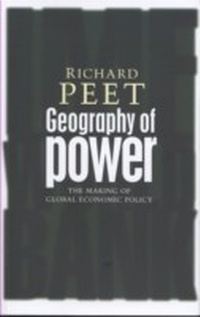
Geography of Power
Making Global Economic Policy
1st Edition
Published on 4. April 2013
224 pages
978-1-84813-683-0 (ISBN)
Description

This work looks at how contemporary global economic policies are made: by which institutions, under what ideologies, and how they are enforced. The author reveals the central roles played by organizations such as the IMF and the World Bank in supervising the livelihoods of over 2.5 billion people. He shows that neoliberal economic policy is enforced by a few thousand unelected and unaccountable experts in the North and has failed to deliver tolerable living conditions for the poor.
The book argues for a new geographic theory of power, exercised through dominant institutions, concentrated in hegemonic power centers. It seeks to transform the existing geography of policy-making power by exposing its structures, centers and mechanisms, critiquing its intellectual foundations, uncovering its un-democratic justifications, and passionately supporting its opponents. The conclusion makes a further positive contribution by exploring policy alternatives that point the way forward.
The book argues for a new geographic theory of power, exercised through dominant institutions, concentrated in hegemonic power centers. It seeks to transform the existing geography of policy-making power by exposing its structures, centers and mechanisms, critiquing its intellectual foundations, uncovering its un-democratic justifications, and passionately supporting its opponents. The conclusion makes a further positive contribution by exploring policy alternatives that point the way forward.
Reviews / Votes
Richard Peet has effectively indicted those who sit in the seats of power in our global society. By showing how power is exercised through economic institutions, ideology, and world governance arrangements, he provides an essential foundation for those who want to understand the way the world works in order to bring change. It is a lucid picture - a clear "geography of power" - that is most useful. * Arthur MacEwan, University of Massachusetts * recommended to scholars, students and activists who desire a globalization with substantially more equality, social justice and democracy. * Duane Swank, British Journal of Sociology * Richard Peet has mapped for us a geography of power, a new kind of political geography, exposing the capitalist supernova that now dominate the global political economic landscape. His book brilliantly charts these new centres of accumulated power, their destructive capabilities and the rise of a counter-revolution against a neoliberal order seemingly intent on dragging us all into the black holes of impoverishment and disempowerment. * Michael Watts, University of California Berkeley * Mixing Marx and Foucault but writing more straightforwardly than either, Richard Peet puts social theory to work in an exploration of the architecture of contemporary global economic policy. Bridging grand theory and lively empirical detail, this book is well pitched at readers trying to grasp the making of economic power behind the world's daily business headlines - especially if they have a mind to change how those headlines read. * Neil Smith, The Center for Place, Culture and Politics * The book makes an interesting and insightful contribution to contemporary debates on geography and power. * Tim Vorley, Tijdschrift voor Economische en Sociale Geografie * Richard Peet does an excellent job of illuminating geopolitical realities by rooting them in the dynamic interaction of class structures, the nation state, and globalization. Insightful and provocative, this is a must read for both the activist and the analyst. * Walden Bello, Focus on the Global South *More details
Edition
1. Auflage
Language
English
Place of publication
United Kingdom
Publishing group
Bloomsbury Publishing PLC
Target group
College/higher education
Professional and scholarly
ISBN-13
978-1-84813-683-0 (9781848136830)
Copyright in bibliographic data and cover images is held by Nielsen Book Services Limited or by the publishers or by their respective licensors: all rights reserved.
Schweitzer Classification
Other editions
Additional editions
Book
04/2007
Zed Books Ltd
€41.60
Shipment within 3-4 weeks
Person
Richard Peet is Professor of Geography at Clark University in Worcester, Massachusetts, USA. His published books include: Radical Geography (1977), Global Capitalism (1991), Modern Geographical Thought (1998), Liberation Ecologies (1996 and 2004) and Unholy Trinity: The IMF, World Bank and WTO (Zed 2003).
Content
Preface
1. Introduction: concepts for a geography of power
2. Economic power
3. Ideological power
4. Political power
5. Sub-hegemony: South Africa
6. Counter-hegemony
7. The three neos
1. Introduction: concepts for a geography of power
2. Economic power
3. Ideological power
4. Political power
5. Sub-hegemony: South Africa
6. Counter-hegemony
7. The three neos
