

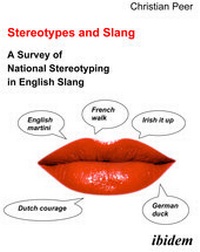
Stereotypes and Slang
A Survey of National Stereotyping in English Slang
1st Edition
Published on 24. February 2012
108 pages
978-3-8382-5715-0 (ISBN)
Description

The theoretical basis of this book is the assumption that stereotyping is a phenomenon which manifests itself primarily through language. It is further based on the observation that slang provides a large number of expressions that imply particular stereotypes.
The focus lies on investigating the nature of both stereotyping and slang, illustrating the subject by a survey that analyses how certain national stereotypes are expressed in selected slang terms.
More details
Other editions
Additional editions
Book
10/2006
1st Edition
ibidem
€19.90
Shipment within 7-9 days
Person
Christian Peer studied English, Philosophy and Psychology and currently teaches in Innsbruck. He is also working at the Institute for English of Innsbruck University, focusing his research on the socio-linguistic Aspects of English dialects.
Content
- Intro
- 1 INTRODUCTION
- 2 STEREOTYPES AND STEREOTYPING
- 2.1 Theoretical Preliminaries
- 2.1.1 The Origin of the Term Stereotype
- 2.1.2 Lippmann's Concept of Stereotypes
- 2.1.3 Definition and Characteristics of Stereotypes
- 2.1.4 The Cognitive Approach to Stereotypes
- 2.1.4.1 The Resistance of Stereotypes to Change
- 2.1.5 Stereotypes and Culture
- 2.2 Stereotypes and Language
- 2.2.1 The Transmission of Stereotypes Through Language
- 2.2.2 The Maintenance of Stereotypes Through Language
- 2.2.2.1 The Linguistic Intergroup Bias
- 2.3 Stereotypes in Linguistics
- 2.3.1 Zybatow's Classification of Linguistic Stereotypes
- 2.3.1.1 Assoziationsstereotypen
- 2.4 Summary
- 3 NATIONAL STEREOTYPES
- 3.1 The Definition of Nation
- 3.2 The Relation Between National Stereotypes and National Identity
- 3.3 The Functions of National Stereotypes
- 3.4 The Study by Katz and Braly
- 3.4.1 The Results
- 3.5 Summary
- 4 SLANG
- 4.1 The History and Origins of Slang
- 4.2 Towards a Definition of Slang
- 4.2.1 What Slang is: Proper Definitions
- 4.2.2 What Slang is Not: An Alternative Approach
- 4.2.2.1 Slang is Not Colloquial
- 4.2.2.2 Slang is Not Dialect
- 4.2.2.3 Slang is Not Jargon
- 4.2.2.4 Slang is Not Argot
- 4.2.2.5 Slang is Not Cant
- 4.2.2.6 Slang is Not Taboo
- 4.3 The Position of Slang Within the English Vocabulary
- 4.4 The Characteristics of Slang
- 4.4.1 Slang is a Question of Vocabulary
- 4.4.2 Slang is Found in Spoken Language
- 4.4.3 Slang is Found in Informal Situations
- 4.4.4 Slang is a Relative Concept
- 4.4.5 Slang is Constantly Changing
- 4.4.6 Slang is Creative
- 4.5 How Slang Terms Enter the Language
- 4.6 The Usage of Slang: Linguistic Situations
- 4.7 The Functions of Slang
- 4.8 Slang - A Poetry of Its Own
- 4.8.1 Figurative Devices in Slang
- 4.9 Summary
- 5 ANALYSIS OF SLANG TERMS
- 5.1 Explanation of the Method Applied in the Analysis
- 5.2 Slang Terms Containing French Stereotypes
- 5.2.1 General Analysis
- 5.3 Slang Terms Containing Irish Stereotypes
- 5.3.1 General Analysis
- 5.4 Slang Terms Containing Dutch Stereotypes
- 5.4.1 General Analysis
- 5.5 Slang Terms Containing Jewish Stereotypes
- 5.5.1 General Analysis
- 5.6 Slang Terms Containing German Stereotypes
- 5.6.1 General Analysis
- 5.7 Slang Terms Containing English Stereotypes
- 5.7.1 General Analysis
- 6 CONCLUSION AND OUTLOOK
- 7 BIBLIOGRAPHY
