

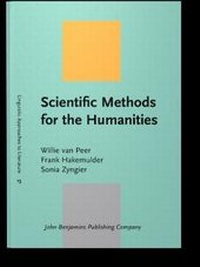
Scientific Methods for the Humanities
1st Edition
Published on 30. May 2012
XXII, 328 pages
978-90-272-7467-0 (ISBN)
Description

Here is a much needed introductory textbook on empirical research methods for the Humanities. Especially aimed at students and scholars of Literature, Applied Linguistics, and Film and Media, it stimulates readers to reflect on the problems and possibilities of testing the empirical assumptions and offers hands-on learning opportunities to develop empirical studies. It explains a wide range of methods, from interviews to observation research, and guides readers through the choices researchers have to make. It discusses the essence of experiments, illustrates how studies are designed, how to develop questionnaires, and helps readers to collect and analyze data by themselves. The book presents qualitative approaches to research but focuses mostly on quantitative methods, detailing the workings of basic statistics. At the end, the book also shows how to give papers at international conferences, how to draft a report, and what is involved in the preparation of a publishable article.
More details
Other editions
Additional editions
Willie van Peer | Frank Hakemulder | Sonia Zyngier
Scientific Methods for the Humanities
Book
05/2012
John Benjamins Publishing Co
€104.94
Shipment within 10-15 days
Persons
Content
- Scientific Methods for the Humanities
- Editorial page
- Title page
- LCC data
- Dedication page
- Table of contents
- List of Figures, Tables and Graphs
- Acknowledgements
- Foreword
- A new beginning
- 1.1 Understanding versus explaining
- 1.2 Some problems
- 1.3 Two cultures?
- 1.4 The scientific study of meaning
- 1.5 A visit to Wundt's laboratory
- 1.6 The Wundt curve
- 1.7 Empirical aesthetics
- 1.8 The Clockwork Muse
- 1.9 Complexity
- 1.10 Why methodology?
- Assignment
- To be carried out before turning to chapter two
- Some misconceptions about scientific and empirical research of culture
- Basic insights from the philosophy of science
- 2.1 The word 'science'
- 2.2 Motion
- 2.3 Foundations
- 2.4 Contradictions
- 2.5 Predictions
- 2.6 An experiment
- 2.7 Comparison of theories
- 2.8 Critique
- 2.9 White swans, black swans
- 2.10 A three-stage model
- 2.11 Immune theories
- 2.12 The truth?
- 2.13 Research, an example
- 2.14 Conclusion
- Research methodology and design
- 3.1 Against monomethodology
- 3.2 Making a plan for research
- 3.2.1 Step 1
- 3.2.2 Step 2
- 3.2.3 Step 3
- 3.2.4 Step 4
- 3.2.5 Step 5
- 3.3 Laying out your conceptual model
- 3.3.1 Step 6
- 3.4 A study of the literature
- 3.4.1 Make a plan
- 3.4.2 Look for sources
- 3.4.3 PsycINFO
- 3.4.4 Evaluation
- Methods of data collection
- 4.1 Introduction
- 4.2 Observation research
- 4.2.1 Deciding on the type of observation research
- 4.2.2 Degree of researcher involvement
- 4.2.3 Reduce subject interactivity
- 4.2.4 How to avoid observer bias
- 4.3 Stages in the research
- 4.4 Think-aloud protocols
- 4.5 Diary
- 4.6 Interview
- 4.7 Focus groups
- 4.8 Experiment
- 4.9 Content analysis
- 4.10 Survey
- 4.10.1 Cross-section study
- 4.10.2 Panel study
- 4.10.3 Trend studies
- 4.10.4 Cohort studies
- 4.11 What is next?
- 4.12 Other sources
- 4.12.1 Observations
- 4.12.2 Electronic texts
- 4.12.3 Concordances
- 4.12.4 Analyzing qualitative research material
- How to construct a questionnaire
- 5.1 Introduction
- 5.2 Levels of measurement
- 5.3 Types of questions
- 5.3.1 Checklist
- 5.3.2 Multiple choice
- 5.3.3 Graphic rating scale
- 5.3.4 Itemized rating scale
- 5.3.5 Rank-order rating scale
- 5.3.6 Constant-sum rating scale and fractionation rating scale
- 5.3.7 Likert scale
- 5.3.8 Semantic differential scales
- 5.4 How to formulate a question?
- 5.5 Questionnaire design
- 5.6 Instruction
- 5.7 Layout
- 5.8 Procedure
- Experiment
- 6.1 Introduction
- 6.2 Independent and dependent variables
- 6.3 Designs
- 6.3.1 Between-subjects designs
- 6.3.2 Within-subjects designs
- 6.4 Building an experimental design
- 6.4.1 Extending on the classical experimental design
- 6.4.2 Doing the 'next best thing'
- 6.5 Control groups
- 6.6 Estimating validity
- 6.6.1 Internal validity
- 6.6.2 External validity
- How to enter and manipulate data in SPSS
- 7.1 Why use a computer program?
- 7.2 Start SPSS
- 7.3 Preparing the Variable View
- 7.4 Entering the data in data view
- 7.5 Manipulating data
- 7.5.1 Compute: making new variables based on your data
- 7.5.2 Recode: changing the values of your variables
- 7.5.3 Select Cases: doing analyses on a subset of your data
- 7.6 Closing SPSS
- Descriptive statistics
- 8.1 Two measures of descriptive statistics
- 8.2 Measures of central tendency
- 8.3 Measures of dispersion
- 8.4 The normal distribution
- 8.5 Two distributions
- 8.6 Descriptive statistics with spss
- 8.7 Cronbach's a
- 8.8 Graphs
- 8.8.1 Bar charts
- 8.8.2 Line graph
- 8.8.3 Boxplots
- 8.9 Final words
- Inference Statistics
- 9.1 Introduction
- 9.2 Errors
- 9.3 Region of rejection
- 9.4 Regression analysis
- 9.5 Correlations
- 9.6 Outlook
- Inference statistics
- 10.1 Which test(s) to choose?
- 10.2 t-test
- 10.3 Wilcoxon test for paired samples
- 10.4 Mann-whitney ('U-Test') for independent samples
- 10.5 The Kruskal-Wallis test
- 10.6 Non-parametric tests for related samples
- 10.7 Crosstabs
- 10.8 Overview
- Inference statistics
- 11.1 Analysis of variance
- 11.2 General Linear Model
- 11.3 Repeated measures
- 11.4 Conclusion
- Communicating results
- 12.1 Oral presentations
- 12.1.1 Submitting an abstract
- 12.1.2 Presenting yourself
- 12.1.3 Organizational aspects
- 12.1.4 Preparing a script
- 12.1.5 Speaking to an audience
- 12.1.6 Discussion time
- 12.1.7 Using media
- 12.2 Written presentations
- 12.2.1 Where to publish
- 12.2.2 Structuring your paper
- 12.2.2.1 Title page
- 12.2.2.2 Keywords
- 12.2.2.3 Abstract
- 12.2.2.4 Introduction
- 12.2.2.5 Method
- 12.2.2.6 Results
- 12.2.2.7 Discussion
- 12.2.3 Where to begin
- 12.2.4 Some stylistic reminders
- 12.2.4.1 Pronouns
- 12.2.4.2 Markers
- 12.2.4.3 Gender
- 12.2.4.4 Politeness
- 12.2.4.5 Tone
- 12.2.5 Sources and citing
- 12.2.5.1 Citing sources APA style
- 12.2.5.2 Citing sources MLA style
- 12.2.6 Some words of caution
- 12.2.7 Final checklist before submitting
- 12.2.8 Submitting your paper
- 12.3 Poster sessions
- 12.3.1 Preparations
- 12.3.2 Graphs, tables, illustrations
- 12.3.3 The text
- 12.3.4 Making the poster
- 12.4 Final words
- Epilogue
- Bibliography
- Notes on contributors
- Author index
