

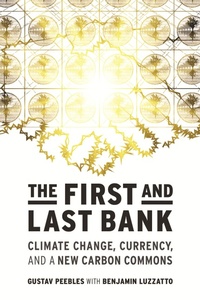
The First and Last Bank
Climate Change, Currency, and a New Carbon Commons
Published on 17. June 2025
318 pages
978-0-262-38233-5 (ISBN)
Description

A groundbreaking approach to currency and community that may allow us to seize carbon from the atmosphere-and offer a new tool in the fight against climate change.
Through the ages, currencies have been based on all manner of objects-from tobacco leaves to salt to gold to collateralized debt obligations. The only thing that this odd assortment of objects shares is the communal belief that these objects could harness and direct economic growth-that they are, in a sense, fertile. In The First and Last Bank, Gustav Peebles and Benjamin Luzzatto propose that atmospheric carbon could be seen anew as fertile in this same sense. In other words, carbon, rather than loom as waste in our skies, could instead be "drawn down" to the earth by millions of currency users and the communally owned banks they rely on, where it could serve as a foundation of new biological life.
Seeing currency as a powerful tool for collective action, the authors argue that dovetailing developments in digital currencies and the biosequestration of carbon have, together, made a new and radical intervention in the climate battle possible: a nonproprietary currency backed by sequestered carbon. This new currency would be managed via Wikipedia-style open-source policies that privilege sustainability and equity over endless growth and pollution. Because it is backed by sequestered carbon, the use of the currency would draw gaseous carbon out of the atmosphere and push it back into the ground, following the exact same trajectory as gold during the era of the international gold standard. While it is no silver bullet, such a currency would act as a necessary complement to wide-scale mitigation efforts, at the same time engaging ordinary citizens in the fight to reduce the dangerous levels of carbon in our atmosphere.
Through the ages, currencies have been based on all manner of objects-from tobacco leaves to salt to gold to collateralized debt obligations. The only thing that this odd assortment of objects shares is the communal belief that these objects could harness and direct economic growth-that they are, in a sense, fertile. In The First and Last Bank, Gustav Peebles and Benjamin Luzzatto propose that atmospheric carbon could be seen anew as fertile in this same sense. In other words, carbon, rather than loom as waste in our skies, could instead be "drawn down" to the earth by millions of currency users and the communally owned banks they rely on, where it could serve as a foundation of new biological life.
Seeing currency as a powerful tool for collective action, the authors argue that dovetailing developments in digital currencies and the biosequestration of carbon have, together, made a new and radical intervention in the climate battle possible: a nonproprietary currency backed by sequestered carbon. This new currency would be managed via Wikipedia-style open-source policies that privilege sustainability and equity over endless growth and pollution. Because it is backed by sequestered carbon, the use of the currency would draw gaseous carbon out of the atmosphere and push it back into the ground, following the exact same trajectory as gold during the era of the international gold standard. While it is no silver bullet, such a currency would act as a necessary complement to wide-scale mitigation efforts, at the same time engaging ordinary citizens in the fight to reduce the dangerous levels of carbon in our atmosphere.
More details
Other editions
Additional editions
Gustav Peebles | Benjamin Luzzatto
The First and Last Bank
Climate Change, Currency, and a New Carbon Commons
Book
06/2025
MIT Press
€45.00
Shipment within 10-20 days
Person
Gustav Peebles is Associate Professor of Anthropology at Stockholm University. His research is focused on the history of monetary policy.
Ben Luzzatto is an interdisciplinary artist and professor at the Maryland Institute College of Art in Baltimore. His work draws from a variety of fields, including sculpture, ecology, architecture, and object design.
Ben Luzzatto is an interdisciplinary artist and professor at the Maryland Institute College of Art in Baltimore. His work draws from a variety of fields, including sculpture, ecology, architecture, and object design.
