

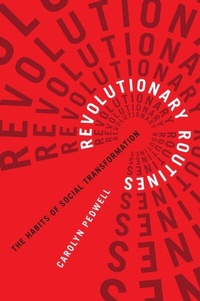
Revolutionary Routines
The Habits of Social Transformation
1st Edition
Published on 1. May 2021
249 pages
978-0-2280-0761-6 (ISBN)
Description

Although we tend to associate social transformation with major events, historical turning points, or revolutionary upheaval, Revolutionary Routines argues that seemingly minor everyday habits are the key to meaningful change.
Through its account of influential socio-political processes - such as the resurgence of fascism and white supremacy, the crafting of new technologies of governance, and the operation of digital media and algorithms - this book rethinks not only how change works, but also what counts as change. Drawing examples from the affective politics of Trumpism and Brexit, nudge theory and behaviour change, social media and the international refugee crisis, and the networked activism of Occupy and Black Lives Matter, Carolyn Pedwell argues that minor gestures may be as significant as major happenings, revealing the powerful potential in our ability to remake shared habits and imaginatively reinhabit everyday life.
Revolutionary Routines offers a new understanding of the logics of habit and the nature of social change, power, and progressive politics, illustrating diverse forms of consciousness and co-operation through which political solidarities might take shape.
Through its account of influential socio-political processes - such as the resurgence of fascism and white supremacy, the crafting of new technologies of governance, and the operation of digital media and algorithms - this book rethinks not only how change works, but also what counts as change. Drawing examples from the affective politics of Trumpism and Brexit, nudge theory and behaviour change, social media and the international refugee crisis, and the networked activism of Occupy and Black Lives Matter, Carolyn Pedwell argues that minor gestures may be as significant as major happenings, revealing the powerful potential in our ability to remake shared habits and imaginatively reinhabit everyday life.
Revolutionary Routines offers a new understanding of the logics of habit and the nature of social change, power, and progressive politics, illustrating diverse forms of consciousness and co-operation through which political solidarities might take shape.
Reviews / Votes
"There is very much to commend the book to a readership, but for me, the most important aspect is the way it adds to the literature that explores the 'minor politics' of the event. By recasting social change in a minor key, other actors, environments and practices come into focus. Pedwell's book demonstrates, with great acuity, the importance of the transformation of habitual relations to a project of social change. This minor politics is essential not simply in and of itself, but also because it runs through (perhaps even constitutes) the event of constituent power. In this way, Revolutionary Routines provides fresh resources for anyone who seeks to explore the question of constituent power, protest and social movement. It is well worth a read." Critical Legal Thinking "Revolutionary Routines is a quintessentially philosophical text, which offers possibilities for rethinking our understanding of the habitual nature of social oppression in its various guises. [Pedwell's] exploration of how popular culture, media, government techniques and digital ecologies are reshaping the mind, bodies and environment in ways that affect the conditions of political possibility remains an important endeavour." LSE Review of Books "Revolutionary Routines: The Habits of Social Transformation will be useful reading for scholars, practitioners and activists working on social change and transformation, particularly as they engage with the continuing negotiations and ambivalence of social change. To fully engage with the potential of Carolyn Pedwell's book, however, it is crucial to actively consider the nature and influence of institutionalised and contextualised power, especially its ability to stall progressive politics and transformation." The Sociological Review "This is a valuable project, and Pedwell's processual thinking is a fruitful ground for her inquiries. She reminds us that Dewey argued that successful revolutions require cultivating the needed 'habits of thought.'" Theory & Event "Revolutionary Routines: The Habits of Social Transformation is ultimately and necessarily a call for speculative intervention, politics, and modes of praxis - an invitation to continue affecting, practising, and theorizing a world otherwise. As such, Pedwell's book offers a substantial contribution to what the author identifies as the "emergent critical return to habit" and to the transdisciplinary field of affect studies." University of Toronto QuarterlyMore details
Series
Language
English
Place of publication
Montreal, QC
Canada
Target group
Professional and scholarly
Edition type
Digital original
File size
1,58 MB
ISBN-13
978-0-2280-0761-6 (9780228007616)
Copyright in bibliographic data and cover images is held by Nielsen Book Services Limited or by the publishers or by their respective licensors: all rights reserved.
Schweitzer Classification
Other editions
Additional editions

Book
05/2021
McGill-Queen's University Press
€35.00
Shipment within 15-20 days
Book
05/2021
McGill-Queen's University Press
€154.50
Article not available at the moment
Person
Carolyn Pedwell is associate professor of cultural studies, University of Kent.
Content
- Cover
- REVOLUTIONARY ROUTINES
- Title
- Copyright
- CONTENTS
- Acknowledgments
- Preface
- Introduction: Social Change in a Minor Key
- 1 Affective Habits
- 2 Habits in Crisis
- 3 Governing Habits
- 4 Mediated Habits
- 5 Habits of Solidarity
- Conclusion: Inhabiting the Pandemic
- Notes
- Bibliography
- Index
