

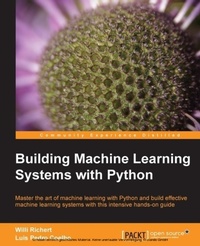
Building Machine Learning Systems with Python
Expand your Python knowledge and learn all about machine-learning libraries in this user-friendly manual. ML is the next big breakthrough in technology and this book will give you the head-start you need.
1st Edition
Published on 3. June 2024
290 pages
978-1-78216-141-7 (ISBN)
Description

Expand your Python knowledge and learn all about machine-learning libraries in this user-friendly manual. ML is the next big breakthrough in technology and this book will give you the head-start you need.Key Features - Master Machine Learning using a broad set of Python libraries and start building your own Python-based ML systems
- Covers classification, regression, feature engineering, and much more guided by practical examples
- A scenario-based tutorial to get into the right mind-set of a machine learner (data exploration) and successfully implement this in your new or existing projects
Book DescriptionMachine learning, the field of building systems that learn from data, is exploding on the Web and elsewhere. Python is a wonderful language in which to develop machine learning applications. As a dynamic language, it allows for fast exploration and experimentation and an increasing number of machine learning libraries are developed for Python.Building Machine Learning system with Python shows you exactly how to find patterns through raw data. The book starts by brushing up on your Python ML knowledge and introducing libraries, and then moves on to more serious projects on datasets, Modelling, Recommendations, improving recommendations through examples and sailing through sound and image processing in detail. Using open-source tools and libraries, readers will learn how to apply methods to text, images, and sounds. You will also learn how to evaluate, compare, and choose machine learning techniques. Written for Python programmers, Building Machine Learning Systems with Python teaches you how to use open-source libraries to solve real problems with machine learning. The book is based on real-world examples that the user can build on. Readers will learn how to write programs that classify the quality of StackOverflow answers or whether a music file is Jazz or Metal. They will learn regression, which is demonstrated on how to recommend movies to users. Advanced topics such as topic modeling (finding a text's most important topics), basket analysis, and cloud computing are covered as well as many other interesting aspects.Building Machine Learning Systems with Python will give you the tools and understanding required to build your own systems, which are tailored to solve your problems.What you will learn - Build a classification system that can be applied to text, images, or sounds
- Use scikit-learn, a Python open-source library for machine learning
- Explore the mahotas library for image processing and computer vision
- Build a topic model of the whole of Wikipedia
- Get to grips with recommendations using the basket analysis
- Use the Jug package for data analysis
- Employ Amazon Web Services to run analyses on the cloud
- Recommend products to users based on past purchases
Who this book is forThis book is for Python programmers who are beginners in machine learning, but want to learn Machine learning. Readers are expected to know Python and be able to install and use open-source libraries. They are not expected to know machine learning, although the book can also serve as an introduction to some Python libraries for readers who know machine learning. This book does not go into the detail of the mathematics behind the algorithms.This book primarily targets Python developers who want to learn and build machine learning in their projects, or who want to provide machine learning support to their existing projects, and see them getting implemented effectively.
- Covers classification, regression, feature engineering, and much more guided by practical examples
- A scenario-based tutorial to get into the right mind-set of a machine learner (data exploration) and successfully implement this in your new or existing projects
Book DescriptionMachine learning, the field of building systems that learn from data, is exploding on the Web and elsewhere. Python is a wonderful language in which to develop machine learning applications. As a dynamic language, it allows for fast exploration and experimentation and an increasing number of machine learning libraries are developed for Python.Building Machine Learning system with Python shows you exactly how to find patterns through raw data. The book starts by brushing up on your Python ML knowledge and introducing libraries, and then moves on to more serious projects on datasets, Modelling, Recommendations, improving recommendations through examples and sailing through sound and image processing in detail. Using open-source tools and libraries, readers will learn how to apply methods to text, images, and sounds. You will also learn how to evaluate, compare, and choose machine learning techniques. Written for Python programmers, Building Machine Learning Systems with Python teaches you how to use open-source libraries to solve real problems with machine learning. The book is based on real-world examples that the user can build on. Readers will learn how to write programs that classify the quality of StackOverflow answers or whether a music file is Jazz or Metal. They will learn regression, which is demonstrated on how to recommend movies to users. Advanced topics such as topic modeling (finding a text's most important topics), basket analysis, and cloud computing are covered as well as many other interesting aspects.Building Machine Learning Systems with Python will give you the tools and understanding required to build your own systems, which are tailored to solve your problems.What you will learn - Build a classification system that can be applied to text, images, or sounds
- Use scikit-learn, a Python open-source library for machine learning
- Explore the mahotas library for image processing and computer vision
- Build a topic model of the whole of Wikipedia
- Get to grips with recommendations using the basket analysis
- Use the Jug package for data analysis
- Employ Amazon Web Services to run analyses on the cloud
- Recommend products to users based on past purchases
Who this book is forThis book is for Python programmers who are beginners in machine learning, but want to learn Machine learning. Readers are expected to know Python and be able to install and use open-source libraries. They are not expected to know machine learning, although the book can also serve as an introduction to some Python libraries for readers who know machine learning. This book does not go into the detail of the mathematics behind the algorithms.This book primarily targets Python developers who want to learn and build machine learning in their projects, or who want to provide machine learning support to their existing projects, and see them getting implemented effectively.
All prices
More details
Other editions
New editions
Luis Pedro Coelho | Matthieu Brucher
Building Machine Learning Systems with Python
Explore machine learning and deep learning techniques for building intelligent systems using scikit-learn and TensorFlow
E-Book
07/2018
3rd Edition
De Gruyter
€31.49
Available for download
Additional editions
Willi Richert | Luis Pedro Coelho
Building Machine Learning Systems with Python
Expand your Python knowledge and learn all about machine-learning libraries in this user-friendly manual. ML is the next big breakthrough in technology and this book will give you the head-start you need.
Book
03/2013
Packt Publishing
€63.00
Shipment within 3-4 weeks
Content
Table of Contents

