

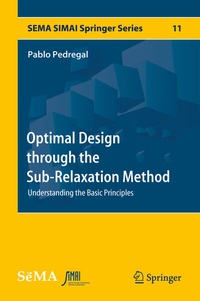
Optimal Design through the Sub-Relaxation Method
Description

This book provides a comprehensive guide to analyzing and solving optimal design problems in continuous media by means of the so-called sub-relaxation method. Though the underlying ideas are borrowed from other, more classical approaches, here they are used and organized in a novel way, yielding a distinct perspective on how to approach this kind of optimization problems. Starting with a discussion of the background motivation, the book broadly explains the sub-relaxation method in general terms, helping readers to grasp, from the very beginning, the driving idea and where the text is heading. In addition to the analytical content of the method, it examines practical issues like optimality and numerical approximation. Though the primary focus is on the development of the method for the conductivity context, the book's final two chapters explore several extensions of the method to other problems, as well as formal proofs. The text can be used for a graduate course in optimal design, even if the method would require some familiarity with the main analytical issues associated with this type of problems. This can be addressed with the help of the provided bibliography.
Reviews / Votes
"The book is devoted to the study of optimal design problems . . The book is very well written, with problems clearly presented; it can provide a good starting point for any researcher who wants to approach the field of optimal design problems, from both the theoretical side and the applied side. The book could also be used as a textbook for master or graduate courses." (Giuseppe Buttazzo, Mathematical Reviews, June, 2017)More details
Other editions
Additional editions
Content
1 Motivation and framework.- 2 Our approach.- 3 Relaxation through moments.- 4 Optimality.- 5 Simulation.- 6 Some extensions.- 7 Some technical proofs.
