

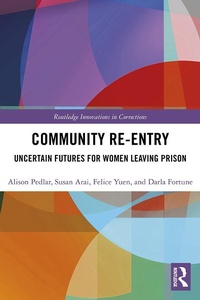
Community Re-Entry
Uncertain Futures for Women Leaving Prison
Published on 19. January 2018
196 pages
978-1-351-20446-0 (ISBN)
Description

In their journeys to prison and community re-entry, women leaving prison tend to share overarching challenges connected to lives of poverty, trauma, and abuse. Community Re-Entry: Uncertain Futures for Women Leaving Prison provides a rare opportunity to hear directly from women who have spent time in a Canadian federal penitentiary. Based on more than a decade of engagement with women in prison, the authors gathered rich and personal information on women's lived experiences during incarceration and what they anticipated and hoped for on release. This book relates their narratives and the authors' critical analysis of their experiences both within and outside prison. By bridging relational and other critical theories (critical feminist, critical race, critical disability, and post-structural understandings) with lived experience, this volume sheds light on the challenges incarcerated women face as they seek to return to the community as valued and contributing citizens.
Community Re-Entry's unique perspective on women's post-imprisonment policy will appeal to academics, community-based advocates and activists, and undergraduate and postgraduate students studying criminology and social science courses on gender and crime, correctional policy, and qualitative research methods.
Community Re-Entry's unique perspective on women's post-imprisonment policy will appeal to academics, community-based advocates and activists, and undergraduate and postgraduate students studying criminology and social science courses on gender and crime, correctional policy, and qualitative research methods.
Reviews / Votes
"Community Re-entry is an invaluable contribution and compelling must-read not only in academic scholarship, but also to all front-line workers in community social services devoted to work with marginalized and isolated criminalized women, and those at-risk of criminalization. Merging several theoretical frameworks - relational, post-structuralism, critical feminist, disability and race theories - allows the researchers to contextualize what are often pathologized needs and risk factors. It further permits a critical evaluation of what are often characterized as new and innovative terms, such as empowerment, as continuing the retributive patterns such language sought to redress originally. The findings corroborate many found in this body of literature - uniquely gendered pathways, systemic forces guiding a woman's 'choices,' and the intersecting needs to be addressed - with perfect articulation and context 28 years after Creating Choices was published. As a community agency devoted to the integration of women, this research supports the value of our ongoing quest toward meaningful, supportive connections and sense of belonging for all women." - The Elizabeth Fry Society of Kingston (Stacey Alarie, Programs Administrator)"Pedlar, Arai, Yuen and Fortune offer readers an urgently-needed examination of women's experiences in the Canadian federal correctional system and emerging from it. A rare, 10-year longitudinal study with impeccable scholarship, the book prioritizes the insights, voices and analyses of women who are themselves navigating the system. Community Re-Entry: Uncertain Futures for Women Leaving Prison is a must-read, and I hope we all listen to its recommendations!" - Simone Weil Davis, Associate Director of Ethics, Society & Law at Trinity College, the University of Toronto; co-founder of the Walls to Bridges program at Wilfrid Laurier University, Kitchener
"A place to call home, a fairly compensated job, connections to family and friends, a regard for one's personhood and the sense that one matters all have the power to stop the revolving door we have become so tragically accustomed to in our correctional system. The book not only gives voice to those rarely heard (women inside corrections) it also amplifies basic principles of justice and common sense that have been lost to ill-conceived notions of evil. The evidence on what we need to do to succeed in rehabilitation is well documented, not new and surprisingly simple: If getting out means you enter the "nowhere society," staying out is almost impossible. Instead, being valued, having the chance to meaningfully contribute to community, being included, being met with authenticity and compassion and having your basic needs met are our most powerful tools for change. They are also the very essence or upstream prevention. This book shines a light on the shadow sides of incarceration that follow on the heels of decades of neglect of knowledge in an attempt to cater to a perceived vengeful public." - Christiane Sadeler, Executive Director, Waterloo Region Crime Prevention Council "Community Re-entry is an invaluable contribution and compelling must-read not only in academic scholarship, but also to all front-line workers in community social services devoted to work with marginalized and isolated criminalized women, and those at-risk of criminalization. Merging several theoretical frameworks - relational, post-structuralism, critical feminist, disability and race theories - allows the researchers to contextualize what are often pathologized needs and risk factors. It further permits a critical evaluation of what are often characterized as new and innovative terms, such as empowerment, as continuing the retributive patterns such language sought to redress originally. The findings corroborate many found in this body of literature - uniquely gendered pathways, systemic forces guiding a woman's 'choices,' and the intersecting needs to be addressed - with perfect articulation and context 28 years after Creating Choices was published. As a community agency devoted to the integration of women, this research supports the value of our ongoing quest toward meaningful, supportive connections and sense of belonging for all women." - The Elizabeth Fry Society of Kingston (Stacey Alarie, Programs Administrator)
"Pedlar, Arai, Yuen and Fortune offer readers an urgently-needed examination of women's experiences in the Canadian federal correctional system and emerging from it. A rare, 10-year longitudinal study with impeccable scholarship, the book prioritizes the insights, voices and analyses of women who are themselves navigating the system. Community Re-Entry: Uncertain Futures for Women Leaving Prison is a must-read, and I hope we all listen to its recommendations!" - Simone Weil Davis, Associate Director of Ethics, Society & Law at Trinity College, the University of Toronto; co-founder of the Walls to Bridges program at Wilfrid Laurier University, Kitchener
"A place to call home, a fairly compensated job, connections to family and friends, a regard for one's personhood and the sense that one matters all have the power to stop the revolving door we have become so tragically accustomed to in our correctional system. The book not only gives voice to those rarely heard (women inside corrections) it also amplifies basic principles of justice and common sense that have been lost to ill-conceived notions of evil. The evidence on what we need to do to succeed in rehabilitation is well documented, not new and surprisingly simple: If getting out means you enter the "nowhere society," staying out is almost impossible. Instead, being valued, having the chance to meaningfully contribute to community, being included, being met with authenticity and compassion and having your basic needs met are our most powerful tools for change. They are also the very essence or upstream prevention. This book shines a light on the shadow sides of incarceration that follow on the heels of decades of neglect of knowledge in an attempt to cater to a perceived vengeful public." - Christiane Sadeler, Executive Director, Waterloo Region Crime Prevention Council
More details
Series
Language
English
Place of publication
London
United Kingdom
Publishing group
Taylor & Francis Ltd
Target group
Professional and scholarly
College/higher education
Illustrations
2 Tables, black and white; 2 Line drawings, black and white; 2 Illustrations, black and white
File size
2,23 MB
ISBN-13
978-1-351-20446-0 (9781351204460)
Copyright in bibliographic data and cover images is held by Nielsen Book Services Limited or by the publishers or by their respective licensors: all rights reserved.
Schweitzer Classification
Other editions
Additional editions
Alison Pedlar | Susan Arai | Felice Yuen
Community Re-Entry
Uncertain Futures for Women Leaving Prison
Book
09/2019
1st Edition
Routledge
€67.80
Shipment within 15-20 days

Book
04/2018
Routledge
€50.55
No shipping information available
Alison Pedlar | Susan Arai | Felice Yuen
Community Re-Entry
Uncertain Futures for Women Leaving Prison
Book
02/2018
1st Edition
Routledge
€231.40
Shipment within 15-20 days
Persons
Alison Pedlar is a Distinguished Professor Emerita, University of Waterloo, Ontario. Alison has broad applied research and practical experience in issues related to disability, aging, and leisure services in Canada. Her teaching and research activity focused on social policy, planning, and development of human services. Much of her work was conducted within a participatory and collaborative research framework, and included community development work with older adults, individuals with disabilities, criminalized women, and other marginalized populations. Her primary research program was concerned with community, citizenship, social justice, and rights.
Susan Arai is a registered psychotherapist and Adjunct Professor in Recreation and Leisure Studies at the University of Waterloo, Ontario. During Sue's 20-year career in the departments of Community Health Sciences (Brock University) and Leisure Studies (University of Waterloo) her writing and practice focused on mindfulness, healing and transformation in the aftermath of trauma, navigations of oppression and marginalization within social systems and institutions, community inclusion, critical pedagogy, and reflective practice. Sue has worked and conducted research in health and human services with hospitals, municipal and regional governments, federal corrections, community health centers, healthy-communities initiatives, social-planning councils, and disability organizations. She is currently in private practice and a clinical member of the Ontario Society of Psychotherapists. She has received training in relational psychotherapy, Psych-K (R), mindfulness-based stress reduction (R), mindfulness-based cognitive therapy, and sensorimotor psychotherapy.
Darla Fortune is an Assistant Professor at Concordia University in Montreal, Quebec. Her research is embedded in a concern for social justice and aims to create positive change in the lives of people most at risk of experiencing exclusion from community. In past research, Darla engaged with women who entered community after a period of incarceration to critically examine the notion of inclusion for individuals who often experience chronic marginalization. Themes of inclusion and social justice have been carried into Darla's research within the contexts of dementia and long-term care. In this realm, Darla strives to counter dehumanizing care practices dominated by medical and institutional models of care by emphasizing the need for a cultural shift that embraces relational approaches. A belief in the capacity of individuals who are marginalized to create positive social change drives Darla's research program.
Felice Yuen is an Associate Professor at Concordia University in Montreal, Quebec, in the Department of Applied Human Sciences. Broadly, her research encompasses healing, social justice, and community development. She often employs arts-based approaches in her research. Her work with the Native Sisterhood, an Indigenous women's group in a federal prison, and with Journey Women, a group of women dedicated to exploring and advocating for Indigenous women's healing, has led to publications in Critical Criminology, Arts in Psychotherapy, Leisure Sciences, and the Journal of Leisure Research.
Susan Arai is a registered psychotherapist and Adjunct Professor in Recreation and Leisure Studies at the University of Waterloo, Ontario. During Sue's 20-year career in the departments of Community Health Sciences (Brock University) and Leisure Studies (University of Waterloo) her writing and practice focused on mindfulness, healing and transformation in the aftermath of trauma, navigations of oppression and marginalization within social systems and institutions, community inclusion, critical pedagogy, and reflective practice. Sue has worked and conducted research in health and human services with hospitals, municipal and regional governments, federal corrections, community health centers, healthy-communities initiatives, social-planning councils, and disability organizations. She is currently in private practice and a clinical member of the Ontario Society of Psychotherapists. She has received training in relational psychotherapy, Psych-K (R), mindfulness-based stress reduction (R), mindfulness-based cognitive therapy, and sensorimotor psychotherapy.
Darla Fortune is an Assistant Professor at Concordia University in Montreal, Quebec. Her research is embedded in a concern for social justice and aims to create positive change in the lives of people most at risk of experiencing exclusion from community. In past research, Darla engaged with women who entered community after a period of incarceration to critically examine the notion of inclusion for individuals who often experience chronic marginalization. Themes of inclusion and social justice have been carried into Darla's research within the contexts of dementia and long-term care. In this realm, Darla strives to counter dehumanizing care practices dominated by medical and institutional models of care by emphasizing the need for a cultural shift that embraces relational approaches. A belief in the capacity of individuals who are marginalized to create positive social change drives Darla's research program.
Felice Yuen is an Associate Professor at Concordia University in Montreal, Quebec, in the Department of Applied Human Sciences. Broadly, her research encompasses healing, social justice, and community development. She often employs arts-based approaches in her research. Her work with the Native Sisterhood, an Indigenous women's group in a federal prison, and with Journey Women, a group of women dedicated to exploring and advocating for Indigenous women's healing, has led to publications in Critical Criminology, Arts in Psychotherapy, Leisure Sciences, and the Journal of Leisure Research.
Content
1. Incarceration and Community Re-Entry for Women. 2. Studying Community Re-Entry for Federally Sentenced Women. 3. Defining Aspects of Everyday Life: Poverty, Trauma, and Substance-Dependence. 4. The Downward Spiral of Prison Life. 5. Finding Identity. 6. Getting Out and Staying Out.
