

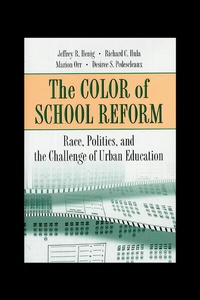
The Color of School Reform
Race, Politics, and the Challenge of Urban Education
1st Edition
Published on 22. January 2001
320 pages
978-1-4008-2329-1 (ISBN)
Description

Why is it so difficult to design and implement fundamental educational reform in large city schools in spite of broad popular support for change? How does the politics of race complicate the challenge of building and sustaining coalitions for improving urban schools? These questions have provoked a great deal of theorizing, but this is the first book to explore the issues on the basis of extensive, solid evidence. Here a group of political scientists examines education reform in Atlanta, Baltimore, Detroit, and Washington, D.C., where local governmental authority has passed from white to black leaders. The authors show that black administrative control of big-city school systems has not translated into broad improvements in the quality of public education within black-led cities. Race can be crucial, however, in fostering the broad civic involvement perhaps most needed for school reform.
In each city examined, reform efforts often arise but collapse, partly because leaders are unable to craft effective political coalitions that would commit community resources to a concrete policy agenda. What undermines the leadership, according to the authors, is the complex role of race in each city. First, public authority does not guarantee access to private resources, usually still controlled by white economic elites. Second, local authorities must interact with external actors, at the state and national levels, who remain predominantly white. Finally, issues of race divide the African American community itself and often place limits on what leaders can and cannot do. Filled with insightful explanations together with recommendations for policy change, this book is an important component of the debate now being waged among researchers, education activists, and the community as a whole.
In each city examined, reform efforts often arise but collapse, partly because leaders are unable to craft effective political coalitions that would commit community resources to a concrete policy agenda. What undermines the leadership, according to the authors, is the complex role of race in each city. First, public authority does not guarantee access to private resources, usually still controlled by white economic elites. Second, local authorities must interact with external actors, at the state and national levels, who remain predominantly white. Finally, issues of race divide the African American community itself and often place limits on what leaders can and cannot do. Filled with insightful explanations together with recommendations for policy change, this book is an important component of the debate now being waged among researchers, education activists, and the community as a whole.
More details
Other editions
Additional editions
Jeffrey R. Henig | Richard C. Hula | Marion Orr
The Color of School Reform
Race, Politics, and the Challenge of Urban Education
Book
02/2001
Princeton University Press
€49.10
Article not available at the moment
Jeffrey R. Henig | Richard C. Hula | Marion Orr
The Color of School Reform
Race, Politics, and the Challenge of Urban Education
Book
08/1999
Princeton University Press
€55.80
Article exhausted; check different version
Persons
Jeffrey R. Henig is Professor of Political Science and Director of the Center for Washington Area Studies at George Washington University. His books include Rethinking School Choice (Princeton). Richard C. Hula is Professor of Political Science and Urban Affairs at Michigan State University and is the author of Market-Based Public Policy and The Reconstruction of Family Policy.
Marion Orr is Associate Professor of Political Science and Urban Studies at Brown University and is the author of Black Social Capital: The Politics of School Reform in Baltimore, 1986-1998. Desiree S. Pedescleaux is Assistant Professor of Political Science at Spelman College.
Marion Orr is Associate Professor of Political Science and Urban Studies at Brown University and is the author of Black Social Capital: The Politics of School Reform in Baltimore, 1986-1998. Desiree S. Pedescleaux is Assistant Professor of Political Science at Spelman College.
Content
List of Figures ix
List of Tables xi
Acknowledgments xiii
Chapter One Civic Capacity, Race, and Education in Black-Led Cities 3
The Challenge of Urban Education 9
Reforms That Go Nowhere 12
Civic Capacity: Organizing Communities to Get Things Done 14
A Tough Task: Why Human Development May Be More Difficult than Economic Development 15
Competing Views of Race and School Politics 17
Research Design 22
The Plan of the Book 26
Chapter Two Racial Change and the Politics of Transition 30
Patterns of Racial Turnover in Atlanta, Baltimore, Detroit, and D.C. 31
Racial Transition and Political Change: The Rise of Black Political Power 33
Managing School Desegregation 41
Political Compromise and Transition: The Evolution of Black-led School Districts 50
The Political Landscape in Black-Led Cities: From Formal to Informal Power 55
Conclusion: Historical Legacies and Racial Politics 61
Chapter Three The Elusiveness of Education Reform 63
The Condition of Education: Poor Performance and Even Poorer Conditions 65
Local Problem Definitions: A Favorable Foundation for Reform 71
An Array of Reform Efforts 74
The Frustration of Reform 82
Why Is Reform So Difficult? 113
Chapter Four Race and the Political Economy of Big-City Schools: Teachers and Preachers 115
Race, jobs, and Politics 118
Unions and Reform 127
Black Ministers and School Affairs: 1960-1980 137
Reform with Teachers and jobs in Mind 152
Chapter Five Parental and Community Participation in Education Reform 155
What Kind of Participation and on Whose Terms? 158
Patterns of Participation in Black-Led Cities 164
The Dog That Hasn't Barked: Accounting for the Absence of a Stronger Community-Based Movement 189
Fizzled Expectations 207
Chapter Six Black Leaders, White Businesses: Racial Tensions and the Construction of Public-Private Partnerships in Education 209
Business-School Partnerships: The Rallying Cry 212
Some Cautionary Notes 217
Business and School Reform in Black-Led Cities 220
Race As an Inhibiting Factor to Business Involvement 235
Partnerships and Racial Politics in Black-Led Cities 243
Chapter Seven The Role of External Actors 247
Traditional Roles of External Actors 249
Growing Regulatory Assertiveness of External Actors 252
The Changing Role of the Courts 255
Current Issues and Interventions 257
Variations in State Policy 266
Local Capacity and External Actors 271
Chapter Eight School Reform As If Politics and Race Matter 273
Race As a Complicating Factor in the Politics of School Reform 275
Education Policy As If Politics and Race Matter 279
Prospects for a Human Capital Regime 290
Index 293
List of Tables xi
Acknowledgments xiii
Chapter One Civic Capacity, Race, and Education in Black-Led Cities 3
The Challenge of Urban Education 9
Reforms That Go Nowhere 12
Civic Capacity: Organizing Communities to Get Things Done 14
A Tough Task: Why Human Development May Be More Difficult than Economic Development 15
Competing Views of Race and School Politics 17
Research Design 22
The Plan of the Book 26
Chapter Two Racial Change and the Politics of Transition 30
Patterns of Racial Turnover in Atlanta, Baltimore, Detroit, and D.C. 31
Racial Transition and Political Change: The Rise of Black Political Power 33
Managing School Desegregation 41
Political Compromise and Transition: The Evolution of Black-led School Districts 50
The Political Landscape in Black-Led Cities: From Formal to Informal Power 55
Conclusion: Historical Legacies and Racial Politics 61
Chapter Three The Elusiveness of Education Reform 63
The Condition of Education: Poor Performance and Even Poorer Conditions 65
Local Problem Definitions: A Favorable Foundation for Reform 71
An Array of Reform Efforts 74
The Frustration of Reform 82
Why Is Reform So Difficult? 113
Chapter Four Race and the Political Economy of Big-City Schools: Teachers and Preachers 115
Race, jobs, and Politics 118
Unions and Reform 127
Black Ministers and School Affairs: 1960-1980 137
Reform with Teachers and jobs in Mind 152
Chapter Five Parental and Community Participation in Education Reform 155
What Kind of Participation and on Whose Terms? 158
Patterns of Participation in Black-Led Cities 164
The Dog That Hasn't Barked: Accounting for the Absence of a Stronger Community-Based Movement 189
Fizzled Expectations 207
Chapter Six Black Leaders, White Businesses: Racial Tensions and the Construction of Public-Private Partnerships in Education 209
Business-School Partnerships: The Rallying Cry 212
Some Cautionary Notes 217
Business and School Reform in Black-Led Cities 220
Race As an Inhibiting Factor to Business Involvement 235
Partnerships and Racial Politics in Black-Led Cities 243
Chapter Seven The Role of External Actors 247
Traditional Roles of External Actors 249
Growing Regulatory Assertiveness of External Actors 252
The Changing Role of the Courts 255
Current Issues and Interventions 257
Variations in State Policy 266
Local Capacity and External Actors 271
Chapter Eight School Reform As If Politics and Race Matter 273
Race As a Complicating Factor in the Politics of School Reform 275
Education Policy As If Politics and Race Matter 279
Prospects for a Human Capital Regime 290
Index 293
