

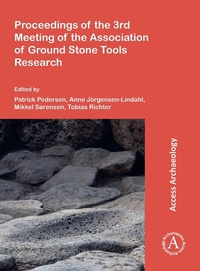
Proceedings of the 3rd Meeting of the Association of Ground Stone Tools Research
Published on 6. January 2022
274 pages
978-1-78969-479-6 (ISBN)
Description

Ground Stone Tools and Past Foodways brings together a selection of papers presented at the 3rd meeting of the Association of Ground Stone Tools Research, which was held at the University of Copenhagen in 2019. Ground stone artefacts are one of the most enduring classes of material culture: first used by Palaeolithic gatherer-hunters, they are still used regularly by people in many parts of the world to grind, mash and pulverize plants, meat and minerals. As such, ground stone artefacts provide a well preserved record at the nexus of interaction between humans, plants and animals. The papers in this volume focus especially on the relationship between ground stone artefacts and foodways and include archaeological and ethnographic case studies ranging from the Palaeolithic to the current era, and geographically from Africa to Europe and Asia. They reflect the current state of the art in ground stone tool research and highlight the many ways in which foodways can be studied through holistic examinations of ground stone artefacts.
More details
Language
English
Place of publication
Oxford
United Kingdom
Target group
Professional and scholarly
File size
19,24 MB
ISBN-13
978-1-78969-479-6 (9781789694796)
Copyright in bibliographic data and cover images is held by Nielsen Book Services Limited or by the publishers or by their respective licensors: all rights reserved.
Schweitzer Classification
Other editions
Additional editions
Patrick Norskov Pedersen | Anne Joergensen-Lindahl | Mikkel Sorrensen
Proceedings of the 3rd Meeting of the Association of Ground Stone Tools Research
Book
01/2022
Archaeopress
€56.00
Shipment within 3-4 weeks
Persons
Patrick Norskov Pedersen is a PhD-student in Near Eastern Archaeology at the University of Copenhagen. His research specializes in ground stone tool technology, currently focusing on the ground stone assemblages from Shubayqa 1 and 6, two late Epipalaeolithic-early Neolithic sites in eastern Jordan. ;
Anne Joergensen-Lindahl is a PhD student at the department of Cross-Cultural and Regional Studies, University of Copenhagen. Her PhD project researches the chipped stone assemblage from Natufian-PPNA Shubayqa 1 and 6 (Jordan) using micro-wear analysis to understand the role of the tools in terms of food procurement, processing and disposal during the early stages of the transition from hunting-gathering to agriculture in southwest Asia. ;
Mikkel Sorrensen is Associate Professor of prehistoric archaeology at the SAXO Institute, University of Copenhagen. His main areas of research are prehistoric hunter-gatherer societies of northern Europe and the eastern Arctic, climate change research in human science, lithic technology and the chaine operatoire approach. ;
Tobias Richter is Associate Professor in Near Eastern Archaeology at the University of Copenhagen. His research focuses on the material culture, economy, social organisation and development of gatherer-hunter-cultivator-fishers during the late Pleistocene and early Holocene in southwest Asia.
Anne Joergensen-Lindahl is a PhD student at the department of Cross-Cultural and Regional Studies, University of Copenhagen. Her PhD project researches the chipped stone assemblage from Natufian-PPNA Shubayqa 1 and 6 (Jordan) using micro-wear analysis to understand the role of the tools in terms of food procurement, processing and disposal during the early stages of the transition from hunting-gathering to agriculture in southwest Asia. ;
Mikkel Sorrensen is Associate Professor of prehistoric archaeology at the SAXO Institute, University of Copenhagen. His main areas of research are prehistoric hunter-gatherer societies of northern Europe and the eastern Arctic, climate change research in human science, lithic technology and the chaine operatoire approach. ;
Tobias Richter is Associate Professor in Near Eastern Archaeology at the University of Copenhagen. His research focuses on the material culture, economy, social organisation and development of gatherer-hunter-cultivator-fishers during the late Pleistocene and early Holocene in southwest Asia.
Content
1. Making Flour in Palaeolithic Europe. New Perspectives on Nutritional Challenges From Plant Food Processing - Anna Revedin, Biancamaria Aranguren, Silvia Florindi, Emanuele Marconi, Marta Mariotti Lippi, Annamaria Ronchitelli ;
2. The Groundstone Assemblages of Shubayqa 1 and 6, Eastern Jordan - Technological choices, Gestures and Processing Strategies of Late Hunter-Gatherers in the Qa' Shubayqa - Patrick Norskov Pedersen ;
3. Starch Grain Analysis of Early Neolithic (Linearbandkeramik and Blicquy/Villeneuve-Saint-Germain) Contexts: Experimental Grinding Tests of Cereals and Legumes - Clarissa Cagnato, Caroline Hamon, and Aurelie Salavert ;
4. Mapping Life-Cycles: Exploring Grinding Technologies And The Use Of Space At Late/Final Neolithic Kleitos, Northern Greece - D. Chondrou and S.M. Valamoti ;
5. Macro-Lithic Tools and the Late Neolithic Economy in the Middle Morava Valley, Serbia - Vesna Vuckovic ;
6. The Ecological Significance of Ground-stone axes in the Later Stone Age (LSA) of West-Central Africa - Orijemie Emuobosa Akpo ;
7. The New Oasis: Potential of Use-Wear for Studying Plant Exploitation in the Gobi Desert Neolithic - Laure Dubreuil, Angela Evoy, and Lisa Janz ;
8. Above and Below: The Late Chalcolithic Ground Stone Tool Assemblage of Tsomet Shoket - Daniela Alexandrovsky, Ron Be'eri and Danny Rosenberg ;
9. Grinding technologies in the Bronze Age of northern Greece: New data from the sites of Archontiko and Angelochori - Tasos Bekiaris, Lambrini Papadopoulou, Christos L. Stergiou and Soultana-Maria Valamoti ;
10. Pounding Amid the Cliffs: Stationary Facilities and Cliff Caves in the Judean Desert, Israel - Uri Davidovich ;
11. Quernstones in Social Context: the early medieval baker's house from Wroclaw - Ewa Lisowska ;
12. Stone Mortars: A Poorly Known Component of Material Culture, Used in France Since the Iron Age. Including Recent Data for Late Medieval Trading Reaching the Baltic - Geert Verbrugghe ;
13. Telling Textures: Surface Textures May Reveal Which Grains Were Ground in Northern Ethiopia - Laurie Nixon-Darcus ;
14. The Bored Stone, Nougouil: Weighted Digging Sticks in Ethiopia - Jerome Robitaille
2. The Groundstone Assemblages of Shubayqa 1 and 6, Eastern Jordan - Technological choices, Gestures and Processing Strategies of Late Hunter-Gatherers in the Qa' Shubayqa - Patrick Norskov Pedersen ;
3. Starch Grain Analysis of Early Neolithic (Linearbandkeramik and Blicquy/Villeneuve-Saint-Germain) Contexts: Experimental Grinding Tests of Cereals and Legumes - Clarissa Cagnato, Caroline Hamon, and Aurelie Salavert ;
4. Mapping Life-Cycles: Exploring Grinding Technologies And The Use Of Space At Late/Final Neolithic Kleitos, Northern Greece - D. Chondrou and S.M. Valamoti ;
5. Macro-Lithic Tools and the Late Neolithic Economy in the Middle Morava Valley, Serbia - Vesna Vuckovic ;
6. The Ecological Significance of Ground-stone axes in the Later Stone Age (LSA) of West-Central Africa - Orijemie Emuobosa Akpo ;
7. The New Oasis: Potential of Use-Wear for Studying Plant Exploitation in the Gobi Desert Neolithic - Laure Dubreuil, Angela Evoy, and Lisa Janz ;
8. Above and Below: The Late Chalcolithic Ground Stone Tool Assemblage of Tsomet Shoket - Daniela Alexandrovsky, Ron Be'eri and Danny Rosenberg ;
9. Grinding technologies in the Bronze Age of northern Greece: New data from the sites of Archontiko and Angelochori - Tasos Bekiaris, Lambrini Papadopoulou, Christos L. Stergiou and Soultana-Maria Valamoti ;
10. Pounding Amid the Cliffs: Stationary Facilities and Cliff Caves in the Judean Desert, Israel - Uri Davidovich ;
11. Quernstones in Social Context: the early medieval baker's house from Wroclaw - Ewa Lisowska ;
12. Stone Mortars: A Poorly Known Component of Material Culture, Used in France Since the Iron Age. Including Recent Data for Late Medieval Trading Reaching the Baltic - Geert Verbrugghe ;
13. Telling Textures: Surface Textures May Reveal Which Grains Were Ground in Northern Ethiopia - Laurie Nixon-Darcus ;
14. The Bored Stone, Nougouil: Weighted Digging Sticks in Ethiopia - Jerome Robitaille
