

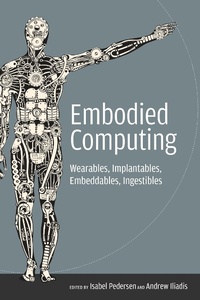
Embodied Computing
Description

Body-centered computing now goes beyond the "wearable” to encompass implants, bionic technology, and ingestible sensors—technologies that point to hybrid bodies and blurred boundaries between human, computer, and artificial intelligence platforms. Such technologies promise to reconfigure the relationship between bodies and their environment, enabling new kinds of physiological interfacing, embodiment, and productivity. Using the term embodied computing to describe these devices, this book offers essays by practitioners and scholars from a variety of disciplines that explore the accompanying ethical, social, and conceptual issues.
The contributors examine technologies that range from fitness monitors to neural implants to a toe-controlled mouse. They discuss topics that include the policy implications of ingestibles; the invasive potential of body area networks, which transmit data from bodily devices to the internet; cyborg experiments, linking a human brain directly to a computer; the evolution of the ankle monitor and other intrusive electronic monitoring devices; fashiontech, which offers users an aura of "cool” in exchange for their data; and the "final frontier” of technosupremacism: technologies that seek to read our minds. Taken together, the essays show the importance of considering embodied technologies in their social and political contexts rather than in isolated subjectivity or in purely quantitative terms.
Contributors
Roba Abbas, Andrew Iliadis, Gary Genosko, Suneel Jethani, Deborah Lupton, Katina Michael, M. G. Michael, Marcel O'Gorman, Maggie Orth, Isabel Pedersen, Christine Perakslis, Kevin Warwick, Elizabeth Wissinger
More details
Other editions
Additional editions
Persons
Andrew Iliadis is Assistant Professor in the Department of Media Studies and Production at Temple University.
Isabel Pedersen is Canada Research Chair in Digital Life, Media, and Culture and Associate Professor at the Ontario Tech University.
Andrew Iliadis is Assistant Professor in the Department of Media Studies and Production at Temple University.
Isabel Pedersen is Canada Research Chair in Digital Life, Media, and Culture and Associate Professor at the Ontario Tech University.
Andrew Iliadis is Assistant Professor in the Department of Media Studies and Production at Temple University.
Content
- Cover
- Contents
- Acknowledgments
- Introduction: Embodied Computing
- 1 Computer Guts and Swallowed Sensors: Ingestibles Made Palatable in an Era of Embodied Computing
- 2 Will the Body Become a Platform? Body Networks, Datafied Bodies, and AI Futures
- 3 Wearable Devices: Sociotechnical Imaginaries and Agential Capacities
- 4 Cyborg Experiments and Hybrid Beings
- 5 Überveillance and the Rise of Last-Mile Implantables: Past, Present, and Future
- 6 Designing Technological Comportment: On Wearable Technology, Digital Rituals, and Non-Users
- 7 The Big Toe's Resistance to Smart Rehabilitations
- 8 Doing Time in the Home-Space: Ankle Monitors, Script Analysis, and Anticipatory Methodology
- 9 Click-Click-Gimme-Gimme: Pleasures and Perils of the "Opt In" World of Fashion Tech
- 10 TechnoSupremacy and the Final Frontier: Other Minds
- Contributors
- Index
