

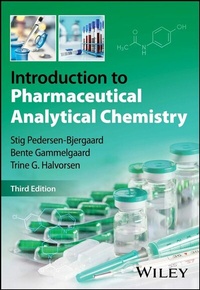
Introduction to Pharmaceutical Analytical Chemistry
Description

Primary source for learning pharmaceutical analytical chemistry, fully updated and revised to reflect current practice and Pharmacopoeia standards
Introduction to Pharmaceutical Analytical Chemistry enables students to gain fundamental knowledge of the vital concepts, techniques, and applications of the chemical analysis of pharmaceutical substances, final pharmaceutical products, and drug substances in biological fluids.
Extensively revised throughout to reflect the current European Pharmacopoeia (Ph. Eur.) and United States Pharmacopeia (USP), this Third Edition presents updated methodologies, practical examples, and calculations to reflect current pharmaceutical laboratory practice. Revisions to the chapter structure, text, and figures have been implemented to improve clarity and comprehension. New practice problems, up-to-date practical examples, and detailed illustrations are also included throughout the text.
Written by a team of experienced academics, Introduction to Pharmaceutical Analytical Chemistry explores topics including:
- Pharmacopoeias and the link between pharmaceuticals and analytical chemistry
- Fundamentals of bases, acids, solubility, polarity, partition, and stereochemistry
- Titration, UV-Vis spectrophotometry, IR spectrophotometry, and atomic spectrometry
- High-performance liquid chromatography, gas chromatography, electrophoretic methods, and mass spectrometry
- Quantitation, quality of analytical data, and validation
- Chemical analysis of pharmaceutical substances and products including biopharmaceuticals
- Sample preparation and determination of pharmaceutical substance in biological samples
Introduction to Pharmaceutical Analytical Chemistry is essential reading for undergraduate and graduate students enrolled in pharmaceutical courses, along with chemists, biochemists, and other scientists entering the pharmaceutical industry.
More details
Other editions
Additional editions
Persons
Stig Pedersen-Bjergaard is Professor at the School of Pharmacy, University of Oslo, Norway and at the Department of Pharmaceutics and Analytical Chemistry, University of Copenhagen, Denmark. His research is in the area of pharmaceutical analytical chemistry.
Bente Gammelgard is Professor of Analytical Biosciences at the University of Copenhagen, Denmark. She is responsible for teaching Instrumental Analytical Chemistry.
Trine Grønhaug Halvorsen is Professor at the School of Pharmacy, University of Oslo, Norway.
Content
Preface to the Third Edition xiii
Symbols and Units xv
Chapter 1: The Link Between Pharmaceuticals and Analytical Chemistry 1
Chapter 2: The Link between Pharmaceutical Substances and Pharmacopoeias 15
Chapter 3: Chemical and Physicochemical Properties of Pharmaceutical Substances and Reagents 39
Chapter 4: Fundamentals of Pharmaceutical Analytical Chemistry 59
Chapter 5: Titration 97
Chapter 6: Introduction to Spectroscopic Methods 121
Chapter 7: UV-Vis Spectrophotometry 130
Chapter 8: Infrared Spectrophotometry 150
Chapter 9: Atomic Spectrometry 161
Chapter 10: Introduction to Chromatography 175
Chapter 11: Separation Principles in Liquid Chromatography 190
Chapter 12: High-Performance Liquid Chromatography 215
Chapter 13: Gas Chromatography 230
Chapter 14: Electrophoretic Methods 246
Chapter 15: Mass Spectrometry 262
Chapter 16: Sample Preparation 290
Chapter 17: Data Quality, Quantification and Validation 311
Chapter 18: Chemical Analysis of Pharmaceutical Substances 337
Chapter 19: Chemical Analysis of Pharmaceutical Products 380
Chapter 20: Bioanalysis 415 20.1 Biological Fluids: Composition, Sample Collection and Storage 416
Chapter 21: Chemical Analysis of Biopharmaceuticals 432
Index 469
Symbols and Units
The units in the book are not strictly following the SI units. The units are adjusted to the dimensions in analytical work.
Symbol Unit A Absorbance - A(1%, 1 cm) Specific absorbance - AS Symmetry factor - AU Absorbance units - a Activity - a Relative retention (separation factor) - Specific optical rotation (o) degrees c Concentration g/L, mol/L d Dextrorotary (optical rotation) o (degrees) D Distribution ratio (also named distribution coefficient or partition coefficient) - E Potential V E Electrical field (CE) V/cm E0 Standard electrode potential (standard reduction potential) V e Molar absorption coefficient cm-1 · mol-1 · L eo Relative elution strength - ? Viscosity cPoise F Flow rate (chromatography) mL/min F Fluorescence - h Peak height mm H Height Equivalent to Theoretical Plate mm I Intensity - IA Acid value mg II Iodine value mg IOH Hydroxyl value mg IS Saponification value mg Ka Acid ionisation constant (= acid dissociation constant, acidity constant) Kb Base ionisation constant (= basicity constant) KD Partition ratio (= Distribution constant) Ksp Solubility product Kw Autoproteolysis equilibrium constant of water (= ion product of water) k Retention factor - ? Wavelength nm L Length m (mm) l Levorotary (optical rotation) o (degrees) µapp Apparent mobility cm2 · min-1 · V-1 µe Electrophoretic mobility cm2 · min-1 · V-1 µeo Electroosmotic mobility cm2 · min-1 · V-1 M Molarity mol/L M Molar mass g/mol M Molecular mass u = Da Mr Relative molar mass - N Number of theoretical plates - ? Frequency Hz (s-1) pI Isoelectric point - P Distribution ratio between 1-octanol and aqueous solution - P´ Polarity index - ? Quantum yield (fluorescence) - r Radius m (mm) Rf Retention factor (TLC) - RS Resolution (chromatography) - ? Density g/cm3 s Standard deviation - s Standard deviation T Temperature K, C T Transmittance - tR Retention time min tM Hold-up time min t'R Adjusted retention time min u Atomic mass units u u Linear velocity (flow rate) cm/s v Velocity m/s V Volume L, 1 mL = 1 cm3 VM Hold-up volume (void volume) (LC); Total permeation volume (SEC) mL V0 Exclusion volume mL VR Retention volume mL W Peak width min Wh Peak width at half height min Mean - z Charge -Constants
Avogadros number N 6.0221 · 1023 mol-1 Faraday's constant F 9.649 · 104 · C(oulomb) · mol-1 = 96.485 kJ · mol-1 Gas constant R 8.314 J · K-1 · mol-1 Speed of light in vacuum c 2.998 · 108 m/s Planck's constant h 6.626 · 10-34 J · s
Greek alphabet
Upper case Lower case Name English A a Alpha a B ß Beta b G ? Gamma g ? d Delta d E e Epsilon e Z ? Zeta z H ? Eta h Ø ? Theta th I ? Iota i K ? Kappa k ? ? Lambda l M µ Mu m N ? Nu n ? ? Xi x O o Omicron o ? p Pi p P ? Rho r S s Sigma s T t Tau t Y ? Upsilon u F ? Phi ph X ? Chi ch ? ? Psi ps O ? Omega o
Abbreviations
- AAS
- Atomic Absorption Spectrometry
- ADME
- ...
