

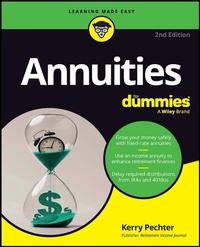
Annuities For Dummies
Description

Turning retirement savings into a steady income is a big step toward a worry-free retirement. This book introduces you to how to add annuities to your investment mix. It helps you evaluate how to select the best annuities for your needs and steer clear of the worst. You'll learn how different types of annuities can help you turn your retirement savings into a monthly paycheck, protect your investments from market ups and downs, postpone taxes, stay in your home for the rest of your life, and even buy long-term care insurance for less..
Written by an annuity thought leader who is a frequent guest-expert on webcasts, podcasts and radio broadcasts as well as editor and publisher of Retirement Income Journal, the book offers the knowledge earned from interviews with hundreds of annuity industry insiders on their own turf. Get insight into which annuities do (or don't) provide near-retirees and retirees with solid value.
* Stretch your savings into lifelong income
* Ask smarter questions when talking to an agent, broker or adviser
* Retire with less anxiety about the market
* Feel more in control of your financial life
Annuities For Dummies is the must-have guide for anyone making retirement plans or managing their retirement savings.
More details
Other editions
Additional editions
Person
Content
Part 1: Making Sense of Annuities 5
Chapter 1: The ABCs of Annuities 7
Chapter 2: Taming the Big Retirement Risks 21
Chapter 3: Diving into Annuity Documents 33
Chapter 4: Weighing Annuity Pros and Cons 47
Chapter 5: Deciding Whether an Annuity Is Right for You 59
Part 2: Identifying the Major Annuities 73
Chapter 6: Earning Interest with Fixed Annuities 75
Chapter 7: Creating Retirement Paychecks with Income Annuities 91
Chapter 8: Gambling on Fixed Indexed Annuities 111
Chapter 9: Aiming Higher with Registered Index-Linked Annuities 129
Chapter 10: Tapping Variable Annuities for Tax Breaks and Income 143
Chapter 11: Aging Gracefully with Deferred Income Annuities and Qualified Longevity Annuity Contracts 161
Chapter 12: Tapping the Liquidity in Your Home 175
Part 3: Shopping in the Annuity Marketplace 189
Chapter 13: Issuing Annuities: It's What Life Insurers Do 191
Chapter 14: Meeting the Annuity Salespeople 205
Chapter 15: Site-Seeing in the Annuity Web World 219
Chapter 16: Adding Annuities to 401(k)s 229
Part 4: Getting the Most out of Your Annuity 243
Chapter 17: Building Safe Retirement Income 245
Chapter 18: The Taxing Side of Annuities 259
Chapter 19: Recognizing Annuity Exit Ramps 269
Chapter 20: Structuring Your Annuity Correctly 277
Chapter 21: Avoiding Annuity Pitfalls 285
Part 5: The Part of Tens 295
Chapter 22: Ten Great Books about Annuities 297
Chapter 23: Ten Questions to Ask Before You Sign a Contract 303
Chapter 24: Ten Annuity Checkpoints on the Information Highway 311
Part 6: Appendixes 317
Appendix A: Glossary 319
Appendix B: State Guaranty Associations 329
Index 333
Chapter 1
The ABCs of Annuities
IN THIS CHAPTER
Understanding annuities
Learning the major types of annuities
Noting the reasons why people buy annuities
Recognizing the life cycle of all annuities
Like millions of Americans, you've probably purchased stocks, bonds, or mutual funds. All those investments involve risks. You may be less familiar with a type of product that can reduce those financial risks, especially for people in or near retirement.
Those risk-reducing products are called annuities.
Of course, annuities aren't quite that simple. Most annuity brochures and prospectuses contain enough disclaimers, footnotes, and contingencies to keep a dozen lawyers busy. And the tax features of annuities keep a lot of accountants busy, too.
But it's useful, at least at first, to set aside the complexities of annuities and take a high-level snapshot of what they are and how they work.
If investing is like walking a tightrope and insurance is like a safety net, annuities are both the tightrope and the safety net. They involve risk and guarantees at the same time. Annuities won't return as much as pure investments can, all else being equal - but they're not as risky either. If you're in or near retirement, you may find such a trade-off appealing.
In this chapter, I provide an overview of what annuities are, what they do, how they work, who should buy them, and so on. In later chapters, I dig down into the details. Throughout the book, I also share my own opinions about annuities, based on my experience in writing about the products and the industry that produces and sells them.
Getting Acquainted with Annuities
To a list of life's mysteries - the curvature of space-time, for instance - I would add annuities. Hardly anyone understands them. That's a shame, because annuities can bring stability to our financial lives during retirement, which is arguably when we need it most.
Part investment, part insurance
Annuities differ from other financial tools in several important ways. With investments, you may buy stocks, bonds, or mutual funds through a broker. You hope that in the near or distant future you can sell them for a profit. The risk that you may lose money is on you.
With annuities, you're buying a type of insurance policy or contract. You transfer money from one of your existing accounts (or from another annuity) to a life/annuity company. The life insurer invests the money and assumes certain risks on your behalf.
Some contracts offer a guaranteed or minimum gain over a certain number of years. Other contracts help your money grow until you retire, with an option to convert your savings to income at some point. Still others help you turn savings into income right away.
In this book, you see references to life/annuity companies, life insurance companies, and life insurers or carriers. These are all the same kind of entity. This book focuses on the annuity businesses of life insurers.
Deferring taxes
Investments and annuities differ in the way the federal government taxes them. When you buy mutual funds and hold them in a traditional brokerage account, the fund distributes or reinvests capital gains, dividends, or interest on which you owe income tax each year.
When you buy an annuity, you pay no taxes on the annual gains until you take the money out (after age 59½, there's no 10 percent IRS penalty tax on withdrawals). More money stays in your account, so it can grow faster. In that respect, an annuity is a bit like an individual retirement account (IRA). I delve into the tax benefits of annuities in Chapter 18.
The types of annuities that most people buy today are usually long-term tax-deferred investments with protections against loss. Relatively few people buy annuities solely for monthly income in retirement, and only a minority converts investment-style annuities to retirement income.
The different types of annuities are so different from each other (despite several similarities) that I recommend approaching them as distinct products. Different types of annuities are sold by different kinds of agents or advisers to different kinds of clients for different purposes.
Annuities are often sloppily described in the media. The media typically defines them as ways for people to create guaranteed retirement income that starts right away (immediate annuities) or after an "accumulation period" (in the case of deferred annuities) and in the form of either steady or fluctuating payments.
This definition makes it sound as if every annuity ends up as guaranteed income in retirement. That's like saying that all eggs grow into chickens, instead of getting fried, hard-boiled, poached, or added to cakes long before then. Most annuity owners use them for the benefit of tax deferral and to protect their savings from loss due to market volatility.
WAIT, DID SOMEONE SAY "CONTRACT"?
Yes, buying an annuity means filling out an application, which, if approved, is followed by the signing of a contract. Like those endless software contracts online, annuity contracts can be long, hard to understand, and printed in a font size that strains the naked eye.
The application will acquaint you with the terms of your annuity. It will also require you to make certain decisions about how you'll fund the annuity, how you want your money invested, and when you want your money back.
Hundreds of thousands of dollars are typically transferred in annuity transactions. Signing your name to the application and/or contract can be scary. But the thought of losing a chunk of your retirement nest egg in a market crash can be scarier. That, along with the tax deferral, is why people buy annuities.
THREE ANNUITIES IN ACTION
Let's bring this discussion of annuities down to earth with a few concrete examples. Consider these common financial situations:
Imagine that you'll need exactly $50,000 in five years, and you can't afford to lose any of it between now and then. You can take $43,000 or so from savings, buy a five-year contract, and receive a guarantee that it will compound by 3 percent or 4 percent each year for the next five years (depending on current interest rates) with no taxes on the annual gains during that period. After five years, you'd have $50,000. Guaranteed. That's an investment-oriented, fixed deferred annuity.
Or imagine that you're 70 years old and you've saved enough money to cover your essential expenses for the next 15 years but not for 20 years or longer. You can buy an annuity that pays you an income starting next month and lasting as long as you live. Alternatively, you can, with a much smaller premium, buy an annuity whose payments start only if and when you reach age 85. That's a single premium immediate annuity (SPIA) and a deferred income annuity (DIA), respectively.
Or imagine that you've contributed the maximum amount to your defined contribution plan or IRA, but you'd like to save more every year for retirement in a tax-deferred account whose value may fluctuate (upward, you hope) over time. You can put that money in an annuity and let it compound tax-deferred indefinitely. That's a deferred variable annuity or a structured variable annuity.
Recognizing the Most Popular Annuities
Many books and articles describe annuities as having two stages. In the first stage - the accumulation stage - you contributed to the contract, as you would to a bank account. In the second stage - the income stage - you converted your contributions to a monthly income in retirement.
Long ago, these two stages became decoupled and evolved into two distinct types of annuities:
- Deferred annuities, which are contracts that stay in the accumulation stage indefinitely, with the assets growing tax-deferred
- Immediate annuities, which are contracts that skip the accumulation stage and start paying out monthly or quarterly income shortly after the owner makes a large, lump-sum investment
Each of these two types evolved further. Depending on the type of deferred annuity you bought, your money can accumulate at
- A fixed rate (if the insurance company invested your money in bonds)
- A variable rate (if it was invested in the insurance versions of mutual funds, often called subaccounts)
- An indexed rate (if returns were linked to a market index)
If you bought an immediate annuity, on the other hand, the level of monthly or quarterly income can be
- Fixed (if the money was invested in the insurance company's bonds)
- Variable (if the money was invested in subaccounts)
Over the years, certain types of annuities have become more popular than others. Deferred variable annuities were the most widely sold from the 1990s up until about 2010. Since then, sales of index-linked annuities have become more prevalent.
In the following sections, you find thumbnail portraits of the annuities most commonly purchased. In Part 2 of this book, I devote a chapter to each.
"Savings account" annuities
When people simply need a safe place to grow a large sum of money for a few years, or if they're saving for a...
