

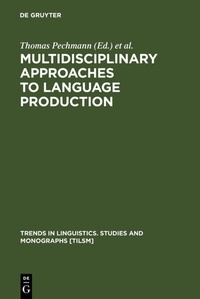
Multidisciplinary Approaches to Language Production
1st Edition
Published on 3. June 2011
VIII, 603 pages
978-3-11-089402-8 (ISBN)
Description

This volume comprises contributions from different disciplines (cognitive psychology, linguistics, computer science, neuroscience) concerned with the generation of natural speech. It summarizes the outcome of a six-year long priority program funded by the German Research Foundation (DFG) that aimed at bringing together colleagues with different viewpoints but sharing a principal interest in the cognitive processes underlying language production. The result is a state-of-the-art discussion of one of the most fascinating branches of human behavior taking into account a particularly rich multidisciplinary empirical data base.
More details
Series
Language
English
Place of publication
Berlin/Boston
Germany
Publishing group
de Gruyter Mouton
Target group
Professional and scholarly
US School Grade: College Graduate Student
Illustrations
82 s/w Abbildungen, 4 farbige Abbildungen, 55 s/w Tabellen
82 b/w and 4 col. ill., 55 b/w tbl.
File size
179,40 MB
ISBN-13
978-3-11-089402-8 (9783110894028)
Schweitzer Classification
Other editions
Additional editions
Thomas Pechmann | Christopher Habel
Multidisciplinary Approaches to Language Production
Book
04/2004
1st Edition
De Gruyter Mouton
€184.95
Shipment within 7-9 days
Thomas Pechmann | Christopher Habel
Multidisciplinary Approaches to Language Production
Book
01/2004
1st Edition
De Gruyter Mouton
€259.00
Article exhausted; check different version
Persons
Thomas Pechmann is Professor at the University of Leipzig, Germany.
Christopher Habel is Professor at the University of Hamburg, Germany.
Content
Thomas Pechmann and Christopher Habel
Preface
Merrill Garrett
Introduction
Gerhard Blanken, Florian Kulke, Britta Biedermann, Tobias Bormann, Juergen Dittmann, and Claus-W. Wallesch
The dissolution of word production in aphasia: Implications for normal functions
Jens Boelte, Pienie Zwitserlood, and Petra Dohmes
Morphology in experimental speech production research
Mary Carroll, Christiane von Stutterheim, and Ralf Nuese
The language and thought debate: A psycholinguistic approach
Grzegorz Dogil, Hermann Ackermann, Wolfgang Grodd, Hubert Haider, Hans Kamp, Joerg Mayer, Axel Riecker, Dietmar Roehm, Dirk Wildgruber, and Wolfgang Wokurek
Brain dynamics induced by language production.
Claire Gardent, Helene Manuelian, Kristina Striegnitz, and Marilisa Amoia
Generating definite descriptions, non-incrementality, inference, and data
Markus Guhe, Christoper Habel, and Ladina Tschander
Incremental generation of interconnected preverbal messages
Silke Hamm and Juergen Bredenkamp
Working memory and slips of the tongue
Karin Harbusch and Jens Woch
Integrated natural language generation with schema-tree adjoining grammars
Bernadette M. Jansma, Antoni Rodriguez-Fornells, Juern Moeller, and Thomas F. Muente
Electrophysiological studies of speech production
Dirk Janssen, Denisa Bordag, and Thomas Pechmann
Morphological encoding and morphological structures in German
Gerard Kempen and Karin Harbusch
A corpus study into word order variation in German subordinate clauses: Animacy affects linearization independently of grammatical function assignment
Ralf Klabunde and Daniel Glatz
On the production of focus
Helen Leuninger, Annette Hohenberger, Eva Waleschkowski, Elke Menges, and Daniela Happ
The impact of modality on language production: Evidence from slips of the tongue and hand
Thomas Pechmann and Dieter Zerbst
Syntactic constraints on lexical access in language production
Ulrich Schade
The benefits of local-connectionist production
Heike Tappe, Holden Haertl, and Susan Olsen
Thematic information, argument structure, and discourse adaptation in language production
Ruediger Weingarten, Guido Nottbusch, and Udo Will
Morphemes, syllables, and graphemes in written word production
Preface
Merrill Garrett
Introduction
Gerhard Blanken, Florian Kulke, Britta Biedermann, Tobias Bormann, Juergen Dittmann, and Claus-W. Wallesch
The dissolution of word production in aphasia: Implications for normal functions
Jens Boelte, Pienie Zwitserlood, and Petra Dohmes
Morphology in experimental speech production research
Mary Carroll, Christiane von Stutterheim, and Ralf Nuese
The language and thought debate: A psycholinguistic approach
Grzegorz Dogil, Hermann Ackermann, Wolfgang Grodd, Hubert Haider, Hans Kamp, Joerg Mayer, Axel Riecker, Dietmar Roehm, Dirk Wildgruber, and Wolfgang Wokurek
Brain dynamics induced by language production.
Claire Gardent, Helene Manuelian, Kristina Striegnitz, and Marilisa Amoia
Generating definite descriptions, non-incrementality, inference, and data
Markus Guhe, Christoper Habel, and Ladina Tschander
Incremental generation of interconnected preverbal messages
Silke Hamm and Juergen Bredenkamp
Working memory and slips of the tongue
Karin Harbusch and Jens Woch
Integrated natural language generation with schema-tree adjoining grammars
Bernadette M. Jansma, Antoni Rodriguez-Fornells, Juern Moeller, and Thomas F. Muente
Electrophysiological studies of speech production
Dirk Janssen, Denisa Bordag, and Thomas Pechmann
Morphological encoding and morphological structures in German
Gerard Kempen and Karin Harbusch
A corpus study into word order variation in German subordinate clauses: Animacy affects linearization independently of grammatical function assignment
Ralf Klabunde and Daniel Glatz
On the production of focus
Helen Leuninger, Annette Hohenberger, Eva Waleschkowski, Elke Menges, and Daniela Happ
The impact of modality on language production: Evidence from slips of the tongue and hand
Thomas Pechmann and Dieter Zerbst
Syntactic constraints on lexical access in language production
Ulrich Schade
The benefits of local-connectionist production
Heike Tappe, Holden Haertl, and Susan Olsen
Thematic information, argument structure, and discourse adaptation in language production
Ruediger Weingarten, Guido Nottbusch, and Udo Will
Morphemes, syllables, and graphemes in written word production
