

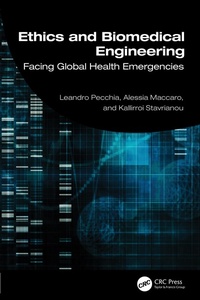
Ethics and Biomedical Engineering
Facing Global Health Emergencies
1st Edition
Published on 12. December 2024
188 pages
978-1-040-18647-3 (ISBN)
Description

This book is about the interaction between biomedical engineering and ethics during emergencies, such as low-resource settings and the COVID-19 pandemic. It addresses the issues between the universalism of human rights, ethical principles, and regulatory standards of biomedical devices in the context of emergencies.
Ethics and Biomedical Engineering: Facing Global Health Emergencies connects biomedical engineering and ethics with particular regard to emergency context such as in low-income countries and the COVID-19 pandemic. It examines how the COVID-19 crisis exposed gaps in access to healthcare, ignited debates about resource allocation, and highlighted the importance of patient privacy. The book presents case studies conducted in Africa and the role of the biomedical engineer (and more generally the scientist) during a pandemic or other health emergency. The book also addresses the way in which the pandemic has been addressed in low-income contexts. Finally, it also explains the need for an interdisciplinary approach between scientists, ethicists, and policymakers to improve outcomes in the future.
The book is intended for undergraduate and graduate students in bioengineering. It would also be useful for policy makers and medical professionals that could be faced with ethical dilemmas in times of crisis.
Ethics and Biomedical Engineering: Facing Global Health Emergencies connects biomedical engineering and ethics with particular regard to emergency context such as in low-income countries and the COVID-19 pandemic. It examines how the COVID-19 crisis exposed gaps in access to healthcare, ignited debates about resource allocation, and highlighted the importance of patient privacy. The book presents case studies conducted in Africa and the role of the biomedical engineer (and more generally the scientist) during a pandemic or other health emergency. The book also addresses the way in which the pandemic has been addressed in low-income contexts. Finally, it also explains the need for an interdisciplinary approach between scientists, ethicists, and policymakers to improve outcomes in the future.
The book is intended for undergraduate and graduate students in bioengineering. It would also be useful for policy makers and medical professionals that could be faced with ethical dilemmas in times of crisis.
More details
Edition
1. Auflage
Language
English
Place of publication
London
United Kingdom
Publishing group
Taylor & Francis Ltd
Target group
Professional and scholarly
College/higher education
Illustrations
7 Tables, black and white; 16 Line drawings, black and white; 16 Illustrations, black and white
ISBN-13
978-1-040-18647-3 (9781040186473)
Copyright in bibliographic data and cover images is held by Nielsen Book Services Limited or by the publishers or by their respective licensors: all rights reserved.
Schweitzer Classification
Other editions
Additional editions
Leandro Pecchia | Alessia Maccaro | Kallirroi Stavrianou
Ethics and Biomedical Engineering
Facing Global Health Emergencies
Book
approx. 06/2026
1st Edition
CRC Press
€69.00
Not yet published
Leandro Pecchia | Alessia Maccaro | Kallirroi Stavrianou
Ethics and Biomedical Engineering
Facing Global Health Emergencies
Book
12/2024
1st Edition
CRC Press
€170.60
Shipment within 10-20 days
Persons
Prof. Leandro Pecchia is Chair of Biomedical Engineering at the University Campus Bio-Medico in Rome, Italy and the Rector Delegate for Internationalization and Sustainable Development Goals. In 2021, the Italian Minister of Health appointed him as one of the three medical device experts of the Technical and Clinical Committee of the Ministry of Health. From 2020 to September 2023, he worked as Innovation Manager for the World Health Organization (WHO), Emergency program (WHE) Infection Prevention and Control (IPC) unit. Prof. Pecchia has authored more than 200 peer-reviewed papers in journals, books and conferences in the fields of artificial intelligence, medical devices, biomedical signal processing, health technology assessment, Internet of Things and machine learning applied to active and healthy ageing and management of chronic diseases. Prof. Pecchia is the Secretary General of the International Federation of Medical and Biological Engineering, an NGO with official relations with the WHO, and the Past President of the European Scientific Society of Biomedical Engineering.
Dr. Alessia Maccaro is Research Fellow in Moral Philosophy and Bioethics for the School of Engineering of the University of Warwick, UK. She is an expert in interdisciplinary research in the ethical and regulatory aspects of healthcare technologies, in particular in low resource settings and in emergency situations such as pandemics. Currently she co-leads a work package on the pilot management for the Horizon 2020 ODIN Project on Smart Hospitals. She obtained the National Academic Qualification as Associate Professor of Moral Philosophy for the SS M-FIL/03 in 2020. She is member of several professional bodies, including the Italian Society of Moral Philosophy (SIFM) and Interuniversity Center of Bioethical Research (CIRB - University of Naples Federico II), and she is member of Scientific Advisory Board of the Laboratory "Ethics, Bioethics and Citizenship" (EBC), University of Naples Federico II.
Dr. Kallirroi Stavrianou is an experienced Postdoctoral Researcher with a demonstrated history of working in the higher education industry and skilled in medical devices, health technology assessment and health technology management. She is a strong research professional with a Doctor of Philosophy (PhD) and MSc focused on Clinical Engineering and a Bachelor's degree in Physics from the University of Patras. She is the manager of the Global Clinical Engineering Alliance and Global Clinical Engineering Journal, board member of the Clinical Engineering Division of IFMBE, former member of the Health Technology Assessment Division of IFMBE and chairs the IFMBE Publicity Committee. Dr. Stavrianou is also a member of the Hellenic Society for Biomedical Technology (ELEVIT).
Dr. Alessia Maccaro is Research Fellow in Moral Philosophy and Bioethics for the School of Engineering of the University of Warwick, UK. She is an expert in interdisciplinary research in the ethical and regulatory aspects of healthcare technologies, in particular in low resource settings and in emergency situations such as pandemics. Currently she co-leads a work package on the pilot management for the Horizon 2020 ODIN Project on Smart Hospitals. She obtained the National Academic Qualification as Associate Professor of Moral Philosophy for the SS M-FIL/03 in 2020. She is member of several professional bodies, including the Italian Society of Moral Philosophy (SIFM) and Interuniversity Center of Bioethical Research (CIRB - University of Naples Federico II), and she is member of Scientific Advisory Board of the Laboratory "Ethics, Bioethics and Citizenship" (EBC), University of Naples Federico II.
Dr. Kallirroi Stavrianou is an experienced Postdoctoral Researcher with a demonstrated history of working in the higher education industry and skilled in medical devices, health technology assessment and health technology management. She is a strong research professional with a Doctor of Philosophy (PhD) and MSc focused on Clinical Engineering and a Bachelor's degree in Physics from the University of Patras. She is the manager of the Global Clinical Engineering Alliance and Global Clinical Engineering Journal, board member of the Clinical Engineering Division of IFMBE, former member of the Health Technology Assessment Division of IFMBE and chairs the IFMBE Publicity Committee. Dr. Stavrianou is also a member of the Hellenic Society for Biomedical Technology (ELEVIT).
Content
About the Authors
Introduction
Statement
1. Biomedical Engineering and Ethics Face COVID- 19 Pandemic
Biomedical Engineering and Ethics: Reflections on Medical Devices and Personal Protective Equipment During the First Wave of COVID-19
The Role of Ethics in Science: A Systematic Literature Review from the First Wave of COVID- 19
2. Case Studies in Low- Resource Settings
COVID- 19 Preparedness and Social Dynamics in a Sub- Saharan Africa Country, Benin
Social Engagement in the Fight Against COVID- 19 in the Urban and Peri- Urban areas of Cotonou (Benin, Sub- Saharan Africa): Acceptability of the Vaccination and Tracking Program
A Framework for Designing Medical Devices Resilient to Low- Resource Settings
A Framework for Assessing Healthcare Facilities in Low- Resource Settings: Field Studies in Benin and Uganda
3. Ethics and Regulation
Personal Protective Equipment and COVID- 19: The Inadequacy of Regulatory Frameworks in Time of Crisis and in Low-Resource Settings
On the Universality of Medical Device Regulations: The Case of Benin
4. Building a Stronger Europe: The EAMBES' Role in Healthcare Resilience and Sustainability
5. Conclusions
Introduction
Statement
1. Biomedical Engineering and Ethics Face COVID- 19 Pandemic
Biomedical Engineering and Ethics: Reflections on Medical Devices and Personal Protective Equipment During the First Wave of COVID-19
The Role of Ethics in Science: A Systematic Literature Review from the First Wave of COVID- 19
2. Case Studies in Low- Resource Settings
COVID- 19 Preparedness and Social Dynamics in a Sub- Saharan Africa Country, Benin
Social Engagement in the Fight Against COVID- 19 in the Urban and Peri- Urban areas of Cotonou (Benin, Sub- Saharan Africa): Acceptability of the Vaccination and Tracking Program
A Framework for Designing Medical Devices Resilient to Low- Resource Settings
A Framework for Assessing Healthcare Facilities in Low- Resource Settings: Field Studies in Benin and Uganda
3. Ethics and Regulation
Personal Protective Equipment and COVID- 19: The Inadequacy of Regulatory Frameworks in Time of Crisis and in Low-Resource Settings
On the Universality of Medical Device Regulations: The Case of Benin
4. Building a Stronger Europe: The EAMBES' Role in Healthcare Resilience and Sustainability
5. Conclusions
