

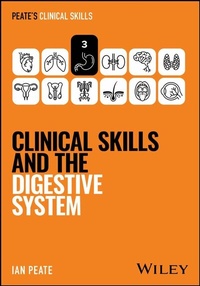
Clinical Skills and the Digestive System
Description

Develop essential skills for enhancing digestive health, ensuring accurate assessment and patient-focused treatment
Clinical Skills and the Digestive System delivers a structured approach to understanding and mastering the clinical assessment and procedural skills that are essential for delivering safe, effective and compassionate care for patients with conditions affecting the digestive system.
Part of Peate's Clinical Skills, a 12-book series that combines knowledge of human anatomy and physiology with practical, confident clinical skills, this volume is organised into chapters covering how to engage with patients, assessing the digestive system, health promotion, planning care for ulcerative colitis, vital signs, nasogastric tube insertion, rectal medication administration, and stoma care.
Clinical Skills and the Digestive System equips readers with:
- Clear explanations of anatomy, physiology, and pathophysiology relevant to the digestive system
- Step-by-step guidance on assessment, examination, and procedural techniques, emphasising best practice and patient safety
- Insights on interpreting findings, recognising abnormalities, and applying knowledge to guide care decisions
- Guidance on teamwork, infection prevention and control, documentation, and patient-centred care throughout clinical practice
- Strategies to explain diagnoses, treatment plans, and care procedures to patients and families, while offering emotional support
Clinical Skills and the Digestive System is an essential resource for all healthcare and social care students-including those returning to practice and newly qualified practitioners-who manage patients with digestive conditions and seek practical ways to deliver a higher standard of care.
More details
Other editions
Additional editions
Person
IAN PEATE is a Visiting Professor at Northumbria University and Buckinghamshire New University and a Senior Clinical Fellow at the University of Hertfordshire. He is also the Editor-in-Chief of the British Journal of Nursing, and Consultant Editor of the Journal of Paramedic Practice and the International Journal of Advancing Practice.
Content
Preface viii
Acknowledgements x
1 The Anatomy and Physiology of the Digestive System 1
2 Engaging with Patients and Assessing the Digestive System 31
3 Health Promotion 55
4 Planning Care: Ulcerative Colitis 72
5 Vital Signs 97
6 Nasogastric Tube Insertion 117
7 Rectal Medication Administration 139
8 Stoma Care 159
References 181
MCQ Answers 183
Index 184
Chapter 1
The Anatomy and Physiology of the Digestive System
Introduction
The digestive system is also known as the gastrointestinal system or the alimentary canal. A comprehensive understanding of the anatomy and physiology of the digestive system is fundamental to the education and clinical practice of healthcare students. The digestive system is a highly specialised and dynamic network responsible for the ingestion, digestion, absorption and assimilation of nutrients, as well as the elimination of waste products. Its function is vital not only for maintaining nutritional homeostasis but also for supporting the body's immune defences, metabolic processes and overall health.
This chapter offers an examination of the structure and function of the digestive tract and its associated organs. It will begin by exploring the organisation of the alimentary canal, from the oral cavity, pharynx and oesophagus, through to the stomach, small intestine and large intestine, before discussing the accessory organs, including the liver, gallbladder and pancreas. Each anatomical region will be discussed in relation to its specialised physiological role, highlighting the intricate coordination required for the effective processing of food substances.
An understanding of these mechanisms is critical for appreciating how the digestive system responds to varying physiological demands and how dysfunction can contribute to a range of pathological conditions.
In clinical practice, recognising the normal anatomy and physiology of the digestive system provides the foundation for identifying deviations indicative of disease or dysfunction. A thorough grasp of these principles enhances clinical reasoning, informs patient assessment and underpins safe, evidence-based care across a range of healthcare settings.
Through the study of this chapter, readers will not only gain essential knowledge of the digestive system's structure and function but also develop the ability to apply this knowledge in clinical scenarios, supporting the provision of holistic, person-centred care.
Role and function of the digestive system
The activity of the digestive system can be classified into five fundamental processes, each integral to the overall function of nutrient acquisition and waste elimination.
Ingestion
This is the active process by which food is introduced into the oral cavity. It represents the initial stage of digestion, whereby food is voluntarily placed into the mouth to commence mechanical and enzymatic processing.
Propulsion
Propulsion encompasses the movement of food through the gastrointestinal tract. It begins with the voluntary act of swallowing (deglutition) and is followed by peristalsis, which is an involuntary, coordinated series of muscular contractions that systematically advances food through the digestive system.
Digestion
Digestion refers to the breakdown of food into its constituent nutrients, facilitating absorption. This occurs through two interrelated mechanisms:
- Mechanical digestion, involving physical processes such as mastication (chewing) and the churning and segmentation movements within the stomach and intestines, which increase the surface area of food particles.
- Chemical digestion, involving the enzymatic degradation of complex macromolecules (proteins, carbohydrates and lipids) into absorbable monomers (these are the small molecules that are produced by digestion that the body can absorb and use) through the action of digestive secretions that are produced by the salivary glands, stomach, pancreas, liver and intestines.
Absorption
Absorption is the transfer of the end products of digestion across the epithelial lining of the gastrointestinal tract into the circulatory and lymphatic systems. The majority of absorption occurs within the small intestine, where nutrients such as monosaccharides, amino acids, fatty acids, vitamins and minerals are taken up for distribution and use by body tissues.
Elimination
The final process, elimination or defaecation, is where indigestible food residues and waste products of metabolism are expelled from the body in the form of faeces. This process primarily occurs in the large intestine, where water is reabsorbed and the remaining material is compacted and stored until excretion.
How the digestive system is organised
The digestive system is organised into two principal components:
- The primary digestive organs
- The accessory digestive organs
The primary structures comprise the continuous, hollow muscular tube known as the gastrointestinal tract, which is responsible for the ingestion, propulsion, digestion, absorption and elimination of food substances. The gastrointestinal tract includes the following:
- Mouth
- Pharynx
- Oesophagus
- Stomach
- Small intestine
- Large intestine
- Rectum and anus
Figure 1.1 provides details of the digestive system.
Figure 1.1 The digestive system.
Source: Tortora and Derrickson (2009). With permission of John Wiley & Sons.
Each segment of the tract is anatomically and functionally specialised to perform specific roles; for example, the stomach has a role to play as a reservoir for food; it also initiates protein digestion, while the small intestine is the primary site for the digestion of enzymes and nutrient absorption.
In parallel, there are several accessory organs that support and enhance the digestive process without being part of the alimentary canal itself. These accessory organs include the following:
- Salivary glands
- Liver
- Gallbladder
- Pancreas
The salivary glands secrete saliva containing enzymes such as amylase, which begin the chemical breakdown of carbohydrates in the oral cavity. The liver synthesises bile, a substance that is crucial for the emulsification and absorption of dietary fats, while the gallbladder stores and concentrates bile, releasing it into the duodenum in response to hormonal signals. The pancreas has a dual role; it produces both digestive enzymes (such as proteases, lipases and amylases) and bicarbonate ions, which neutralise the acidic chyme entering the small intestine from the stomach. Collectively, the primary and accessory components of the digestive system work in a highly coordinated manner to ensure the efficient processing of ingested nutrients, the maintenance of internal homeostasis and the elimination of metabolic waste products.
The mouth
The process of digestion begins as food enters the mouth (also known as the oral cavity). This initial stage involves the ingestion of food, which then mixes with saliva to facilitate further breakdown. The oral cavity is composed of various structures, as shown in Figure 1.2, which illustrates an anterior view of the mouth. The lips and cheeks are made up of muscle and connective tissue, and they play a critical role in the mechanical manipulation of food. These structures help move the food, now combined with saliva, around the mouth, initiating the mechanical process of digestion.
Figure 1.2 An anterior view of the mouth.
Source: Tortora and Derrickson (2009). With permission of John Wiley & Sons.
The teeth further contribute to mechanical digestion through grinding and tearing food, a process that is known as mastication. The act of chewing, combined with the mixing of food with saliva, enhances the breakdown of food particles, preparing them for chemical digestion. Given that the oral cavity may be exposed to extreme temperatures, for example, very hot or cold food, as well as rough food particles, it is lined with a protective layer of mucus-secreting, stratified squamous epithelial cells. This epithelial layer serves as a barrier, offering protection against abrasion, thermal damage and the wear and tear associated with regular food processing.
In addition to their role in facilitating the mechanical movement of food during digestion, the lips and cheeks are integral to several other functions, including the production of speech and the expression of emotions. The lips, composed of both muscular and connective tissue, are essential for articulating sounds and forming words. They also contribute to non-verbal communication by enabling various facial expressions that convey emotions. Similarly, the cheeks, which are also made up of muscle and connective tissue, assist in the modulation of airflow during speech, as well as in the movement of food within the oral cavity. Together, these structures play a multifaceted role in both the digestive and communicative processes, highlighting their importance beyond simple mechanical digestion.
Tongue
The tongue is a large, voluntary muscular organ that occupies a significant portion of the oral cavity. It is firmly anchored at its posterior end to the hyoid bone and at its inferior surface by the lingual frenulum, a small fold of tissue (see Figure 1.3).
Figure 1.3 Tongue, hyoid bone and frenum.
Source: Tortora and Derrickson (2009). With permission of John Wiley & Sons.
The superior surface of the tongue is covered by stratified squamous epithelium, which provides a resilient layer that protects the tongue from mechanical abrasion during mastication and other oral activities. This surface is also populated by numerous small projections known as papillae, which contain the taste buds (see Figure 1.3). These...
