

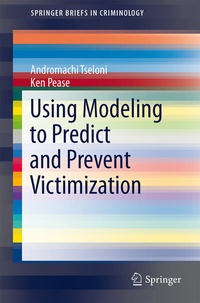
Using Modeling to Predict and Prevent Victimization
Description

More details
Other editions
Additional editions
Persons
Professor Andromachi Tseloni teaches quantitative methodology for applied social research to undergraduate and especially graduate students. She is currently responsible for research generation and mentoring in the Division and contributes to the Research Committees of the Division and the School. She serves on the Editorial Board of Journal of Quantitative Criminology. Apart from single - dependent variable (preferably hierarchical) modeling of counts or risks, her current interests include cross-national comparisons; multivariate hierarchical modeling of associated outcomes, such as violence and property crimes; and Poisson mixtures for counts, such as victimization and/or offending events. These methodologies are most relevant for studying the ecology of crime as well as other socio-economic issues such as mental health, education and social services. Ken Pease is Emeritus Professor of Criminology at the University of Huddersfield, where he established the Applied Criminology Group in 1995. He is also Visiting Professor at the Jill Dando Institute of Crime Science at University College London. Professor Pease has acted as a consultant to a number of international organizations including the United Nations, the Council of Europe and the Customs Co-operation Council. He is a former Parole Board member. He has worked intermittently on repeat victimization for 18 years and has been involved with the British Crime Survey for 14; his work has concerned the anticipation of crime trends and he has been responsible for some of the most innovative, rigorous, yet practical work in crime reduction in the last few decades. He helped to coin the term 'crime science' and has striven to integrate serious scientific methods into crime reduction.
