
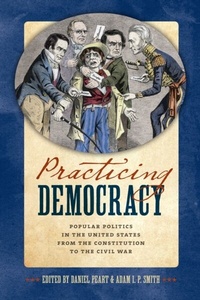
Practicing Democracy
Description
Alles über E-Books | Antworten auf Fragen rund um E-Books, Kopierschutz und Dateiformate finden Sie in unserem Info- & Hilfebereich.
In Practicing Democracy, eleven historians challenge conventional narratives of democratization in the early United States, offering new perspectives on the period between the ratification of the Constitution and the outbreak of the Civil War. The essays in this collection address critical themes such as the origins, evolution, and disintegration of party competition, the relationship between political parties and popular participation, and the place that parties occupied within the wider world of United States politics.
In recent years, historians of the early republic have demolished old assumptions about low rates of political participation and shallow popular partisanship in the age of Jefferson-raising the question of how, if at all, Jacksonian politics departed from earlier norms. This book reaffirms the significance of a transition in political practices during the 1820s and 1830s but casts the transformation in a new light. Whereas the traditional narrative is one of a party-driven democratic awakening, the contributors to this volume challenge the correlation of party with democracy. They both critique constricting definitions of legitimate democratic practices in the decades following the ratification of the Constitution and emphasize the proliferation of competing public voices in the buildup to the Civil War. Taken together, these essays offer a new way of thinking about American politics across the traditional dividing line of 1828 and suggest a novel approach to the long-standing question of what it meant to be part of "We the People."
Contributors:Tyler Anbinder, George Washington University · Douglas Bradburn, Fred W. Smith National Library for the Study of George Washington at Mount Vernon · John L. Brooke, The Ohio State University · Andrew Heath, University of Sheffield · Reeve Huston, Duke University · Johann N. Neem, Western Washington University · Kenneth Owen, University of Illinois, Springfield · Graham A. Peck, Saint Xavier University · Andrew W. Robertson, Graduate Center of the City University of New York and Lehman College, CUNY
All prices
More details
Other editions
Additional editions
Persons
Daniel Peart, Lecturer in American History at Queen Mary University of London, is author of Era of Experimentation: American Political Practices in the Early Republic (Virginia). Adam I. P. Smith, Senior Lecturer at University College London, is author of The American Civil War.

System requirements
File format: ePUB
Copy protection: Adobe-DRM (Digital Rights Management)
System requirements:
- Computer (Windows; MacOS X; Linux): Install the free reader Adobe Digital Editions prior to download (see eBook Help).
- Tablet/smartphone (Android; iOS): Install the free app Adobe Digital Editions or the app PocketBook before downloading (see eBook Help).
- E-reader: Bookeen, Kobo, Pocketbook, Sony, Tolino and many more (not Kindle).
The file format ePub works well for novels and non-fiction books – i.e., „flowing” text without complex layout. On an e-reader or smartphone, line and page breaks automatically adjust to fit the small displays.
This eBook uses Adobe-DRM, a „hard” copy protection. If the necessary requirements are not met, unfortunately you will not be able to open the eBook. You will therefore need to prepare your reading hardware before downloading.
Please note: We strongly recommend that you authorise using your personal Adobe ID after installation of any reading software.
For more information, see our ebook Help page.
File format: PDF
Copy-Protection: Adobe-DRM (Digital Rights Management)
System requirements:
- Computer (Windows; MacOS X; Linux): Install the free reader Adobe Digital Editions prior to download (see eBook Help).
- Tablet/smartphone (Android; iOS): Install the free app Adobe Digital Editions or the app PocketBook before downloading (see eBook Help).
- E-reader: Bookeen, Kobo, Pocketbook, Sony, Tolino and many more (only limited: Kindle).
The file format PDF always displays a book page identically on any hardware. This makes PDF suitable for complex layouts such as those used in textbooks and reference books (images, tables, columns, footnotes). Unfortunately, on the small screens of e-readers or smartphones, PDFs are rather annoying, requiring too much scrolling.
This eBook uses Adobe-DRM, a „hard” copy protection. If the necessary requirements are not met, unfortunately you will not be able to open the eBook. You will therefore need to prepare your reading hardware before downloading.
Please note: We strongly recommend that you authorise using your personal Adobe ID after installation of any reading software.
For more information, see our eBook Help page.
File format: ePUB
Copy protection: without DRM (Digital Rights Management)
System requirements:
- Computer (Windows; MacOS X; Linux): Use a reader that can handle the file format ePUB, such as Adobe Digital Editions or FBReader – both free (see eBook Help).
- Tablet/Smartphone (Android; iOS): Install the free app Adobe Digital Editions or the app PocketBook (see eBook Help).
- E-reader: Bookeen, Kobo, Pocketbook, Sony, Tolino and many more (not Kindle).
The file format ePUB works well for novels and non-fiction books – i.e., 'flowing' text without complex layout. On an e-reader or smartphone, line and page breaks automatically adjust to fit the small displays.
This eBook does not use copy protection or Digital Rights Management
For more information, see our eBook Help page.
