

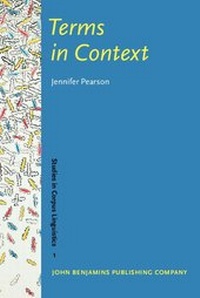
Terms in Context
1st Edition
Published on 15. May 1998
XII, 246 pages
978-90-272-9892-8 (ISBN)
Description

Terms in Context applies the methodology that has been developed over the last two decades in corpus linguistics to the relatively new and still little developed field of corpus-based terminography. While corpora are already being used by some terminologists for the identification of terms and retrieval of contextual fragments, this book describes the first attempt to use corpora for terminography in much the same way as large general reference corpora are already being used for general language lexicography. The author goes beyond the standard problem of identifying terms as opposed to non-terminological lexical items in text and focuses on identifying metalanguage patterns which point to the presence in text of (parts of) reusable definitions of terms. The author examines these patterns and shows how the information which they contain can be retrieved and used as input for terminological entries.
Terms in Context should be of interest to 'traditional' terminologists who have not previously considered adopting a corpus-based approach to their work or at least not on the scale proposed here; to 'modern' terminologists who use text primarily for the identification of terms and the retrieval of contextual examples; to those in the corpus linguistic community who have hitherto used general language corpora for the purposes of lexicography and have not previously considered using special purpose corpora for more specific lexicography studies; and to academics in the ESP/LSP community who are interested in showing students how to use text as a means of ascertaining the meaning of terms.
Terms in Context should be of interest to 'traditional' terminologists who have not previously considered adopting a corpus-based approach to their work or at least not on the scale proposed here; to 'modern' terminologists who use text primarily for the identification of terms and the retrieval of contextual examples; to those in the corpus linguistic community who have hitherto used general language corpora for the purposes of lexicography and have not previously considered using special purpose corpora for more specific lexicography studies; and to academics in the ESP/LSP community who are interested in showing students how to use text as a means of ascertaining the meaning of terms.
More details
Other editions
Additional editions
Jennifer Pearson
Terms in Context
Book
05/1998
John Benjamins Publishing Co
€111.30
Shipment within 10-15 days
Person
Content
- Terms in context
- Editorial page
- Title page
- LCC data
- Dedication page
- Contents
- Acknowledgements
- 0 Introduction
- 0.1 Background
- 0.2 Target Audience
- 0.3 General Outline
- 0.4 Chapter Contents
- 1 Identifying differences between words and terms
- 1.1 Introduction
- 1.2 Emergence of terminology as a discipline
- 1.3 What is terminology?
- 1.4 General theory of terminology
- 1.5 The 'traditional' definition of term
- 1.6 Pragmatic definitions of term
- 1.7 Exploring other methods of distinguishing between words and terms
- 1.8 Sublanguages
- 1.9 Classifying communicative settings
- 1.10 Conclusion
- 2 Corpora, corpus design and corpus selection
- 2.1 Introduction
- 2.2 What is a Corpus?
- 2.3 Types of corpora
- 2.4 Approaches to corpus studies
- 2.5 Corpus users
- 2.6 Compilation of corpora: design considerations
- 2.7 Classification of texts: external and internal criteria
- 2.8 Observations
- 2.9 Overview of design considerations in the compilation of special purpose corpora
- 2.10 Proposals for design criteria for the design of special purpose corpora
- 2.11 The search for suitable texts
- 2.12 Conclusion
- List of Books in the GCSE corpus
- 3 Dictionaries and defining strategies
- 3.1 Introduction
- 3.2 Language dictionaries
- 3.3 Lexicographic methods
- 3.4 Explaining meaning
- 3.5 Recommendations for good defining practice
- 3.6 Conclusion
- 4 Analysis of Definitions in Text
- 4.1 Introduction
- 4.2 Swales
- 4.3 Widdowson
- 4.4 Larry Selinker, R.M.Todd Trimble, Louis Trimble
- 4.5 Darian
- 4.6 Trimble's definition types
- 4.7 Flowerdew
- 4.8 Conclusion
- 5 Defining as a Performative Act
- 5.1 Introduction
- 5.2 Austin's performatives
- 5.3 Defining as a performative
- 5.4 Distinguishing between types of defining performative
- 5.5 Conclusion
- 6 Retrieval of terms from the corpora
- 6.1 Introduction
- 6.2 Previous research into automatic identification and retrieval of terms
- 6.3 Identification and retrieval of corpus specific term formation patterns
- 6.4 Retrieval of term candidates
- 6.5 Refining the term identification process
- 6.6 Conclusion
- 7 Retrieval of formal and semi-formal defining expositives
- 7.1 Introduction
- 7.2 Simple formal defining expositives
- 7.3 Complex formal defining expositives
- 7.4 Semi-formal defining expositives
- 7.5 Dictionary type definitions
- 7.6 Conclusion
- 8 Synonymy, substitution and paraphrasing
- 8.1 Introduction
- 8.2 Defining our terms
- 8.3 In search of synonyms, paraphrase and substitution
- 8.4 Conclusion
- 9 Using the term as the node
- 9.1 Introduction
- 9.2 Evaluating occurrences of Ankyrin
- 9.3 Evaluating occurrences of respiration in the GCSE corpus
- 9.4 Collating the Information
- 9.5 Conclusion
- 10 Summary
- 10.1 Summary of findings
- 10.2 Implications for future research
- References
- Appendix A
- Appendix B
- Index
- The series Studies in Corpus Linguistics (SCL)
