

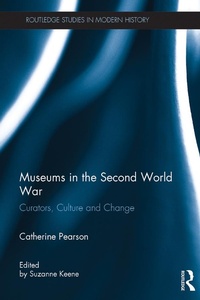
Museums in the Second World War
Curators, Culture and Change
Published on 26. June 2017
296 pages
978-1-351-70255-3 (ISBN)
Description

Exploring the role of museums, galleries and curators during the upheaval of the Second World War, this book challenges the accepted view of a hiatus in museum services during the conflict and its immediate aftermath. Instead it argues that new thinking in the 1930s was realised in a number of promising initiatives during the war only to fail during the fragmented post-war recovery. Based on new research including interviews with retired museum staff, letters, diaries, museum archives and government records, this study reveals a complex picture of both innovation and inertia.
At the outbreak of war precious objects were stored away and staff numbers reduced, but although many museums were closed, others successfully campaigned to remain open. By providing innovative modern exhibitions and education initiatives they became popular and valued venues for the public. After the war, however, museums returned to their more traditional, collections-centred approach and failed to negotiate the public funding needed for reconstruction based on this narrower view of their role. Hence, in the longer term, the destruction and economic and social consequences of the conflict served to delay aspirations for reconstruction until the 1960s. Through this lens, the history of the museum in the mid-twentieth century appears as one shaped by the effects of war but equally determined by the input of curators, audiences and the state. The museum thus emerges not as an isolated institution concerned only with presenting the past but as a product of the changing conflicts and cultures within society.
At the outbreak of war precious objects were stored away and staff numbers reduced, but although many museums were closed, others successfully campaigned to remain open. By providing innovative modern exhibitions and education initiatives they became popular and valued venues for the public. After the war, however, museums returned to their more traditional, collections-centred approach and failed to negotiate the public funding needed for reconstruction based on this narrower view of their role. Hence, in the longer term, the destruction and economic and social consequences of the conflict served to delay aspirations for reconstruction until the 1960s. Through this lens, the history of the museum in the mid-twentieth century appears as one shaped by the effects of war but equally determined by the input of curators, audiences and the state. The museum thus emerges not as an isolated institution concerned only with presenting the past but as a product of the changing conflicts and cultures within society.
More details
Series
Language
English
Place of publication
London
United Kingdom
Publishing group
Taylor & Francis Ltd
Target group
College/higher education
Illustrations
65 s/w Abbildungen, 2 s/w Tabellen, 54 s/w Photographien bzw. Rasterbilder, 9 s/w Zeichnungen
2 Tables, black and white; 9 Line drawings, black and white; 54 Halftones, black and white; 65 Illustrations, black and white
File size
5,25 MB
ISBN-13
978-1-351-70255-3 (9781351702553)
Copyright in bibliographic data and cover images is held by Nielsen Book Services Limited or by the publishers or by their respective licensors: all rights reserved.
Schweitzer Classification
Other editions
Additional editions
Book
06/2020
1st Edition
Routledge
€53.31
Shipment within 15-20 days
Book
06/2017
1st Edition
Routledge
€206.10
Shipment within 10-20 days
Persons
Catherine Pearson, Author, Independent Historian and Scholar, UK. She is the editor of the journals of museum curator, E.J. Rudsdale, 1920-1951.
Suzanne Keene, Editor, Reader Emeritus at University College London. She has a number of published books on museum collections, most recently co-authoring Museums and Silent Objects: Designing Effective Exhibitions.
Suzanne Keene, Editor, Reader Emeritus at University College London. She has a number of published books on museum collections, most recently co-authoring Museums and Silent Objects: Designing Effective Exhibitions.
Content
Timeline: Major events around the Second World War and the Home Front Introduction: a new perspective PART I: 1918-1939: Between the wars Chapter 1 Between the wars: museums and cultural politics Chapter 2 Charting progress: the Markham report Chapter 3 Museums before the war: the context for reform Part II: 1939-1940: At the start of the war Chapter 4 Confronting conflict: collections, closings and openings Chapter 5 As war begins: from propaganda to recognition PART III: 1941-1944: During wartime Chapter 6 State support: the Council for the Encouragement of Music and the Arts (CEMA) Chapter 7 Temples to the arts Chapter 8 Planning for peacetime PART IV: Reflections on wartime practice Chapter 9 Community engagement, education and exhibitions Chapter 10 Audiences in wartime Chapter 11 Memory and identity Chapter 12 Museum staff and the war PART V: 1944-1949 The aftermath of the war Chapter 13 A national museum service: the final bid Chapter 14 The post-war decades: museums in the aftermath of war PART VI: 1950-1964 From austerity to reconstruction Chapter 15 Towards a regional service Chapter 16 Conclusions: museums forget their past
