

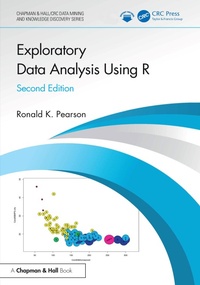
Exploratory Data Analysis Using R
2nd Edition
Will be published approx. on 1. July 2026
592 pages
978-1-040-65622-8 (ISBN)
Description

Exploratory Data Analysis Using R provides a classroom-tested introduction to exploratory data analysis (EDA), and this revised edition is accompanied by the R package ExploreTheData that implements many of the approaches described. As before, the primary focus of the book is on identifying "interesting" features - good, bad, and ugly - in a dataset, why it is important to find them, how to treat them, and more generally, the use of R to explore and explain datasets and the analysis results derived from them.
The book begins with a brief overview of exploratory data analysis using R, followed by a detailed discussion of creating various graphical data summaries in R. Then comes a thorough introduction to exploratory data analysis, and a detailed treatment of 13 data anomalies, why they are important, how to find them, and some options for addressing them. Subsequent chapters introduce the mechanics of working with external data, structured query language (SQL) for interacting with relational databases, linear regression analysis (the simplest and historically most important class of predictive models), and crafting data stories to explain our results to others. These chapters use R as an interactive data analysis platform, while Chapter 9 turns to writing programs in R, focusing on creating custom functions that can greatly simplify repetitive analysis tasks. Further chapters expand the scope to more advanced topics and techniques: special considerations for working with text data, a second look at exploratory data analysis, and more general predictive models.
The book is designed for both advanced undergraduate, entry-level graduate students, and working professionals with little to no prior exposure to data analysis, modeling, statistics, or programming. It keeps the treatment relatively non-mathematical, even though data analysis is an inherently mathematical subject. Exercises are included at the end of most chapters, and an instructor's solution manual is available.
The book begins with a brief overview of exploratory data analysis using R, followed by a detailed discussion of creating various graphical data summaries in R. Then comes a thorough introduction to exploratory data analysis, and a detailed treatment of 13 data anomalies, why they are important, how to find them, and some options for addressing them. Subsequent chapters introduce the mechanics of working with external data, structured query language (SQL) for interacting with relational databases, linear regression analysis (the simplest and historically most important class of predictive models), and crafting data stories to explain our results to others. These chapters use R as an interactive data analysis platform, while Chapter 9 turns to writing programs in R, focusing on creating custom functions that can greatly simplify repetitive analysis tasks. Further chapters expand the scope to more advanced topics and techniques: special considerations for working with text data, a second look at exploratory data analysis, and more general predictive models.
The book is designed for both advanced undergraduate, entry-level graduate students, and working professionals with little to no prior exposure to data analysis, modeling, statistics, or programming. It keeps the treatment relatively non-mathematical, even though data analysis is an inherently mathematical subject. Exercises are included at the end of most chapters, and an instructor's solution manual is available.
More details
Series
Edition
2nd edition
Language
English
Place of publication
London
United Kingdom
Publishing group
Taylor & Francis Ltd
Target group
Professional and scholarly
College/higher education
Product notice
Reflowable
Illustrations
3 Tables, black and white; 35 Line drawings, color; 74 Line drawings, black and white; 35 Illustrations, color; 74 Illustrations, black and white
File size
22,09 MB
ISBN-13
978-1-040-65622-8 (9781040656228)
Copyright in bibliographic data and cover images is held by Nielsen Book Services Limited or by the publishers or by their respective licensors: all rights reserved.
Schweitzer Classification
Other editions
Additional editions
Ronald K. Pearson
Exploratory Data Analysis Using R
Book
approx. 07/2026
2nd Edition
Chapman & Hall/CRC
€117.50
Not yet published
Ronald K. Pearson
Exploratory Data Analysis Using R
Book
approx. 07/2026
2nd Edition
Chapman & Hall/CRC
€64.50
Not yet published
Person
Ronald K. Pearson holds a PhD in Electrical Engineering and Computer Science from the Massachussetts Institute of Technology and has more than 40 years professional experience in exploratory data analysis. Dr. Pearson has held industrial, business, and academic positions in the fields of industrial process control, bioinformatics, drug safety data analysis, software development, and insurance. He has authored or co-authored books including Exploring Data in Engineering, the Sciences, and Medicine (Oxford University Press, 2011) and Mining Imperfect Data with Examples in R and Python (SIAM, 2020).
Content
1. Data, Exploratory Analysis, and R 2. Graphics in R 3. Exploratory Data Analysis: A First Look 4. Thirteen Important Data
Anomalies 5. Working with External Data 6. SQL and Relational Databases 7. Linear Regression Models 8. Crafting Data Stories 9. Programming in R 10. Working with Text Data 11. Exploratory Data Analysis: A Second Look 12. More General Predictive Models
Anomalies 5. Working with External Data 6. SQL and Relational Databases 7. Linear Regression Models 8. Crafting Data Stories 9. Programming in R 10. Working with Text Data 11. Exploratory Data Analysis: A Second Look 12. More General Predictive Models
