

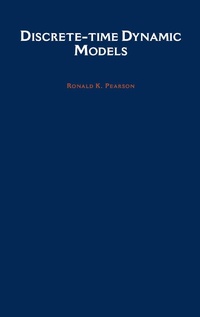
Discrete-time Dynamic Models
Published on 2. December 1999
481 pages
978-0-19-535281-8 (ISBN)
Description

Fueled by advances in computer technology, model-based approaches to the control of industrial processes are now widespread. While there is an enormous literature on modeling, the difficult first step of selecting an appropriate model structure has received almost no attention. This book fills the gap, providing practical insight into model selection for chemical processes and emphasizing structures suitable for control system design.
More details
Other editions
Additional editions
Ronald K. Pearson
Discrete-time Dynamic Models
Book
12/1999
Oxford University Press Inc
€313.00
Shipment within 15-20 days
Content
- Intro
- Contents
- 1 Motivations and Perspectives
- 1.1 Modeling complex systems
- 1.1.1 Fundamental models
- 1.1.2 Assumptions, approximations, and simplifications
- 1.1.3 Continuous- vs. discrete-time models
- 1.1.4 Empirical models
- 1.1.5 Gray-box models
- 1.1.6 Indirect empirical modeling
- 1.2 Inherently nonlinear behavior
- 1.2.1 Harmonic generation
- 1.2.2 Subharmonic generation
- 1.2.3 Chaotic response to simple inputs
- 1.2.4 Input-dependent stability
- 1.2.5 Asymmetric responses to symmetric inputs
- 1.2.6 Steady-state multiplicity
- 1.3 Example 1: distillation columns
- 1.3.1 Hammerstein models
- 1.3.2 Wiener models
- 1.3.3 A bilinear model
- 1.3.4 A polynomial NARMAX model
- 1.4 Example 2: chemical reactors
- 1.4.1 Hammerstein and Wiener models
- 1.4.2 Bilinear models
- 1.4.3 Polynomial NARMAX models
- 1.4.4 Linear multimodels
- 1.4.5 The Uryson model
- 1.5 Organization of this book
- 2 Linear Dynamic Models
- 2.1 Four second-order linear models
- 2.2 Realizations of linear models
- 2.2.1 Autoregressive moving average models
- 2.2.2 Moving average and autoregressive models
- 2.2.3 State-space models
- 2.2.4 Exponential and BIBO stability of linear models
- 2.3 Characterization of linear models
- 2.4 Infinite-dimensional linear models
- 2.4.1 Continuous-time examples
- 2.4.2 Discrete-time slow decay models
- 2.4.3 Fractional Brownian motion
- 2.5 Time-varying linear models
- 2.5.1 First-order systems
- 2.5.2 Periodically time-varying systems
- 2.6 Summary: the nature of linearity
- 3 Four Views of Nonlinearity
- 3.1 Bilinear models
- 3.1.1 Four examples and a general result
- 3.1.2 Completely bilinear models
- 3.1.3 Stability and steady-state behavior
- 3.2 Homogeneous models
- 3.2.1 Homogeneous functions and homogeneous models
- 3.2.2 Homomorphic systems
- 3.2.3 Homogeneous ARMAX models of order zero
- 3.3 Positive homogeneous models
- 3.3.1 Positive-homogeneous functions and models
- 3.3.2 PH°-ARMAX models
- 3.3.3 TARMAX models
- 3.4 Static-linear models
- 3.4.1 Definition of the model class
- 3.4.2 A static-linear Uryson model
- 3.4.3 Bilinear models
- 3.4.4 Mallows' nonlinear data smoothers
- 3.5 Summary: the nature of nonlinearity
- 4 NARMAX Models
- 4.1 Classes of NARMAX models
- 4.2 Nonlinear moving average models
- 4.2.1 Two NMAX model examples
- 4.2.2 Qualitative behavior of NMAX models
- 4.3 Nonlinear autoregressive models
- 4.3.1 A simple example
- 4.3.2 Responses to periodic inputs
- 4.3.3 NARX model stability
- 4.3.4 Steady-state behavior of NARX models
- 4.3.5 Differences between NARX and NARX* models
- 4.4 Additive NARMAX Models
- 4.4.1 Wiener vs. Hammerstein models
- 4.4.2 EXPAR vs. modified EXPAR models
- 4.4.3 Stability of additive models
- 4.4.4 Steady-state behavior of NAARX models
- 4.5 Polynomial NARMAX models
- 4.5.1 Robinson's AR-Volterra model
- 4.5.2 A more general example
- 4.6 Rational NARMAX models
- 4.6.1 Zhu and Billings model
- 4.6.2 Another rational NARMAX example
- 4.7 More Complex NARMAX Models
- 4.7.1 Projection-pursuit models
- 4.7.2 Neural network models
- 4.7.3 Cybenko's approximation result
- 4.7.4 Radial basis functions
- 4.8 Summary: the nature of NARMAX models
- 5 Volterra Models
- 5.1 Definitions and basic results
- 5.1.1 The class V[sub(N,M)] and related model classes
- 5.1.2 Four simple examples
- 5.1.3 Stochastic characterizations
- 5.2 Four important subsets of V[sub(N,M)]
- 5.2.1 The class H[sub(N,M)]
- 5.2.2 The class U[sup(r)][sub(N,M)]
- 5.2.3 The class W[sub(N,M)]
- 5.2.4 The class P[sup(r)][sub(N,M)]
- 5.3 Block-oriented nonlinear models
- 5.3.1 Block-oriented model structures
- 5.3.2 Equivalence with the class V[sub(N,M)]
- 5.4 Pruned Volterra models
- 5.4.1 The class of pruned Volterra models
- 5.4.2 An example: prunings of V[sub(2,2)]
- 5.4.3 The PPOD model structure
- 5.5 Infinite-dimensional Volterra models
- 5.5.1 Infinite-dimensional Hammerstein models
- 5.5.2 Robinson's AR-Volterra model
- 5.6 Bilinear models
- 5.6.1 Matching conditions
- 5.6.2 The completely bilinear case
- 5.6.3 A superdiagonal example
- 5.7 Summary: the nature of Volterra models
- 6 Linear Multimodels
- 6.1 A motivating example
- 6.2 Three classes of multimodels
- 6.2.1 Johansen-Foss discrete-time models
- 6.2.2 A modifed Johansen-Foss model
- 6.2.3 Tong's TARSO model class
- 6.3 Two important details
- 6.3.1 Local model selection criteria
- 6.3.2 Affine vs. linear models
- 6.4 Input-selected multimodels
- 6.4.1 Input-selected moving average models
- 6.4.2 Steady states of input-selected models
- 6.4.3 J-F vs. modified J-F models
- 6.4.4 Two input-selected examples
- 6.5 Output-selected multimodels
- 6.5.1 Output-selected autoregressive models
- 6.5.2 Steady-state behavior
- 6.5.3 Two output-selected examples
- 6.6 More general selection schemes
- 6.6.1 Johanssen-Foss and modified models
- 6.6.2 The isola model
- 6.6.3 Wiener and Hammerstein models
- 6.7 TARMAX models
- 6.7.1 The first-order model
- 6.7.2 The multimodel representation
- 6.7.3 Steady-state behavior
- 6.7.4 Some representation results
- 6.7.5 Positive systems
- 6.7.6 PHADD models
- 6.8 Summary: the nature of multimodels
- 7 Relations between Model Classes
- 7.1 Inclusions and exclusions
- 7.1.1 The basic inclusions
- 7.1.2 Some important exclusions
- 7.2 Basic notions of category theory
- 7.2.1 Definition of a category
- 7.2.2 Classes vs. sets
- 7.2.3 Some illuminating examples
- 7.2.4 Some simple "non-examples
- 7.3 The discrete-time dynamic model category
- 7.3.1 Composition of morphisms
- 7.3.2 The category DTDM and its objects
- 7.3.3 The morphism sets in DTDM
- 7.4 Restricted model categories
- 7.4.1 Subcategories
- 7.4.2 Linear model categories
- 7.4.3 Structural model categories
- 7.4.4 Behavioral model categories
- 7.5 Empirical modeling and IO subcategories
- 7.5.1 IO subcategories
- 7.5.2 Example 1: the category Aff[sup(SS)]
- 7.5.3 Example 2: the category Gauss
- 7.5.4 Example 3: the category Median
- 7.6 Structure-behavior relations
- 7.6.1 Joint subcategories
- 7.6.2 Linear model characterizations
- 7.6.3 Volterra model characterizations
- 7.6.4 Homomorphic system characterizations
- 7.7 Functors, linearization and inversion
- 7.7.1 Basic notion of a functor
- 7.7.2 Linearization functors
- 7.7.3 Inverse NARX models
- 7.8 Isomorphic model categories
- 7.8.1 Autoregressive vs. moving average models
- 7.8.2 Discrete- vs. continuous-time
- 7.9 Homomorphic systems
- 7.9.1 Relation to linear models
- 7.9.2 Relation to homogeneous models
- 7.9.3 Constructing new model categories
- 7.10 Summary: the utility of category theory
- 8 The Art of Model Development
- 8.1 The model development process
- 8.1.1 Parameter estimation
- 8.1.2 Outliers, disturbances and data pretreatment
- 8.1.3 Goodness-of-fit is not enough
- 8.2 Case study 1-bilinear model identification
- 8.3 Model structure selction
- 8.3.1 Structural implications of behavior
- 8.3.2 Behavioral implications of structure
- 8.4 Input sequence design
- 8.4.1 Effectiveness criteria and practical constraints
- 8.4.2 Design parameters
- 8.4.3 Random step sequences
- 8.4.4 The sine-power sequences
- 8.5 Case study 2-structure and inputs
- 8.5.1 The Eaton-Rawlings reactor model
- 8.5.2 Exact discretization
- 8.5.3 Linear approximations
- 8.5.4 Nonlinear approximations
- 8.6 Summary: the nature of empirical modeling
- Bibliography
- Index
- A
- B
- C
- D
- E
- F
- G
- H
- I
- L
- M
- N
- O
- P
- Q
- R
- S
- T
- U
- V
- W
- Z
