

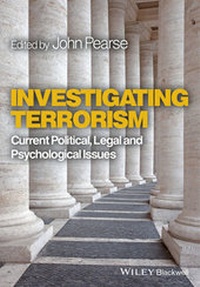
Investigating Terrorism
Current Political, Legal and Psychological Issues
Published on 5. January 2015
288 pages
978-1-118-31627-6 (ISBN)
Description

Investigating Terrorism takes a look behind the closeddoors of terrorist cases. Major players from the world ofcounter-terrorism, including politicians, lawyers, psychologistsand police, offer analyses of recent terror attacks and share theirknowledge of terrorist behaviour
* Deals with legal, psychological and practical issuessurrounding how to deal with a real life 'ticking bomb'scenario
* Provides an insight into the most recent police model forinterviewing witnesses, victims and suspects
* Contains the latest analyses of recent terrorist attacksincluding the recent Norwegian tragedy carried out by terroristAnders Breivik
* Contains the views of major players in the world ofcounter-terrorism, including Lord Carlile, the former HMG'sIndependent Reviewer of Terrorist legislation, and Peter Clarke,the recently retired Head of Terrorist Investigations for theUK
* Incorporates recently-released findings from studiescommissioned by New Scotland Yard to study the effectiveness ofpolice interviews with terrorist suspects
* Includes chapters discussing the context in which people becomesuicide bombers
Reviews / Votes
How can we be more effective in bringing terrorists to justicein ways that uphold our legal traditions? This book providescrucial clues drawn from highly experienced prosecution and defencelawyers, detectives, security experts and forensic psychologists. I highly recommend it for all who want to understand andrespond to the serious threat from jihadist terrorism over theyears to come.--Professor Sir David Omand, former UK Securityand Intelligence Coordinator, Permanent Secretary of the HomeOffice and Director GCHQ The threat of terrorism is a dark shadow which affects all citizensthroughout the world. In this well constructed book a group ofeminent experts with extensive experience in thefield provides valuable discussion of the causes andwider consequences of terrorism as well as itscircumvention, investigation and prosecution. It comprises asubstantial body of precious insight and guidancewhich will be of unquestionable value to policy andlaw makers, police investigators, Judges and legalpractitioners. Those who are active in this sphere wouldbe well advised to familiarise themselves with its contents. Ivery strongly recommend it.--Anthony Heaton-Armstrong,practising barrister at 9 - 12 Bell Yard Edited and written by experts in their fields and with a plethoraof experience, the authors know what they are talking about. This book is a must for those who need to know, those who areinterested to know, and those who think they know it allalready.--Susan Young, Professor of Forensic ClinicalPsychology, Broadmoor Hospital, West London Mental HealthTrust First-rank expertise on the detection, investigation andprosecution of terrorist crime accompanies insights into themotives of its perpetrators. The combination is unusual,welcome and thought-provoking.--David Anderson Q.C.,Independent Reviewer of Terrorism Legislation A collection of very informative papers from many of the experts inthe front line of confronting, analysing, detecting and dealingwith terrorism and terrorist suspects. It confirms that wehave no room for complacency, that we are still learning and thereis still much to be done.--Alastair Logan, OBE, LLB. Solicitorand member of The Law Society's Human Rights CommitteeMore details
Other editions
Additional editions
Book
01/2015
Wiley
€58.00
Shipment within 15-20 days
Book
01/2015
Wiley
€97.90
Article not available at the moment
Person
John Pearse is Vice President of the Paul Ekman Group and the Managing Director of Forensic Navigation Services Ltd, an independent company that combines forensic consultancy and investigation with psychological training and empirical research. He has provided counter-terrorist advice and training around the world and has designed and delivered a number of acclaimed international multi-agency counter terrorism seminars. John has been researching the area of interviewing and interrogation and terrorist related issues since 1991, and is a visiting lecturer at a number of colleges within the University of London.
Content
About the Editor ix
About the Contributors x
Introduction 1
Part I Political, Legal and Policing Context 9
1 The Impact and Consequences of Terrorist Legislation in the United Kingdom Since 2001: A Review 11
Lord Carlile of Berriew, QC, and Carys Owen
2 Investigating Terrorism in the First Decade of the Twenty-First Century: A Different Sort of Crime 31
Peter Clarke
Part II The Criminal Justice Process 43
3 Challenge, Compromise and Collaboration: Part of the Skill Set Necessary for Interviewing a Failed Suicide Bomber 45
John Pearse
4 Urgent Interviews and the Concept of Oppression in Terrorist Cases 66
Max Hill, QC
5 Defence Counsel in Terrorism Trials 80
Peter Carter, QC
6 An Garda Síochána Model of Investigative Interviewing of Witnesses and Suspects 100
Geraldine Noone
7 Risk Assessment of Terrorist Offenders: A Challenge Too Far? 123
Gisli H. Gudjonsson, AdrianWest and Amy McKee
8 Hostage Negotiation and Communication Skills in a Terrorist Environment 144
Simon Wells
Part III Individual and Group Perspectives 167
9 Understanding Suicide Terrorism: Insights from Psychology, Lessons from History 169
Andrew Silke
10 Taking Anders Breivik Seriously as a Political Terrorist 180
Robert Lambert
11 Social Psychology and the Investigation of Terrorism 202
Karl Roberts
12 Community Surveillance and Terrorism 214
Clive Walker and Simon McKay
13 Thinking about Peace While Engaged in Counter-Terrorism: The Primacy of Intelligence 239
John G. D. Grieve
Index 259
About the Contributors
- Lord Carlile of Berriew, CBE, QC, was called to the Bar in 1970. He became a Queen's Counsel in 1984, is a Master of the Bench of Gray's Inn and sits as a deputy High Court judge. From 2001 to 2011 he was the UK Independent Reviewer of Terrorism Legislation. He now advises in a professional capacity on terrorism and compliance matters.
- Peter Carter, QC, was called to the bar in 1974, made Queen's Counsel in 1995 and is a Master of the Bench of Gray's Inn. From 2003 to 2005 he was chair of the Bar Human Rights Committee. He is ranked as a leading criminal silk by Chambers Guide to the Legal Profession, with an emphasis on fraud, terrorism, homicide and trafficking. He is an expert in international human rights law. He appears pro bono in appeals to the Privy Council. He has appeared in domestic and regional human rights courts outside the UK and participated in amicus briefs in overseas jurisdictions. He was one of the team instructed on behalf of both Houses of Parliament to present an amicus brief for the US Supreme Court in the Guantanamo Bay case of Rasul v. Bush which successfully challenged the US government's denial of constitutional and international human rights to the detainees.
- Peter Clarke, CVO, OBE, QPM, joined the Metropolitan Police in 1977 after graduating in Law from Bristol University. After attending the Royal College of Defence Studies, in May 2002 he became the head of the Anti-Terrorist Branch and for nearly six years led all terrorist investigations in the UK and against British interests overseas, including the London bombings (2005), the transatlantic airliners 'liquid bomb' plot (2006) and attacks in Bali, Saudi Arabia, Turkey, Qatar and elsewhere. He retired in 2008 and in 2009 he was appointed by the prime minister to the UK National Security Forum to advise government on the implementation of the UK National Security Strategy. From 2009 to 2013 he was a non-executive director of the Serious Organised Crime Agency in the United Kingdom. In 2014 he was appointed by the Secretary of State for Education to investigate allegations of Islamist infiltration into schools in the city.
- John G. D. Grieve, MPhil, CBE, QPM, served as a detective throughout London in roles that varied from undercover officer to intelligence policy chair. He was the first Director of Intelligence and led the Anti-Terrorist Squad as National Co-ordinator during the 1996-1998 bombing campaigns before becoming the first Director of the Racial and Violent Crime Task Force. He retired in 2002. He holds a number of academic posts including Senior Research Fellow at the University of Portsmouth; Professor Emeritus at London Metropolitan University; Honorary Fellow at Roehampton Institute, Surrey University; and Honorary Doctor at London Metropolitan University. In 2004 he was appointed as a Commissioner of the International Independent Monitoring Commission for the Peace Process in Northern Ireland, in which role he served until 2011. He is the independent chair of the Home Office/Ministry of Justice Independent Advisory Group on Hate Crime. He has published extensively on policing issues including investigation, counter-terrorism, intelligence, crisis management, community engagement, prevention and cultural changes.
- Gisli H. Gudjonsson is an Emeritus Professor of Forensic Psychology at the Institute of Psychiatry, King's College London, and an honorary consultant clinical and forensic psychologist at Broadmoor Hospital. Prior to his retirement from King's College on 1 January 2012, he was the head of Forensic Psychology Services for the Lambeth Forensic Services and Medium Secure Unit at the South London and Maudsley NHS Trust (SLaM). Professor Gudjonsson is a chartered psychologist and a Fellow of the British Psychological Society. A registered practitioner (clinical and forensic) with the Health & Care Professions Council (HCPC), he has been awarded two lifetime achievement awards and was appointed a Commander of the Order of the British Empire (CBE) in the Queen's Birthday 2011 Honours List for services to clinical psychology.
- Max Hill, QC, is Head of Red Lion Chambers in London, chair of the Kalisher Trust and a Bencher of Middle Temple. He is a former chairman of the Criminal Bar Association of England and Wales. He has unrivalled experience prosecuting terrorism trials, from R v. Hulme and others 2003 (Real IRA), to R v. Ibrahim and others 2007 (21 July 2005 London bombers) and R v. Faraz 2011 (terrorist publications). He represented the Metropolitan Police Service at the Coroner's Inquests into the London bombings of 7 July 2005. He has a broad practice in general crime, spanning homicide to fraud and money laundering, as well as regulatory proceedings. He is also a Crown Court Recorder, authorized to sit at the Central Criminal Court.
- Robert Lambert divides his time between two part-time teaching posts at the Handa Centre for the Study of Terrorism and Political Violence, University of St Andrews, and at the John Grieve Policing Centre, London Metropolitan University. At both centres he teaches postgraduate and undergraduate modules based on his research and publications on terrorism, counter-terrorism, far right political violence and anti-Muslim hate crimes. In addition, he supervises and examines PhD research in the same arena. He is the author of Countering al-Qaeda in London: Police and Muslims in Partnership (Hurst, 2011).
- Simon McKay, LLB, LLM, is a solicitor advocate (all proceedings) and an honorary fellow of the School of Law, University of Leeds. He specializes in human rights and criminal law with a particular interest in state-based crimes (terrorism, Official Secrets Act, etc.), covert policing and surveillance issues. Until he resigned in 2012, he was the only solicitor advocate on the Attorney General's panel of special advocates in terrorist cases. He is the author of Covert Policing Law and Practice (Oxford University Press, 2011) and Undercover Cop (McKay Law, 2013).
- Amy McKee, BSc, MSc, DClinPsy, is a clinical psychologist based in the north west of England providing risk assessments, management advice, consultancy and treatment interventions with forensic populations. She has extensive experience of working with offenders who present with complex forensic and mental health needs and provides training to specialist investigation and interviewing courses with a focus on understanding the offender, particularly child offenders and female offenders. She has provided advice on media appeals, investigative interview strategies and downstream monitoring support to police forces throughout the United Kingdom on a number of major inquiries, and has worked closely for a number of years with the North West Counter Terrorism Unit, providing consultation services, risk and threat assessments, training and research. Currently she is working on Project Regulus examining pathways of lone actor terrorists by bringing together academic, practitioner and clinical perspectives to enhance counter-terrorism practice. This research is being carried out in collaboration with NWCTU, SO15 and University College London.
- Geraldine Noone is a sergeant in An Garda Síochána with over 30 years' service. She has considerable operational and training experience and specializes in investigative interviewing with An Garda Síochána and other European law enforcement agencies. She is a senior interview adviser and is responsible for the design and delivery of advanced interview and interview adviser courses. In addition, she is the business leader in the development of the Garda Síochána Interviewing Model (GSIM) and the Manual of Guidance and Training which supports this model. She is currently researching the psychological and background factors associated with 'no comment' interviews for a PhD at Liverpool University.
- Carys Owen was called to the Bar in 2002 following a short career in the British Army as an Intelligence Corps officer. Since 2009 she has specialized in terrorism cases, both civil and criminal. Her civil terrorism cases have included Guantanamo Bay litigation (involving a novel use of the Norwich Pharmacal disclosure regime: Shaker Aamer v. Secretary of State for Foreign and Commonwealth Affairs [2009] EWHC 3316 (Admin)), Abu Hamza (deprivation of British citizenship: Abu Hamza v. Secretary of State for the Home Department SC/23/2003), various exclusion, deportation, and terrorist asset freeze cases, as well as control order and TPIM cases involving suspected members of the transatlantic bomb plot, among others. Her criminal terrorism cases have involved bomb plotting in the UK as well as terrorist training abroad and possession of terrorism materials.
- Karl Roberts is a forensic psychologist and is Professor and Chair of Policing and Criminal Justice at the University of Western Sydney in Sydney, Australia. He is also an Adjunct Professor of Criminology and Criminal Justice at the University of Massachusetts. His areas of expertise are within the field of interpersonal violence and law enforcement investigation with a focus on the behavioural assessment of offenders, investigative interviewing by law enforcement, and risk assessment and risk management. He works closely with law enforcement and other agencies throughout the world, providing training and advice to investigations, and has advised over 400 major police investigations worldwide.
- Andrew...
