

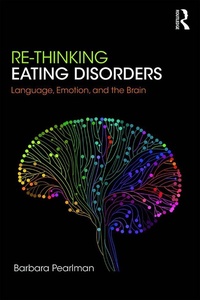
Re-Thinking Eating Disorders
Language, Emotion, and the Brain
1st Edition
Published on 27. July 2018
228 pages
978-0-429-86490-2 (ISBN)
Description

In Re-Thinking Eating Disorders: Language, Emotion, and the Brain, Barbara Pearlman integrates ideas from psychoanalysis, developmental psychology and cutting-edge neuroscience to produce a model of neural emotional processing which may underpin the development of an eating disorder.
Based on clinical observations over 30 years, this book explores how state change from symbolic to concrete thinking may be a key event that precedes an eating disorder episode. The book introduces this theory, and offers clinicians working with these challenging clients an entirely new model for treatment: internal language enhancement therapy (ILET). This easily teachable therapy is explored throughout the book with case studies and detailed descriptions of therapeutic techniques.
Re-Thinking Eating Disorders will appeal to students and practitioners working with this clinical group who are seeking an up-to-date and integrative approach to therapy.
Based on clinical observations over 30 years, this book explores how state change from symbolic to concrete thinking may be a key event that precedes an eating disorder episode. The book introduces this theory, and offers clinicians working with these challenging clients an entirely new model for treatment: internal language enhancement therapy (ILET). This easily teachable therapy is explored throughout the book with case studies and detailed descriptions of therapeutic techniques.
Re-Thinking Eating Disorders will appeal to students and practitioners working with this clinical group who are seeking an up-to-date and integrative approach to therapy.
Reviews / Votes
"What's your gut feeling about this book?Here's mine: this is an extraordinary book. It draws together an impressive literature spanning developmental neurobiology, neuropsychoanalysis, Kleinian theory and the latest eating disorder treatment outcome data. In this regard alone, the book offers an impressive distillation of some very diverse theory and research findings.
However, it goes much further than presenting a novel intersection of theory and practice representing the first serious attempt to develop a neuroscientifically-based treatment for people with eating disorders. It introduces Internal Language Enhancement Therapy (ILET) which covers all the major bases of contemporary eating disorders neuroscience and incorporates this knowledge into the treatment model. Recent work on mentalizing fits neatly with the ILET model; and in this regard the current model is in the 'good company' of Winnicott, Fonagy, Target and Skadarud."
Dr. Ian Frampton, Senior Lecturer in Developmental Neuropsychology, Centre for Clinical Neuropsychology Research, University of Exeter
More details
Edition
1. Auflage
Language
English
Place of publication
London
United Kingdom
Publishing group
Taylor & Francis Ltd
Target group
Professional and scholarly
College/higher education
Illustrations
3 Line drawings, black and white
File size
1,43 MB
ISBN-13
978-0-429-86490-2 (9780429864902)
Copyright in bibliographic data and cover images is held by Nielsen Book Services Limited or by the publishers or by their respective licensors: all rights reserved.
Schweitzer Classification
Other editions
Additional editions
Book
07/2018
1st Edition
Routledge
€165.80
Shipment within 10-20 days
Book
05/2018
Karnac Books
€55.10
Shipment within 15-20 days
Person
Barbara Pearlman, Consultant Clinical Psychologist, is an Honorary Fellow at the Centre for Clinical Neuropsychology Research, University of Exeter. In 2010, she was awarded a PhD for her theoretical work on the neurobiology of how emotions and language are processed in eating disorders, which lead to the creation of a new treatment: internal language enhancement therapy.
Content
Table of Contents
Acknowledgements
Foreword
Preface
Chapter 1 Introduction
Chapter 2 The Neurobiological Contribution to Understanding the Development of an Eating Disorder: Neurobiological Underpinnings of Eating Disorders
Chapter 3 A Conceptual Gap: Current Ideas in Eating Disorders and the Need for a New Treatment Approach
Chapter 4 Filling the Conceptual Gap: The Development of Symbolisation from a Developmental Neuropsychoanalytic Perspective
Chapter 5 Proposing A New Model of the Mind in Eating Disorders
Chapter 6 Theory and Practice
Chapter 7 The Problem With CBT
Chapter 8 ILET Therapy With 'Emily'
Chapter 9 Conclusions
Postscript
Appendices
A: Glossary of Abbreviated Terms
B: The ILET Protocol
C: History Template
D: Information for Patients
E: Emotional Events Questionnaire (EEQ)
F. Baseline Measurements Pre- and Post-Treatment
G. Measures for Randomised Clinical Trials of ILET versus Treatment as Usual, CBT and/or IPT
References
Bibliography
Index
Acknowledgements
Foreword
Preface
Chapter 1 Introduction
Chapter 2 The Neurobiological Contribution to Understanding the Development of an Eating Disorder: Neurobiological Underpinnings of Eating Disorders
Chapter 3 A Conceptual Gap: Current Ideas in Eating Disorders and the Need for a New Treatment Approach
Chapter 4 Filling the Conceptual Gap: The Development of Symbolisation from a Developmental Neuropsychoanalytic Perspective
Chapter 5 Proposing A New Model of the Mind in Eating Disorders
Chapter 6 Theory and Practice
Chapter 7 The Problem With CBT
Chapter 8 ILET Therapy With 'Emily'
Chapter 9 Conclusions
Postscript
Appendices
A: Glossary of Abbreviated Terms
B: The ILET Protocol
C: History Template
D: Information for Patients
E: Emotional Events Questionnaire (EEQ)
F. Baseline Measurements Pre- and Post-Treatment
G. Measures for Randomised Clinical Trials of ILET versus Treatment as Usual, CBT and/or IPT
References
Bibliography
Index
