

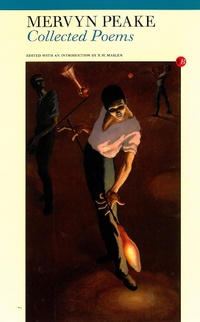
Collected Poems
Published on 27. July 2012
280 pages
978-1-84777-971-7 (ISBN)
Description

It is forty years since the death of Mervyn Peake (1911-68), the author of the much-loved Gormenghast novels. To mark the anniversary this first comprehensive edition of Peake's poetry is published. It includes every black-and-white illustration he made for his verse, together with many previously unpublished drawings. Of the more than 230 poems in the collection, over 80 are printed for the first time. Robert Maslen's detailed work on the manuscripts reveals the poems as a dazzling link between the fantasy world of Gormenghast and the narrative of Peake's own life and of the turbulent times he lived in.
Peake emerges as a compelling poet, with an acute sense of his responsibilities as an artist, passionately engaged with current events, from unemployment in the 1930s to the horrors of the London Blitz and the concentration camp at Bergen-Belsen. He is also a fine love-poet and a sensitive observer of the human form. Readers who love the world of Peake's novels, and those who are new to his work, will discover here one of the great originals of the twentieth century.
Cover painting Mervyn Peake, The Glassblower. Presented to Manchester City Galleries by H.M. Government War Artist's Advisory Committee, 1947. Cover design StephenRaw.com
Peake emerges as a compelling poet, with an acute sense of his responsibilities as an artist, passionately engaged with current events, from unemployment in the 1930s to the horrors of the London Blitz and the concentration camp at Bergen-Belsen. He is also a fine love-poet and a sensitive observer of the human form. Readers who love the world of Peake's novels, and those who are new to his work, will discover here one of the great originals of the twentieth century.
Cover painting Mervyn Peake, The Glassblower. Presented to Manchester City Galleries by H.M. Government War Artist's Advisory Committee, 1947. Cover design StephenRaw.com
Reviews / Votes
Review of Mervyn Peake's Collected Poems in the Guardian.Far from Gormenghast
Jay Parini finds much to admire in Mervyn Peake's collected poems
Mervyn Peake died 40 years ago, at the age of 57, and not many readers knew much about his poetry, although he had published six volumes in his lifetime. His most acclaimed work, of course, was the trilogy of fantasy novels focused on the castle of Gormenghast and featuring a tormented hero called Titus. These strangely beautiful, elusive fictions have attracted a cult following, and they have had many influential admirers, including CS Lewis and Graham Greene. But the poetry was central to Peake's project as a writer, and he illustrated his own work quite brilliantly. Now comes this complete edition of his poems with the poet's illustrations.
Peake's verse found a small but appreciative audience with a posthumous selection of his work that was published by Faber in 1972. But that book is long gone, and the scope and nature of his poetry will surprise and delight many new readers. At his best, he's a haunted and haunting poet (not quite as mad as in the metrical ravings of Lord Sepulchrave in Titus Groan). Unlike his fantasy novels, however, there is nothing vague or mysterious about the world he summons, as in "The Glassblowers", which depicts women blowing glass for cathode ray tubes at a wartime factory in Birmingham. "A lyric ease pervades their toil," he writes, noting that the work makes "Their firelit bodies lordly as they blow".
In the "molten language" of the glassblowers, Peake finds "a poetry of barbarous birth" that grows in "this theatre of fitful light", the urban factory. While the lighting may be "fitful", the poet's imagination blazes. Peake is a late romantic, a lamp unto himself, shining his light on the world as he finds it. And it's often a dismal world, one torn apart by war.
Peake's finest poems emerged from his experiences in the second world war. "The Rhyme of the Flying Bomb", for example, tells the story of an infant subjected to the terrors of the Blitz. It features a sailor who runs through the city streets with the baby in his arms. The poem's innocent ballad form seems utterly incongruous, given the harsh material, with the shattered rooftops and "monkey-flames" of bombs that destroy everything in sight. Tons of explosives fall on the world, and Peake evinces this destruction with hammering lines:
And a ton came down on a coloured road,
And a ton came down on a gaol,
And a ton came down on a freckled girl,
And a ton on the black canal,
And a ton came down on a hospital,
And a ton on a manuscript,
And a ton shot up through the dome of a church,
And a ton roared down to the crypt.
Many of Peake's war poems repay close reading, and among the finest is "The Consumptive. Belsen, 1945". He was sent to the horrific camp at Belsen in the immediate aftermath of the war to record the devastation as an artist. In a hospital, he stood before a dying girl just an "hour before her last / Weak cough into all blackness". He sketches in words the "chalk-white walls" and the "great / Ash coloured bed" where the girl lies. Noting "her limbs like pipes, her head a china skull", he rues his own failure to connect fully to her pain. "Her agony slides through me," he confesses. The poem is ultimately about the failure to connect, and how one person's agony is not another's. Yet Peake nevertheless communicates the agony, the girl's and the artist's as well, recalling the misery of war, its endless awful ramifications.
In a more neutral vein, there is this moving poem about a young soldier heading to visit his sweetheart, called "Leave Train":
To your loveliness I travel
Through a bronze and yellow land.
England burns away November -
Every bough is a lit marvel
Pointing with a sentient hand
To where you stand -
Loveliest ember in the autumn's amber.
The qualities of this poem - its affecting system of linked sounds and lyric grace - are found everywhere in Peake's Collected Poems. (Not surprisingly, his friend Dylan Thomas was a profound influence.) While there are quite a few rough drafts here, which really seem like notations for poems that might one day be accomplished, this remains a landmark volume of sorts, a testament to a poet who never quite achieved the level of attention that he deserved. It would be mistaken to think that Peake is some lost genius of English poetry: he is not that. But his gift was real, and his work worth reading.
Please click here for a link to article.
More details
Language
English
Place of publication
Manchester
United Kingdom
Publishing group
Carcanet Press Ltd
File size
9,87 MB
ISBN-13
978-1-84777-971-7 (9781847779717)
Copyright in bibliographic data and cover images is held by Nielsen Book Services Limited or by the publishers or by their respective licensors: all rights reserved.
Schweitzer Classification
Other editions
Additional editions
Mervyn Peake | Robert Warner Maslen
Collected Poems: Mervyn Peake
Book
06/2008
Fyfield Books
€36.04
Article exhausted; check different version
Persons
Mervyn Peake was a novelist, poet, playwright, painter, illustrator and children's writer. Born in a small European settlement called Kuling, on 9 July, 1911 Peake spent most of his childhood south of Peking, in Tientsin, China, where he attended the Tientsin Grammar School. His family returned to England in 1923 when his father set up a medical practice in Wallington, Surrey. After a brief spell at the Croydon School of Art Peake enrolled at the Royal Academy in December, 1929. By 1935, when Peake began teaching at Westminster School of Art, he had already exhibited his work on several occasions in London and on the island of Sark. 1938 saw Peake's first solo exhibition, and the following year witnessed the publication of his first book, Captain Slaughterboard. During the war Peake joined the Royal Artillery, but was given special dispensation by his commanding officer to finish his novel Titus Groan, the first part of his celebrated Gormenghast trilogy (although the trilogy was originally planned as part of a larger cycle). At the end of the war Peake travelled to Germany and France to illustrate Tom Pocock's articles for the magazine New Leader. This included a tip to the Bergen-Belsen concentration camps, where he drew the dying inmates and collected ideas for his future poetry. Titus Groan was published in 1946, followed by Gormenghast in 1950. At the age of 46 Peake developed Parkinson's disease, but was still able to complete Titus Alone which was subsequently published in 1959.
Mervyn Peake died on November 17th, 1968, at his brother-in-law's carehome in Burcot, near Oxford. Nowadays Peake is best known for the three novels which make up the Gormenghast trilogy. However, prior to their publication he was best known his poems, paintings, drawings, and book illustrations. Educated at Christ Church, Oxford, Robert Maslen has taught at Universities in Oxford, London and Exeter. He is currently a Senior Lecturer at the University of Glasgow, where he teaches an MLitt in Creative Writing, and has been Visiting Professor at Dartmouth College, NH, the University of St Thomas, MN, and the University of Lund, Sweden. He has published articles on science fiction and renaissance literature, two books, Shakespeare and Comedy and Elizabethan Fictions, and is the editor of Mervyn Peake: Collected Poems and, with Peter Winnington, Complete Nonsense (both published by Carcanet).
Mervyn Peake died on November 17th, 1968, at his brother-in-law's carehome in Burcot, near Oxford. Nowadays Peake is best known for the three novels which make up the Gormenghast trilogy. However, prior to their publication he was best known his poems, paintings, drawings, and book illustrations. Educated at Christ Church, Oxford, Robert Maslen has taught at Universities in Oxford, London and Exeter. He is currently a Senior Lecturer at the University of Glasgow, where he teaches an MLitt in Creative Writing, and has been Visiting Professor at Dartmouth College, NH, the University of St Thomas, MN, and the University of Lund, Sweden. He has published articles on science fiction and renaissance literature, two books, Shakespeare and Comedy and Elizabethan Fictions, and is the editor of Mervyn Peake: Collected Poems and, with Peter Winnington, Complete Nonsense (both published by Carcanet).
