

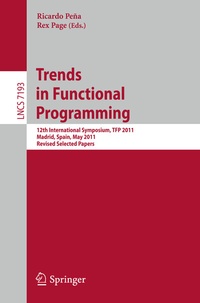
Trends in Functional Programming
12th International Symposium, TFP 2011, Madrid, Spain, May 16-18, 2011, Revised Selected Papers
Published on 20. July 2012
X, 195 pages
978-3-642-32037-8 (ISBN)
Description

This book constitutes the thoroughly refereed post-conference proceedings of the 12th International Symposium on Trends in Functional Programming, TFP 2011, held in Madrid, Spain, in May 2011.
The 12 papers presented were carefully reviewed and selected from 21 submissions. They deal with all aspects of functional programming, taking a broad view of current and future trends in this area. The topical sections the papers are organized in are named as follows: types, compiling, paralelelism and distribution, data structures, and miscellaneous.
More details
Other editions
Additional editions
Ricardo Peña | Rex Page
Trends in Functional Programming
12th International Symposium, TFP 2011, Madrid, Spain, May 16-18, 2011, Revised Selected Papers
Book
07/2012
Springer
€49.22
Shipment within 7-9 days
Content
- Title
- Preface
- Conference Organization
- Table of Contents
- Types
- Constraint-Free Type Error Slicing
- Introduction
- From Constraint-Based to Source-Based Type Error Slicing
- Source-Based Type Error Slicing
- Multiple Type Error Slices
- Source-Based Type Error Slicing for Mini-ML
- Type Error Slicing for Haskell
- Related Work
- Future Work
- References
- Subtyping by Folding an Inductive Relation into a Coinductive One
- Introduction
- The Fold Pattern
- Recursive Types
- Definition of Recursive Subtyping
- Soundness and Completeness
- Monadic Substitution
- Related Work
- Conclusions
- References
- Compiling
- Epic-A Library for Generating Compilers
- Introduction
- The Epic Language
- Definitions
- Foreign Functions
- Low Level Features
- Haskell API
- Example-Compiling the -Calculus
- Representation
- Compilation
- Atuin-A Dynamically Typed Graphics Language
- Abstract Syntax
- Compiling
- Related Work
- Conclusion
- References
- Towards Modular Compilers for Effects
- Introduction
- Setting the Scene
- A Simple Compiler
- Adding a New Effect
- The Problem
- Modular Effects
- Modular Syntax and Semantics
- Datatypes à La Carte
- Smart Constructors
- Putting It All Together
- Modular Compilers
- Towards Modular Machines
- Summary and Conclusion
- References
- Parallelism and Distribution
- Functory: A Distributed Computing Library for Objective Caml
- Introduction
- API
- A Generic Distribution Function
- Low-Level Primitives
- High-Level API
- Deployment Scenarios
- Several Libraries in One
- Implementation Details
- Marshaling
- Protocol
- Fault-Tolerance
- Experiments
- N-Queens
- Matrix Multiplication
- Mandelbrot Set
- SMT Solvers
- Conclusions and Future Work
- References
- ParaForming: Forming Parallel Haskell Programs Using Novel Refactoring Techniques
- Introduction
- Contributions
- The HaRe Refactoring System for Haskell
- GpH and Evaluation Strategies
- Refactorings for Forming Parallel Programs
- Rewrite Rules
- Data Parallelism
- Task Parallelism
- Refactoring Case Studies
- Data Parallelism
- Task Parallelism
- Performance Results
- Related Work
- Conclusions and Future Work
- References
- Functional High Performance Financial IT
- Introduction
- Overview
- Motivation and Background
- Need for More Accurate Modelling in Mathematical Finance
- Need for More Financial System and Software Transparency
- Need for More Computational Performance
- The Hiperfit Center
- Research Goals, Organisation, and Methodology
- Research Themes in Hiperfit
- Functional Programming and Hiperfit
- Domain-Specific Languages for Financial Applications
- Parallel Functional Programming in Hiperfit
- Support for Multicore and Novel Parallel Hardware
- Project Start and First Activities
- Conclusions
- References
- Data Structures
- Thread-Safe Priority Queues in Haskell Based on Skiplists
- Introduction
- Skiplists
- Concurrent Skiplist Variants
- The PriorityQueue Typeclass
- Lock-Based Skiplists
- Software Transactional Memory Based Skiplists
- Skiplists Based on Atomic Compare and Swap Operations
- Testing the Implementations
- Benchmarks
- Additional Comparisons: Difficulty and Code Size
- Related Work
- Conclusion and Future Work
- References
- Adams' Trees Revisited
- Introduction
- BB- Trees
- BB- Tree Operations
- Rebalancing BB- Trees
- Choosing the Parameters , and
- Validity of w=2.5, w=3 and w=4
- Correctness of a Single Rotation
- Correctness of a Double Rotation
- BB- Trees Height
- The Performance of BB-2.5, BB-3 and BB-4 Trees
- Reducing Memory by Introducing Additional Data Constructor
- The Order of Data Constructors
- Conclusions
- Related Work
- References
- Miscellaneous
- Functional Video Games in CS1 II
- Introduction
- The N-Puzzle Game
- The First Encounter with the N-Puzzle Game in CS1
- Finding a Solution
- The Need to Remember Leads to Accumulators
- Developing a Breadth-First Solution
- Refining the Solution: Deriving an A*-like Algorithm
- Facilitating Deployment in the Classroom
- Related Work
- Concluding Remarks
- References
- GiN: A Graphical Language and Tool for Defining iTask Workflows
- Introduction
- The GiN WDL
- The iTask WDL
- The GiN WDL
- Example
- The GiN Tool
- The GiN Compiler
- Related Work
- Conclusions and Future Work
- References
- Applicative Shortcut Fusion
- Introduction
- Shortcut Fusion
- Applicative Functors
- Applicative Shortcut Fusion
- The Datatype-Generic Formulation
- Inductive Data Types
- Fold
- Shortcut Fusion
- Extended Shortcut Fusion
- Generic Traversals
- Applicative Shortcut Fusion
- Applicative Structural Recursion
- Composite Functors
- Conclusions and Future Work
- References
- Author Index
