

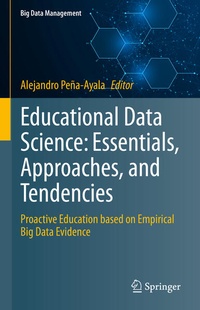
Educational Data Science: Essentials, Approaches, and Tendencies
Description

This book describes theoretical elements, practical approaches, and specialized tools that systematically organize, characterize, and analyze big data gathered from educational affairs and settings. Moreover, the book shows several inference criteria to leverage and produce descriptive, explanatory, and predictive closures to study and understand education phenomena at in classroom and online environments.
This is why diverse researchers and scholars contribute with valuable chapters to ground with well--sounded theoretical and methodological constructs in the novel field of Educational Data Science (EDS), which examines academic big data repositories, as well as to introduces systematic reviews, reveals valuable insights, and promotes its application to extend its practice.
EDS as a transdisciplinary field relies on statistics, probability, machine learning, data mining, and analytics, in addition to biological, psychological, and neurological knowledge aboutlearning science. With this in mind, the book is devoted to those that are in charge of educational management, educators, pedagogues, academics, computer technologists, researchers, and postgraduate students, who pursue to acquire a conceptual, formal, and practical landscape of how to deploy EDS to build proactive, real- time, and reactive applications that personalize education, enhance teaching, and improve learning!
Chapter "Sync Ratio and Cluster Heat Map for Visualizing Student Engagement" is available open access under a Creative Commons Attribution 4.0 International License via link.springer.com.
More details
Other editions
Additional editions
Person
Prof. Alejandro Peña-Ayala, is professor of Artificial Intelligence on Education & cognition in the School of Electric & Mechanical Engineering of the National Polytechnic Institute of México. Dr. Peña-Ayala has published more than 50 scientific works and is author of three machine learning patents (two of them in progress to be authorized), including the role of guest-editor for six Springer Book Series and guest-editor for an Elsevier journal. He is fellow of the National Researchers System of Mexico, the Mexican Academy of Sciences, Academy of Engineering, and the Mexican Academy of Informatics. Professor Peña-Ayala was scientific visitor of the MIT in 2016, made his postdoc at the Osaka University 2010-2012, and earned with honors his PhD, M. Sc., & B. Sc. in computer sciences, artificial intelligence, and informatics respectively.
